
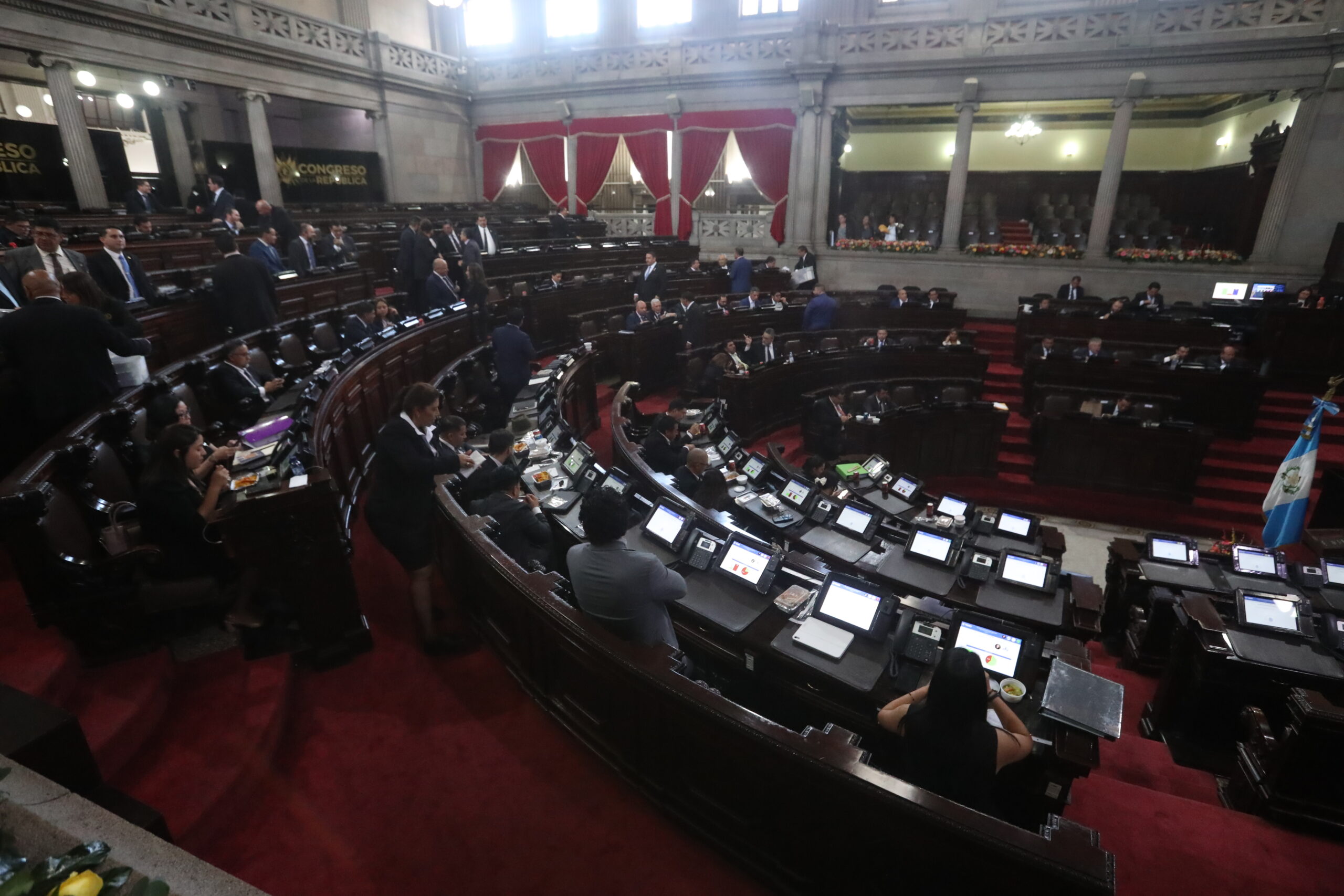
In recent days, payments and compensation for former soldiers for their services to the country have once again gained notoriety., as a result of several legislative initiatives that are being analyzed in Congress, aimed in this direction.
Among these is bill initiative 6723, which seeks to reform Decree 51-2022, which contains the Temporary Law of Comprehensive Development. This proposal stipulates the extension, for a period of 36 additional months, of the delivery of financial support of Q1 thousand for military veterans enrolled in said program.
In this initiative The reform of article 7 of the aforementioned decree is proposedwhich would complete the expansion of the program and guarantee that beneficiaries who still have pending payments can receive in full the contribution established by law.
However, in the opinion of analysts consulted, the extension of this type of contributions or the creation of new programs to benefit former military personnel in Guatemala It has several inconsistencies, mainly of a technical and financial nature, in addition to other aspects such as clientelistic and propaganda use, taking into account that we are in a pre-electoral year and that the former military could represent a good flow of votes for the deputies who promote these law proposals and who seek re-election in the 2027 elections.
Political and electoral connotation
According to Carlos Gossman, analyst and expert at the Central American Institute of Fiscal Studies (Icefi), The expansion of a program such as the Temporary Law of Comprehensive Development creates a “fiscal commitment” that will be transferred to future governments, all of this with possible connotations of “political clientelism” in a pre-electoral context.
“The fact that Congress itself, at the time in 2022, approved this program, could also be speculated to have a tinge of proselytism or political clientelism. However, it is very difficult to propose it because there is no evidence; rather it is the trend and something that is evident in the spaces of the electoral dynamics every four years,” says Gossman.
According to Francisco Quezada, analyst at the National Economic Research Center (Cien), This dynamic of Congress is “doubly demagogic” and is directly linked to electoral and clientelist motives, since, on the one hand, it promotes initiatives that “increase public spending,” such as payments to former military personnel, pensions and other expenses. While, on the other hand, it repeals other sources of income for the State, such as taxes on inheritances and donations and the Single Property Tax (IUSI).
“It is an inconsistency that will not be supported in the short term, because they are increasing, without any technical criteria, spending. All these months have only been increases in spending, there are no counterparts and they are also reducing taxes. It is a doubly demagogic issue. And this issue of the increase – at the time of the law – means votes. This issue of the military is not isolated events, but rather they are going to seek votes from different groups,” says the expert.
No source of financing
According to Gossman, the extension of the deadline for The Temporary Law of Comprehensive Development, for the benefit of military veterans, “is not viable” technically from the budgetary aspect, since the program established in the law is financed with “treasury bonds”, that is, “with debt”, so it lacks a specific financing source that would allow the expansion to be carried out for three more years. He also warns that the creation or expansion of programs to compensate military veterans can become a “watershed that will never close.”
“If programs are re-established from time to time to continue compensating military veterans, this will be a stream that will never close and each government will always have to meet a spending commitment to continue paying them indefinitely,” he assures.
Gossman also indicates that the temporary comprehensive development program does not have a social assistance purpose as such and has come to form a “kind of passive class” with the ex-military members who are its beneficiaries.
“This, on the contrary, does not have a purpose of social assistance as such, but is part, in any case, as a kind of passive class for former State workers, who in the end a member of the Army ends up being a public servant who provided services and for that reason compensation is being made,” he states.
Citizenship could be affected
For his part, Francisco Quezada also indicates that An increase in spending without counterparts or technical criteria will generate a lack of financing for the State, Therefore, it would have to resort to external or internal debt or even a tax reform, which would also bring complications for citizens, who could be affected by these decisions, which is why Congress must “close that stream.”
“It is very delicate because Congress, using its legislative power, is putting the electoral machinery in motion in the sense that these are clientelist issues, obviously, right? And not only what is already being discussed, but the initiatives that are on the way. So Congress has to close that flow. If not, the entire population is going to have to start paying for this extra burden, this financial hole that Congress would be generating and, in return, we have inaction on the part of the Executive,” Quezada concludes.
Settle payments
Deputy Byron Tejeda, from the Cabal bench, whose deputies are the speakers of the bill, explained that the initiative seeks to resolve the payments of the first group of beneficiaries of the law, which concluded in January 2024. This is because there are several of them who are still owed between one and up to twenty payments, which cannot be made effective because the Ministry of Environment no longer continued carrying out the corresponding trainingbecause the period established by law has expired, so it is necessary to make the corresponding modification.
“A first group finished in January 2024; as a result, the Ministry of Environment no longer continued training and this means that they – the beneficiaries – do not get paid. The Ministry of Environment and Natural Resources themselves ask that a reform be made to the law to be able to pay the first group,” said Tejeda.
There are currently 47,645 beneficiaries of the program registered, of which 42,895 are active, to whom payments are owed. From this account, the approval of the reform is necessary, with the objective of complying with the 36 stipulated payments, as established in the law, stated the congressman.