
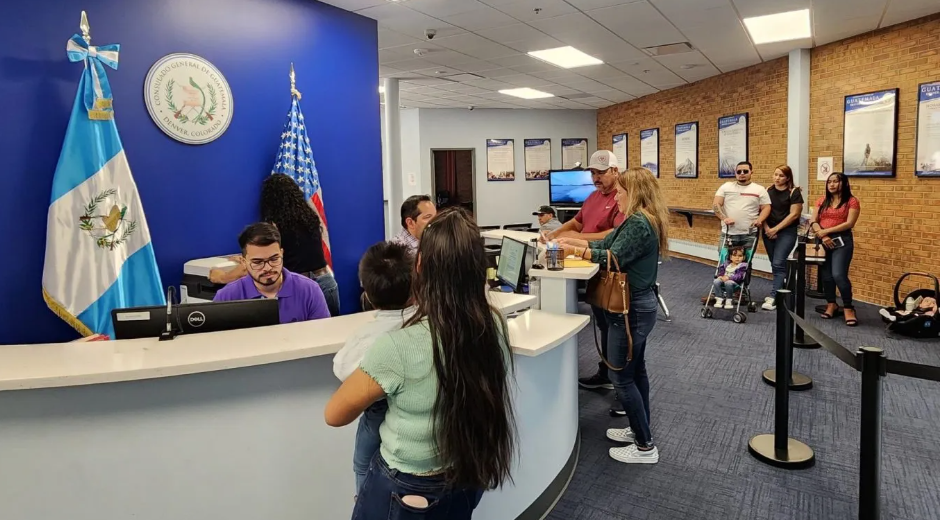
The nationals in the United States They have been unable to obtain the Consular Identification Card (TICG), a document that allows them to cash checks, process driver’s licenses and identify themselves to local authorities. The resumption of service could extend until August.
The reason is that last December the contract with the company that was in charge of printing the card expired, and now the Ministry of Foreign Affairs (Minex) is looking for issue it without outsourcing the service.
María Luisa Ramírez, vice minister of Minex, indicated that the development of its own system is in progress that will allow the document to be printed at the consulates at the same time that nationals request it, and that guarantees the secure storage of personal information, in addition to providing the headquarters with the necessary equipment to carry out the procedure.
During a meeting with the Foreign Relations Commission of the Congress of the Republic, the official said that they will implement a pilot plan with two printing centers at the consulates of Los Angeles, California, and Lake Worth, Florida.
“It was thought about strengthening the consular network. The process will be ready no later than august and thus resume the delivery of the card, with more security measures than the one currently delivered,” said Ramírez.
Congressman Gerardín Díaz, president of the commission, indicated that it should have been foreseen that starting in January the document could no longer be issued, and not “until they were left with nothing, they began to see what they do,” since the Minex had indicated that the printing of the cards would resume in May, which will not happen.
Document required
Alfonso Pérez, president and founder of Alianza Guatemaltecos Unidos in Los Angeles, California, indicated that the TICG is the only Guatemalan identification document that is processed in the United States. This has the person’s photo and address, and they use it to identify themselves to hospitals and receive emergency services, enroll children in school, and open a bank account. It is not proof of immigration statusbut it does allow them to prove that they reside in the country.
For Walter Batres, from the Guatemalan Migrant Network, also in Los Angeles, not having the consular card, as it is also called, affects many Guatemalans, since they “accept it as an official document” to carry out various procedures.
The information from Minex is that There are 3 million 399 thousand 124 Guatemalans in the United States and that by 2022 there would be 1 million 148 thousand 746 nationals who had the active cardsince this is valid for five years. It was mentioned that last year there was a low demand for the document and an increase in passport applications.
“It is affecting us (not being able to complete the procedure). There are Guatemalans who need to identify themselves and, because they do not have the card, they can have serious consequences, such as being detained, taken to a detention center and ending up deported to Guatemala.”
Alfonso Pérez, president and founder of Alianza Guatemaltecos Unidos
The suspension of the TICG is widespread, since Paulino García, a Guatemalan who lives in Houston, Texas, pointed out that since January they have not been able to process it, which is essential for those who do not have a legal immigration status and request it to send remittances to Guatemala.
“This situation is worrying, not only because of the raids, but it adds to the helplessness on the part of the Guatemalan government. It is sad to see people arrive at the consulate and leave with nothing; they only end up wasting the day and, in the process, risk being caught on the street,” said García.
Concern about delay
The documentation service at the consulates continues to be provided and the most requested is the passport. This year they have delivered 109 thousand 213; besides, 47 thousand 707 have been issued IPR to fellow citizens in the United States, according to Minex data.
But, in the opinion of the Guatemalan migrants interviewed, the first is difficult for people to carry everywhere, and the second does not work for carrying out transactions in banks or hospitals. While the TICG is more manageable, easy to load and is accepted as an official document.
“This delay distresses us due to the anti-immigrant situation of the Trump administration, and people need a document to identify themselves. We are not going to walk around with the passport in our hand, because it is a sign that one is a foreigner and they would question our immigration status. It is more practical to have the card, which is recognized by the Secretary of State and accepted by several authorities,” Pérez mentioned.
Representative Sandra Jovel indicated that the Foreign Ministry is violating the right of compatriots to receive the TICG, which is why she suggested the ministry temporarily look for a company to extend the cards until the proposed project begins to work.
“We are waiting for a quick solution. We hoped that they would renew the contract with the company they previously worked with, but it seems that they will not do so. So, we will have to wait until August for them to implement the printing centers,” said Pérez.
The TICG has a cost US$25 and a validity of five years, according to official information.