
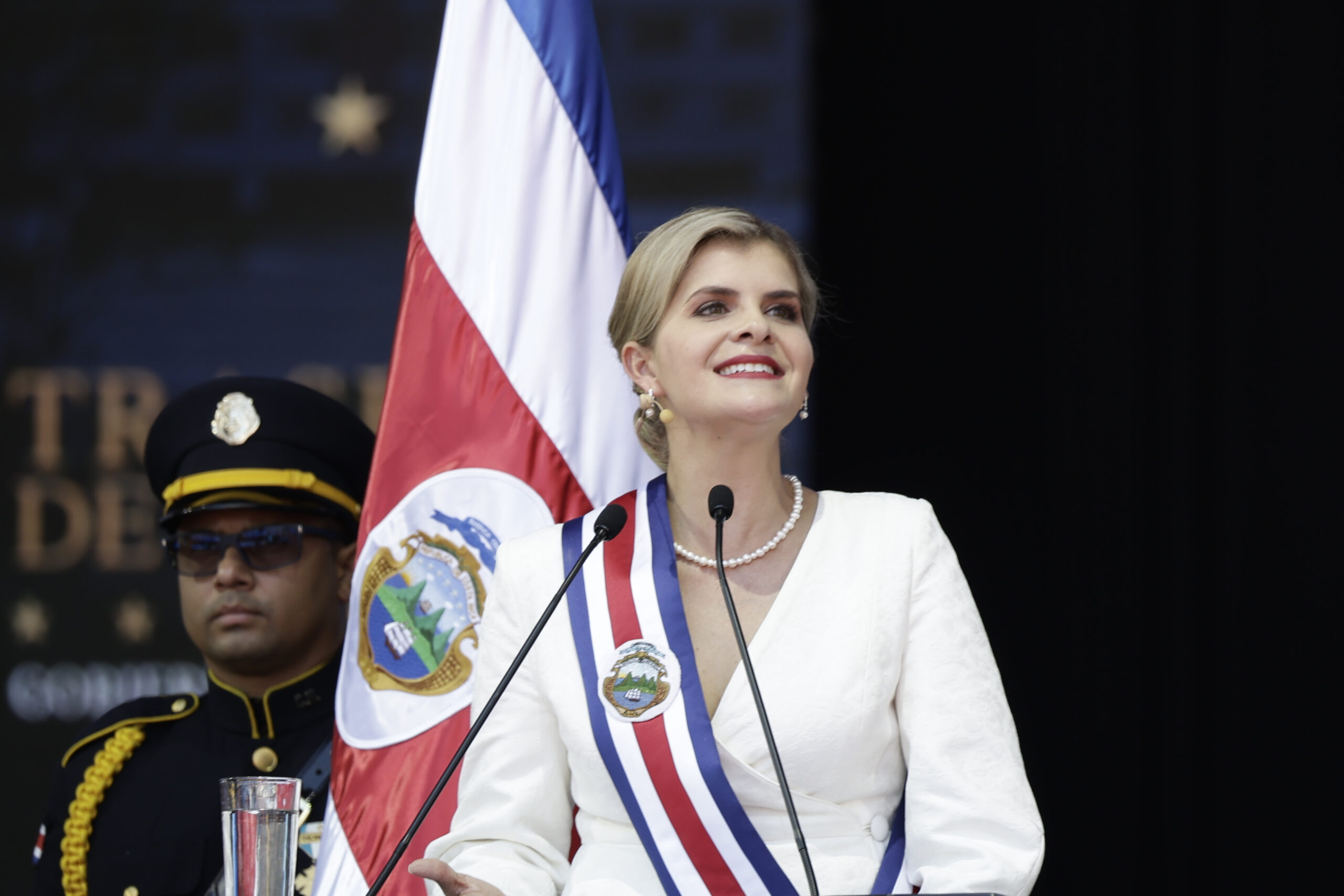
The new president of Costa Rica, Laura Fernandez, announced a strategy “firm hand” against organized crime that includes the construction of a mega prison for five thousand prisoners, a national surveillance center and reforms to the state and judicial system, as part of a plan to confront drug trafficking and violence in the country.
During his investiture speech, Fernández assured that he will promote a “deep reform” of the State and affirmed that his “pulse will not tremble” to combat criminal structures. The president will govern Costa Rica during the period 2026-2030 and presented herself as the political heir of former president Rodrigo Chaves, whose administration maintained a confrontational discourse against crime and the traditional political class.
“The reform we need is profound and we are going to promote it without fear, without hesitation, with resolution,” declared the president during the investiture ceremony held in San José, before representatives of 71 international delegations.
Megaprison, surveillance and combating drug trafficking
One of Fernández’s central announcements was the construction of a megaprison inspired by the security model of Salvadoran President Nayib Bukele. As he explained, the facility will have capacity for five thousand inmates and will be focused on imprisoning members of criminal structures and drug traffickers.
The president also advanced the creation of a Command and Control Center (C5) security to coordinate police operations, surveillance and criminal intelligence.
“To the mothers who have lost their children, I tell you that your pain is not foreign to me. I will apply a tough response, which is what you expect and deserve from me as your president,” said Fernández.
The president added that security measures will have no effect whether the judicial system continues to release dangerous criminals and questioned what he called a “poor man” culture in criminal laws.
Fernández assured that his Government will respect human rights and the division of powers, although he insisted that Costa Rica “cannot accept that drug trafficking finds cracks in the system.”
The proposal of a “third republic”
In addition to fighting crime, Fernández proposed an institutional transformation to build a “third republic,” a concept with which he seeks to reform the functioning of the Costa Rican State.
In Costa Rica, the political system that emerged after the civil war of 1948 and the Constitution of 1949, currently in force, is known as the “second republic.”
“We are on the verge of building a third republic, a new Costa Rica that is not afraid of change,” said the president.
The president said that she intends to modernize public institutions, make the state apparatus more agile and strengthen accountability mechanisms of public powers.
Political continuity of Rodrigo Chaves
Fernández also highlighted the political continuity with former president Rodrigo Chaves, of whom she was a minister and main political figure close to him before launching his presidential candidacy.
The president affirmed that she is the heir to a new way of doing politics based on results and confrontation with traditional sectors of political power.
Rodrigo Chaves accompanied Fernández at the investiture ceremony and will now assume the Ministry of the Presidency and Finance, a decision that strengthens his influence within the new Government.
Labor reform and megaprojects
In economic and infrastructure mattersFernández promised to promote four-day work days of 12 hours a week, a proposal that has generated debate in Costa Rica due to its labor implications.
He also announced projects such as a City Government to concentrate state offices, strategic roads, an electric passenger train and a marina in the Caribbean. The president, who defines herself as economically liberal and socially conservative, dedicated part of her speech to religious references and assured that her administration will be “entrusted to God.”
*Stay up to date with the Now newsletter. Key information at the moment it happens. Subscribe here.