
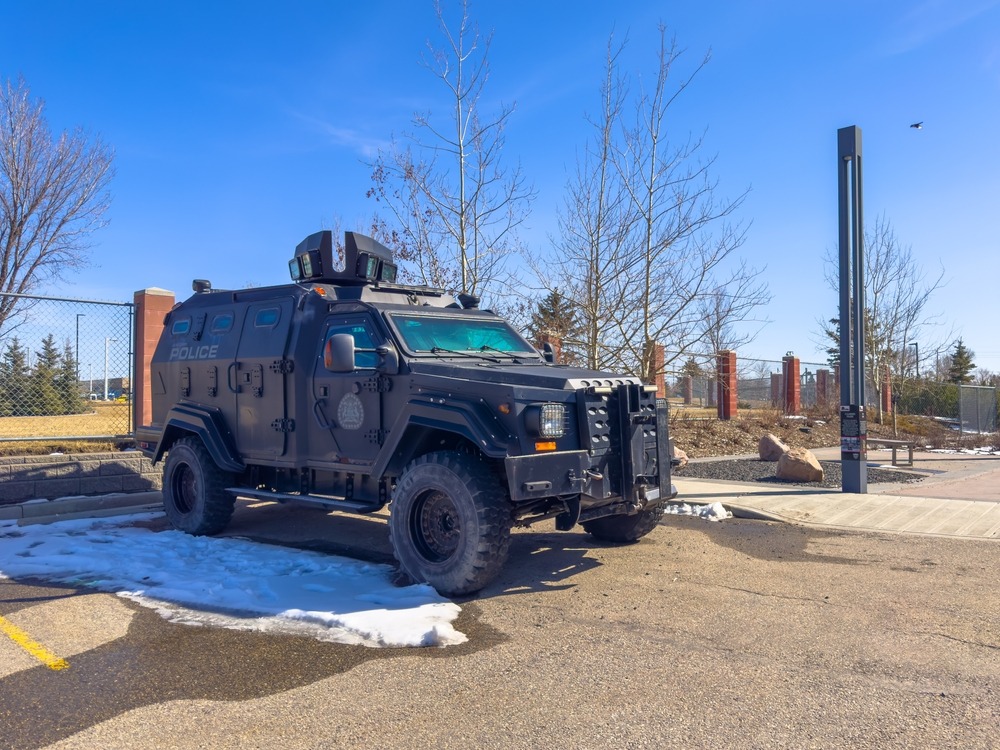
The National Civil Police (PNC) and the Ministry of the Interior plan to acquire more than a thousand vehicles to “reinforce security operations and combat organized crime,” including military-type armored tactical vehicles.
As part of the first batch of vehicles, the PNC seeks to purchase 600 pick-up type patrol cars, 400 sedan cars, 50 agricultural trucks, 35 buses for 30 passengers, 60 minibuses, 10 buses for 48 people, 30 panel vehicles, 30 crane trucks, a towing crane truck and two military-type armored tactical trucks.
The acquisition is justified “due to the lack of police units intended for patrolling and mobilizing police personnel within the national territory.”
The purpose of the vehicles, according to the institution, is “to strengthen the work aimed at preventing and combating organized crime and thus provide tranquility and protection to the Guatemalan population, strengthening the PNC,” details the contest.
Armored with cameras and night vision
The two armored tactical vehicles level B7 or UL 752 level 9-10 that are sought to be purchased, according to the requirements, must have a “V”-shaped rear structure to deflect explosions, ballistic steel, cameras with 360-degree vision, night vision, motion sensors, rotating armored turret and video recording capacity for intelligence operations.
In addition, the vehicles would have a multi-siren system, strobe lights, front and rear winches, air conditioning and recovery equipment for towing vehicles.
The first competition for patrols
On April 20, the first contest for the acquisition of vehicles was published in Guatecompras.
The lot includes 400 picops, 50 agricultural trucks, 20 buses for 30 passengers, 60 minibuses with capacity for 15 passengers, 12 buses for 48 people, 30 panel vehicles, 12 crane trucks, a towing crane truck and two military-type armored tactical trucks.
According to the Ministry of the Interior, the vehicles must be delivered within a maximum period of six months – 180 days -, with the exception of cranes and military-type armored vehicles, which must be delivered between nine and 12 months after the award.
In parallel, the General Subdirectorate of Anti-Drug Information Analysis of the PNC promotes another competition to acquire 20 picop-type patrols.
PNC canceled purchase of patrol cars in 2025
The new planning occurs after a competition to acquire a thousand patrol cars for the PNC for Q365 million failed in September 2025.
In this process, the Tender Board revoked the award granted to Changhe Motors due to an inconsistency considered “insurmountable” in the number of the General Registry of State Acquisitions (RGAE) recorded in the documentation presented by the company.
If the contract had been finalized, the first 220 patrols would be delivered in 60 days and another 150 in January 2026.
The director of the PNC, David Boteo, reported then that the institution had 6,199 patrol cars in circulation and another 2,650 out of service due to irreparable damage.
You could also read: PNC cancels millionaire award for the purchase of a thousand patrol cars
Weapons purchase plan
In addition to the vehicles, the Ministry of the Interior plans to acquire weapons for the PNC and the Penitentiary System with funds allocated in the Anti-Gang Law.
The Minister of the Interior, Marco Antonio Villeda, explained during a meeting in Congress with the Will, Opportunity and Solidarity (VOS) bench that a budget readjustment of Q200 million was approved to purchase equipment for specialized units of the PNC and the Penitentiary System.
According to the official, part of these resources will be used to acquire some two thousand short weapons and 800 long-range rifles.
Villeda stated that they are seeking to reach agreements abroad to purchase weapons.
“We are trying to activate government-to-government agreements or negotiate with state-owned companies abroad so that there are no intermediaries and that we can really buy this weaponry without having to mount bidding processes,” he declared.
He added that they have had approaches with the United States, Canada, Austria, Slovenia and Taiwan to finalize the purchases.