
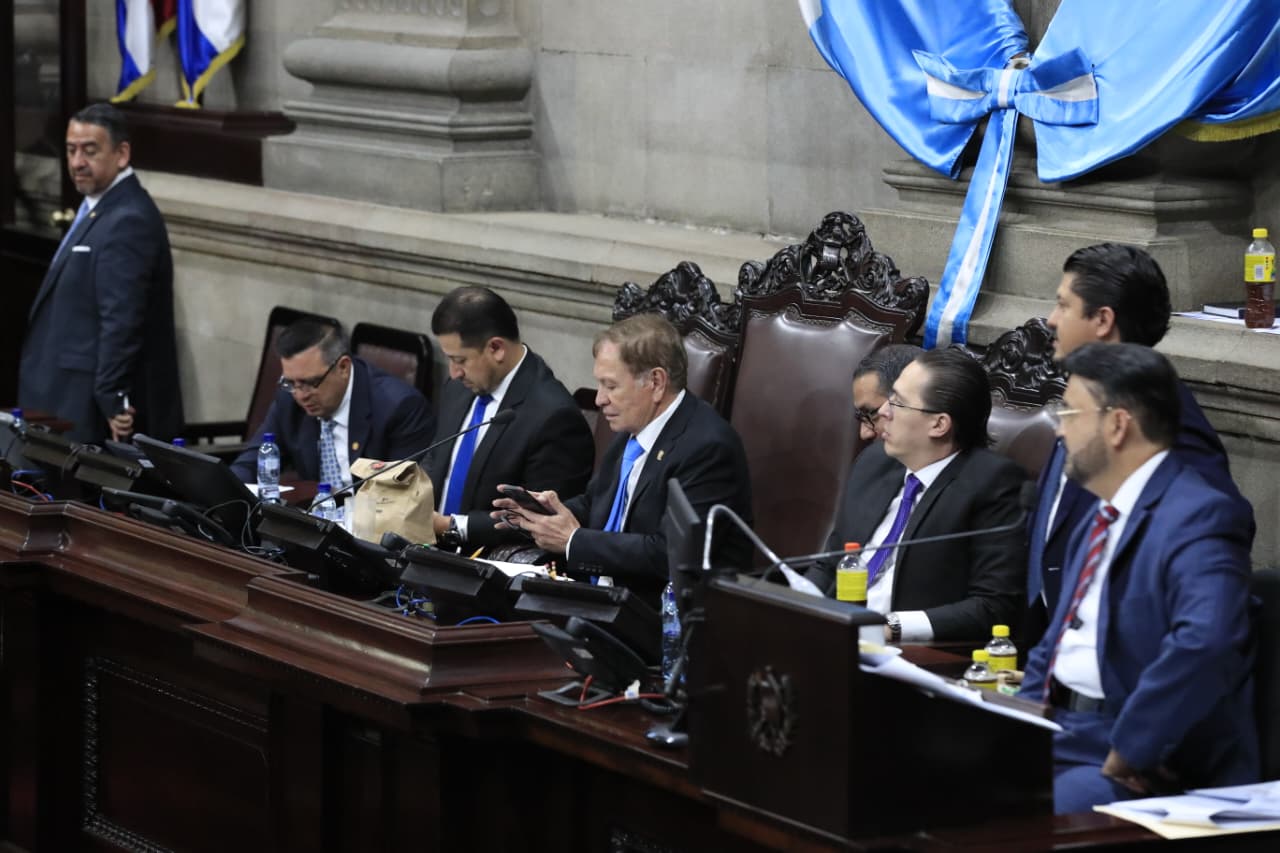
The deputies are seeking agreements to approve the Anti-Laundering Law privately, without the presence of the press or observers. At least that was demonstrated at the meeting of the block heads held this Monday.
This type of meeting is usually public, broadcast on the Congress television signal and its multiple social networks, but the session focused on the Anti-Laundering Law was the exception.
The legislators were summoned last week by Luis Contreras, president of Congress, who also summoned deputies who make up the Economy Commission.
In addition to the congressmen, authorities from the Superintendency of Banks (SIB) and the Special Verification Intendance (IVE) also participated, as explained by participants in the meeting.
Congress, chaired by Contreras, could not approve in its first regular session initiative 6593, Comprehensive Law against Money Laundering or Other Assets and the Financing of Terrorism.
This proposal was sent by President Bernardo Arévalo, but despite the fact that the norm has already passed through its first, second and third debate, it has encountered an obstacle that is impossible to overcome in order to be approved in its final articles.
Despite the fact that the heads of blocks and authorities in banking and financial matters met today, the deputies still have not reached agreements, having to be convened again next week.
Justify session
Contreras assured that this Monday’s results are positive, since, according to him, they are “closer” to reaching consensus for the final drafting of the anti-money laundering law.
“On some issues we are close, others need to be discussed more. The meeting was positive and we will return next Monday,” expressed, and rejected questions of lack of transparency, since “We are not hiding anything.”
Contreras justified the mechanics of the session as a strategy to reach agreements. “We do not hide anything, what happens is that if the meetings are very public, it is difficult to work,” the president noted.
Although there is a new package of amendments to the anti-money laundering law, Contreras preferred not to attribute them to any particular representative or bench, as he said he could not point out the speakers because there were several.
A first package of amendments that would have been positive among the parties, according to deputies who prefer not to be named, are suggestions for changes to articles 2, 25, 52 and 83.
Article 2 explains the definitions of the law, article 25 modifies the original definition of Politically Exposed Person, article 52 reaffirms that the IVE data cannot have probative value or be the basis of precautionary measures, and article 83 softens the prison sentence for “others responsible” for collaborating in money laundering.
The second package of amendments that will be evaluated next week is related to articles 8, 73, 74 and 111, according to a document that has been shared among the deputies.
They see results
The opposition deputies, Allan Rodríguez, head of the Vamos bloc, and Inés Castillo, of the National Unity of Hope (UNE), agree when explaining that this Monday’s session allowed progress on the proposal.
“No one can limit the presentation of amendments, since it is not the only exclusive environment, the commission. The commission has a function, but in the plenary session of Congress is where seat amendments are discussed,” Rodríguez pointed out.
Some doubts stopped the law last week due to the breaking of the quorum in the Congressional Board of Directors, after some groups planned to present apparently non-consensual amendments.
Rodríguez defended the suggestions, ensuring that they have had the support of banking and financial entities, supporting the wording of some of those that have already been reviewed.
“They were accepted amendments, not all of them have been discussed, but they have been declared viable by the SIB because there were some inconsistencies in the opinion, it was a matter of form and not substance,” said.
For his part, Deputy Castillo also justified the proposals that were discussed last week, indicating that they had technical support.
“We made progress in the discussion. The most important thing is that it was demonstrated that the amendments that we were working on on Tuesday night were not out of the blue, they were not ideas,” he pointed out.
The congressman also criticized some colleagues for allegedly using the media and social networks to generate a discussion. “We are on the right path, we are listening to each other. The important thing is that the political reasoning that is on the table was done with respect, not when we seek to become political through the press or false profiles,” he said.
Fear blockages
Despite the fact that there are voices that point to progress regarding the Anti-Laundering Law, Congresswoman Laura Marroquín, from the ruling faction that now identifies itself as the Raíces bench, fears that it is a strategy to delay the approval of the law.
“Until today we learned about the amendments that came out last Tuesday as a surprise. Today we analyze them in the light of the IVE experts,” explained the congresswoman.
He explained that they managed to evaluate a first package of suggestions for changes.“There are four amendments of those already agreed upon, and there are four other new ones that we did not exhaust, we were not able to see them,” he added.
The deputy hopes that the agreements are finally made present, to prevent new amendments from altering the agreements and conversations, potentially blocking a future plenary session.
“We believe that it is a strategy to trap the final approval. Today the same blocks that participated in the first discussion may raise doubts, and we hope that when a new session is held they will not come out with new amendments again,” he concluded.