
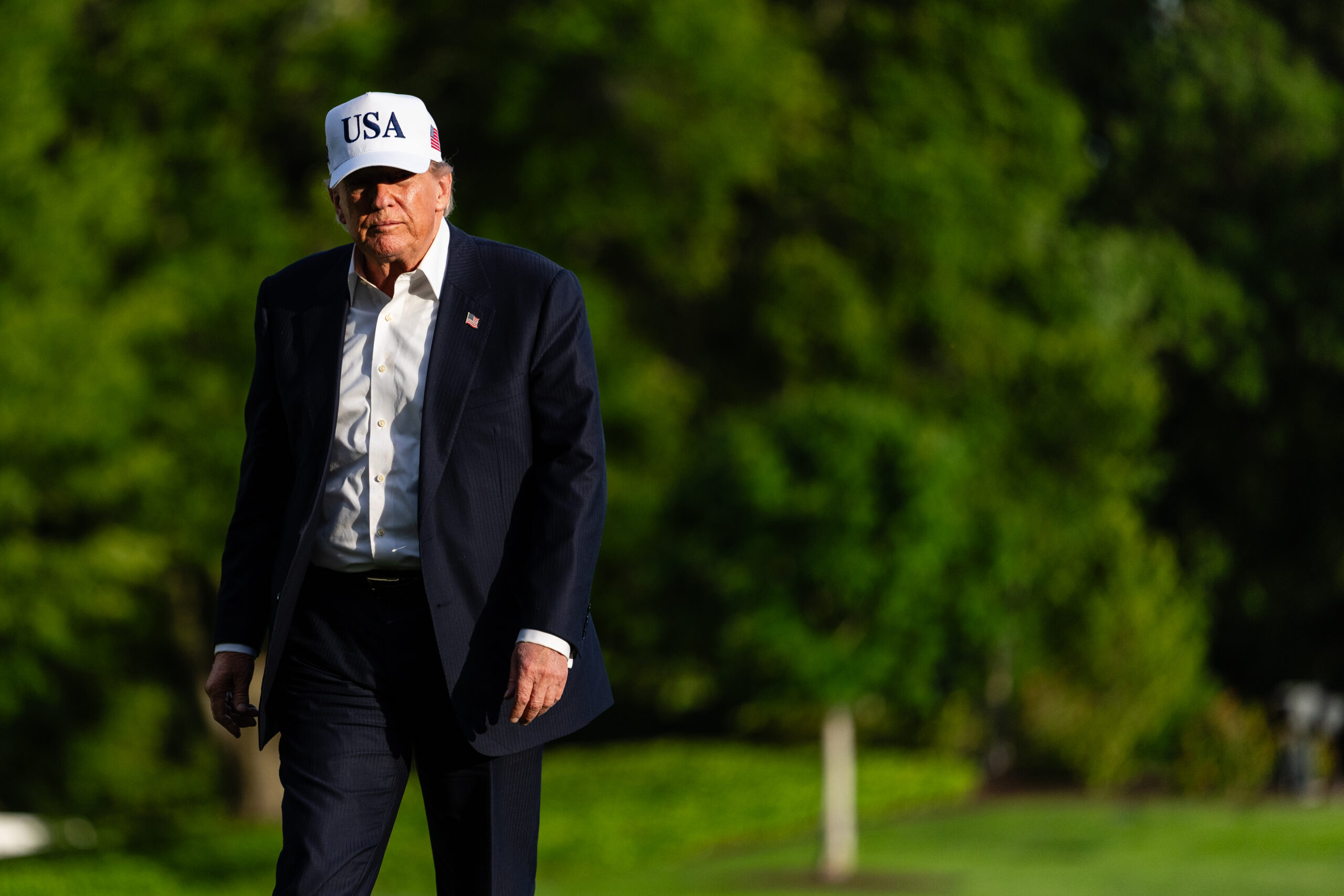
President Donald Trump does not believe in the law of political gravity. The more his popularity sinks in the country at large—numerous polls put it near its lowest level in history—the more he bends the Republican Party to his will and endangers the prospects of submissive Republicans in the fall with unpopular and even brazen actions.
The result is a president historically adept at commanding political loyalty within his party but prone to taking executive actions that alienate the broader public. This paradox has fostered a reluctance—and weakened ability—to engage with Congress on the issues that matter most to voters, a cycle that Trump is unwilling, or unable, to break.
On Tuesday, Trump got the trophy he most desired: the impeachment of Libertarian Congressman Thomas Massie (R-Kentucky). The eight-term congressman is the president’s most prominent Republican critic andin the House of Representatives and led the effort, which Trump resisted until he realized he couldn’t stop it, to release government files on convicted sex offender Jeffrey Epstein. Massie was decisively defeated in the primary by a political unknown until then, former Navy Seal Ed Gallrein, hand-picked by Trump and financed with tens of millions of dollars from his allied organizations.
Massie’s defeat came three days after that of Sen. Bill Cassidy, R-Louisiana, whom the president had called “very disloyal.” Cassidy had voted to convict in Trump’s second Senate impeachment trial five years ago for the Jan. 6, 2021, attack on the Capitol. Although the senator had made efforts, often clumsily, to improve his relationship with the president, Cassidy did not even make it to the runoff. Earlier this month, Trump’s retaliation tour swept through Indiana, where Republican voters heeded his call and defeated five of the seven state senators he had singled out for resisting his demand that they redraw the state’s congressional districts. —A race, in which the candidates are separated by just two votes according to the latest count, has not yet been decided.
On Tuesday, the president once again demonstrated his power by endorsing Texas Attorney General Ken Paxton against current Senator John Cornyn in the second round of the Republican primaries for the Senate in the Lone Star State. This decision dismayed many Republicans on Capitol Hill, as Cornyn was considered a much stronger candidate for the general election; If Paxton wins, Republicans will likely have to spend hundreds of millions—money that might be needed to support candidates elsewhere—for their candidate to prevail in a traditionally Republican state.
Trump made it clear that this decision was personal, not tactical or political. Cornyn had criticized Trump on previous occasions, although he had recently made efforts to curry favor with him, including recently introducing a bill to name one of the country’s longest highways after the president. It was in vain. “John Cornyn is a good man and I worked well with him, but he did not support me in difficult times,” Trump wrote in his social media statement endorsing Paxton. “I think Maga has never been more united,” Trump said to reporters on Tuesday. But Republicans will need considerable support from the rest of the electorate to maintain control of Congress in the fall elections, in which the president sees his own political survival at stake.
“You have to win the midterm elections because if we don’t win them, they’ll just… I mean, they’ll find a reason to impeach me. They’ll impeach me,” he told House Republicans at a retreat in January. But right now, the biggest obstacle to the party retaining its slim majorities in the House and Senate is Trump. A New York Times/Siena poll released Monday was just the latest to show the strong public rejection of the war that Trump started in Iran and to its cost of living management. Even on immigration, his strongest issue, the president was trailing by 15 points. Trump’s approval among key independent voters plummeted to 26% in the survey, with 47% saying his policies had hurt them, down from 41% in the fall.
And the survey figure that is probably most alarming for Republicans is that Democrats were more enthusiastic about voting this year and led Trump by 11 points on the hypothetical question of which party voters would vote for if the election were held today. Meanwhile, even Republicans have been unsettled by some of Trump’s recent actions that have caused a stir, including the settlement he reached with the IRS over the $10 billion lawsuit he filed earlier this year over the leak of his tax returns.
The agreement establishes a $1.8 billion taxpayer-funded compensation fund for those who, like Trump, claim to have been victims of a politicized judicial system. Beneficiaries would presumably include people accused of committing violence during the attack on the US Capitol on January 6, 2021 by Trump supporters seeking to overturn the results of the 2020 presidential election, which he lost. “I’m not very supportive,” Senate Majority Leader John Thune, R-South Dakota, told reporters Tuesday when asked about the fund.
“This corruption has never been so brazen or so pervasive,” said Sen. Patty Murray, D-Wash., during a hearing featuring Acting Attorney General Todd Blanche. “But what happens is that you write the check, Trump and his cronies cash it. American taxpayers, who are already suffering the consequences of high prices, are going to foot the bill.” Under the agreement, Trump and his children are prohibited from personally collecting money from the so-called “anti-weaponization” fund, but the IRS He would also be “forever disqualified and barred” from claiming unpaid taxes against Trump, his family members or his businesses that arose before the deal was reached.
As aggressive as Trump has been with his unilateral actions, his political weakness has diminished his ability to influence getting things done through the legislative branch, where much of his agenda is stalled. Neither Thune nor House Speaker Mike Johnson (R-La.) have supported Trump’s proposal to suspend the gas tax, and the Senate has resisted his call to end the filibuster, in part so he can pass his priority Save America Act, which includes a provision that would require people to prove their citizenship to register to vote.
Trump claims the bill is necessary for election security, but opponents argue it would lead to voter suppression. A more recent source of irritation for Trump is the refusal of the Senate parliamentarian to allow hundreds of millions of dollars intended to fund the security aspects of his unpopular White House ballroom project to be included in a bill under consideration that would fund immigration enforcement. For Trump, the good streak of defeats he has inflicted on incumbent Republicans could have a dark side.
They will all remain in office until January and, presumably, will be less intimidated by him. On Tuesday, following his primary loss, Cassidy committed an act of defiance by voting for the first time in favor of a resolution to prevent Trump from ordering new attacks on Iran. “In Louisiana, I have received comments from people, including supporters of President Trump, who are concerned about this war,” Cassidy said in a statement. In an interview in February, Massie told Washington Post: “I have some colleagues who are waiting for the primaries to pass so they can develop a slightly more independent voice.”
Given the current situation, it may be what they have to do to survive.