
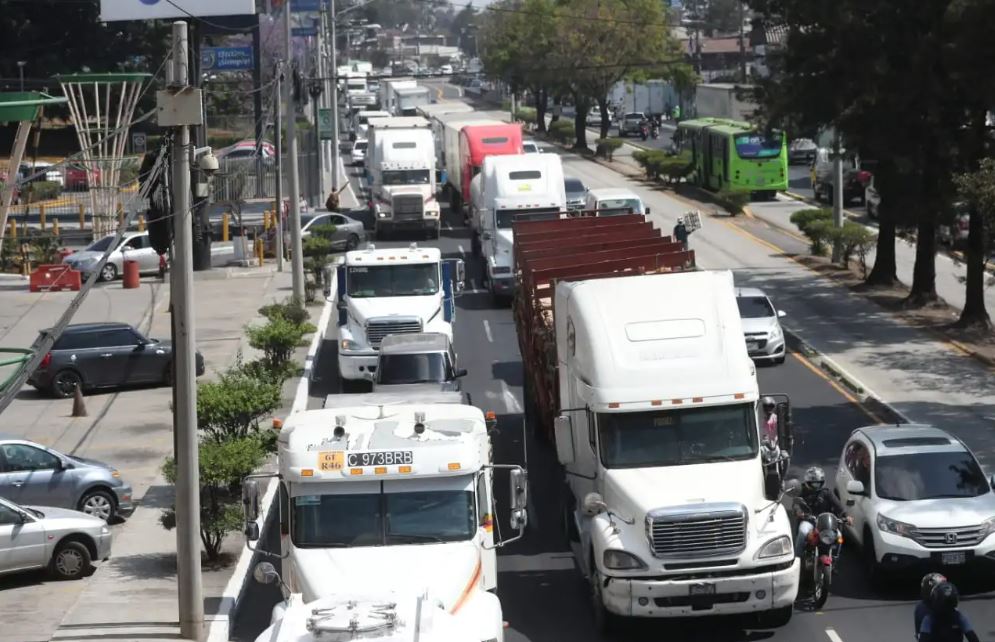
Logistics costs in Guatemala represent, on average, 29% of exports, triple those of developed countries and are among the highest in Latin America, which reduces the competitiveness of the country’s exportable offer.according to Agexport.
Although Guatemala maintains an export projection that could exceed US$18.7 billion, the country continues to face a logistics gap that limits competitiveness, the attraction of investment and the sustained growth of exports, the entity states.
In developed countries, logistics costs range between 8% and 10%, while in Latin America they are between 18% and 35%. This reflects a lag in competitiveness compared to the first group. Guatemala, with 29%, is in the high section of the region with the highest logistics costs, explained Walter Martínez, president of the Integrated Export Services Commission (Siex), and Amílcar Ordóñez, president of the sectoral board of the Export Services Sector, both from Agexport.
Logistics costs and expenses alone represent almost a third of exports, estimated with data at the end of 2025, Martínez explained. That year there was a growth in exports of around 8%; However, when exports increase, but these cost levels are maintained, the contribution margin to the gross domestic product (GDP) is very low, he added.
That 29% includes factors such as poor road infrastructure, port and airport congestion, limited access, complex customs and regulatory processes, high ground transportation costs and a shortage of pilots, executives added.
This varies each year, but from 2013 to 2025 it has remained between 20% and 30% with a peak in 2021 and 2022 due to the covid-19 pandemic.
However, By 2026 there could be an increase in logistics costs of between 30% or 40% above the 29% detected last year derived from the increase in fuel prices, Martínez added.
One of the topics analyzed is the impact of international conflicts on supply chains since recent geopolitical tensions have caused significant increases in logistics costs, especially in maritime transport, where some routes have reported increases of between 10% and 70%, depending on the destination and type of cargo, Martínez added.
Ordóñez explained that the data varies because it is a national estimate that groups together different difficulties, such as weaknesses in infrastructure, traffic and travel times, which are above the Latin American average. In this area, The time to move cargo from one point to another, added to infrastructure deficiencies, is linked to the shortage of pilots in the country.
CONTENT FOR SUBSCRIBERS
Costs also vary by location; However, times in Guatemala remain above the regional average.
The second component corresponds to ports and departures, which includes the costs associated with loading and unloading times, as well as management in ports and airports, in addition to customs and regulatory processes.
Products that require a cold chain must also be considered, since, being perishable, beyond cost, agility is affected and limits access to certain markets or forces them to use less cost-effective routes.
In addition to local complexity, customers and the international market are increasingly demanding sustainability standards, such as emissions reduction and greater logistics efficiency.
Processes at ports and airports, as well as customs and regulatory procedures, continue to be complex for the exporter and require simplification. Added to this is that the cost per kilometer traveled in Guatemala is the highest in Central America.
When a Guatemalan company exports, it competes in quality (at the expense of the exporter), in price (partially under its control), and in innovation. However, when almost a third of the cost is allocated to logistics, transportation, times and procedures, an environment of loss of country competitiveness is generated, Martínez and Ordóñez agreed.
Shortage of cargo pilots continues
Another issue analyzed by the sector is the shortage of pilots. In 2025, it was reported that the land logistics chain faces a deficit of 13,200 pilots. and that this gap could double in three years.
However, the shortage can reach up to 30 thousand pilots in peak seasons, Agexport experts indicated on Tuesday, June 2.
To address this problem, the Interinstitutional Roundtable was established due to the shortage of heavy cargo transportation pilots, made up of Combexim, the Chamber of Industry of Guatemala, Agexport, the Logistics Guild of Guatemala and Amcham.
Although actions have been proposed, there have been no significant changes and the solutions are projected in the medium and long term.
The table has made it possible to define an action route based on a diagnosis already identified, in coordination with state entities and the private sector.
Among the recommendations, the modification of the types of licenses stands out, which requires a public-private alliance with entities such as Intecap, Mintrab and the Ministry of Communications.
CONTENT FOR SUBSCRIBERS
Executives noted that there is progress, but a greater sense of urgency is still required.
One of the proposals is to reduce the minimum age to obtain the type A license, from 25 to 22 years, accompanied by training programs and a progressive experience scheme: type C license from 18 years old, type B at 20 and type A from 22.
As part of the analysis, the third phase of the talent survey was developed to identify potential candidates.
A generational gap was detected: new generations consider the work of pilot as demanding and not very compatible with family life, which is why they prefer other occupations or entrepreneurship.
Likewise, parents who are pilots or owners do not want their children to continue in this activity due to the working conditions, risks, and prolonged time away from home.
Among the conclusions stand out:
- Disinterest in the occupation of heavy lift pilot
- Preference for jobs with regular hours and more family time
- Perception of work as demanding, poorly paid and highly responsible
- Interest as a secondary option in the face of unemployment
- Training gap, with young people driving without a formal license
- Breakdown of the generational change
Discussion of topics, in Green Logistics
To discuss the different topics related to logistics and even the shortage of pilots, the fourth edition of the Green Logistics Congress will be held this Thursday, June 4, 2026, focused on the topic of sustainable, resilient and competitive logistics.
Among others, topics such as:
- Global trends in logistics and supply chain resilience
- Human talent in logistics, the shortage of pilots
- Urban logistics and mobility in Guatemala City
- Strategic infrastructure for sustainable logistics
- Sustainable mobility and energy transition
- Ethanol, from the point of view of benefits and recommendations