
Operating within planetary limits is a guiding axis of its business model, since it is known that the steel industry is intensive by nature, and it is precisely for that reason that it has taken on the challenge of transforming it from within, applying operational discipline to demonstrate that economic growth and environmental respect can, and must, coexist.
For Grupo AG, sustainability begins with maximum technical efficiency. Each optimized resource is one less impact on the environment. In that sense, the company has brought digital transformation directly to the production environment, integrating Artificial Intelligence (AI) to leave manual estimates behind and make exact mathematical decisions in real time.
The implementation of predictive models and thermal sensors allowed it to achieve an 8% reduction in electrical energy consumption in its operations. It is worth mentioning that today, 100% of the continuous castings in the steel process are optimized using AI. This guarantees the exact dosage of chemical components at minimum cost, managing to operate with zero quality rejections and eliminating waste from the source. On the other hand, the company reported the optimization of the heating zones in its lamination furnaces, which has resulted in a 7% saving in bunker fuel.
The steel industry as the largest recycling ecosystem
The steel industry has a circular model and, along these lines, Grupo AG recycled more than 500 thousand metric tons of ferrous scrap in 2025, which represents 57.46% of the total materials they use for their production.
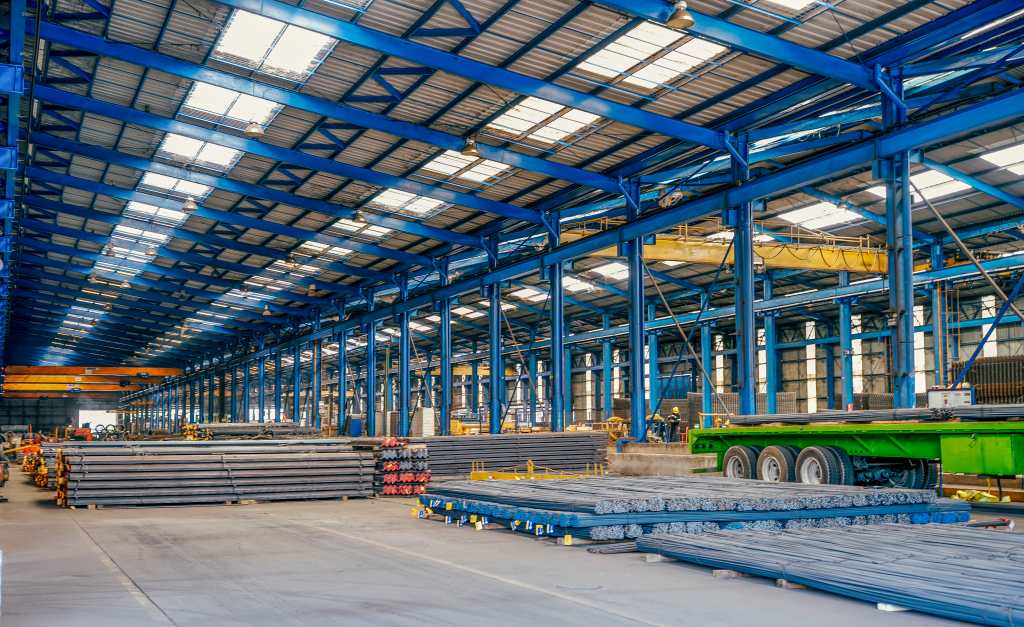
This is reflected in the Grade 60 and Grade 80 rods which are made from 100% recycled material, an achievement supported by the Guatemalan Center for Cleaner Production (CGP+L) Recycled Product Standard Seal.
However, circularity does not end with steel. Through industrial symbiosis alliances, Grupo AG managed to reintegrate almost half of its operational co-products, such as iron scale, transforming them into high-value raw materials for allied industries such as cement. In 2025, they valued 49.87% of their co-products.
Real and transparent decarbonization
Climate change requires profound technological responses. Grupo AG reported for 2025 a carbon footprint intensity of 1.22 tons of CO2 equivalent (tCO2e) per ton of steel. This result positions them below the global average of the steel industry, which stands at 1.92 tCO2e.
This emissions reduction effort, especially in Scope 2, is supported by 79% energy consumption from renewable energy sources.
On this World Environment Day, Grupo AG reaffirms that industrial excellence and environmental protection share the same path: operating under increasingly higher standards and generating a positive impact on the people, communities and territories where they are present, to contribute to development.