
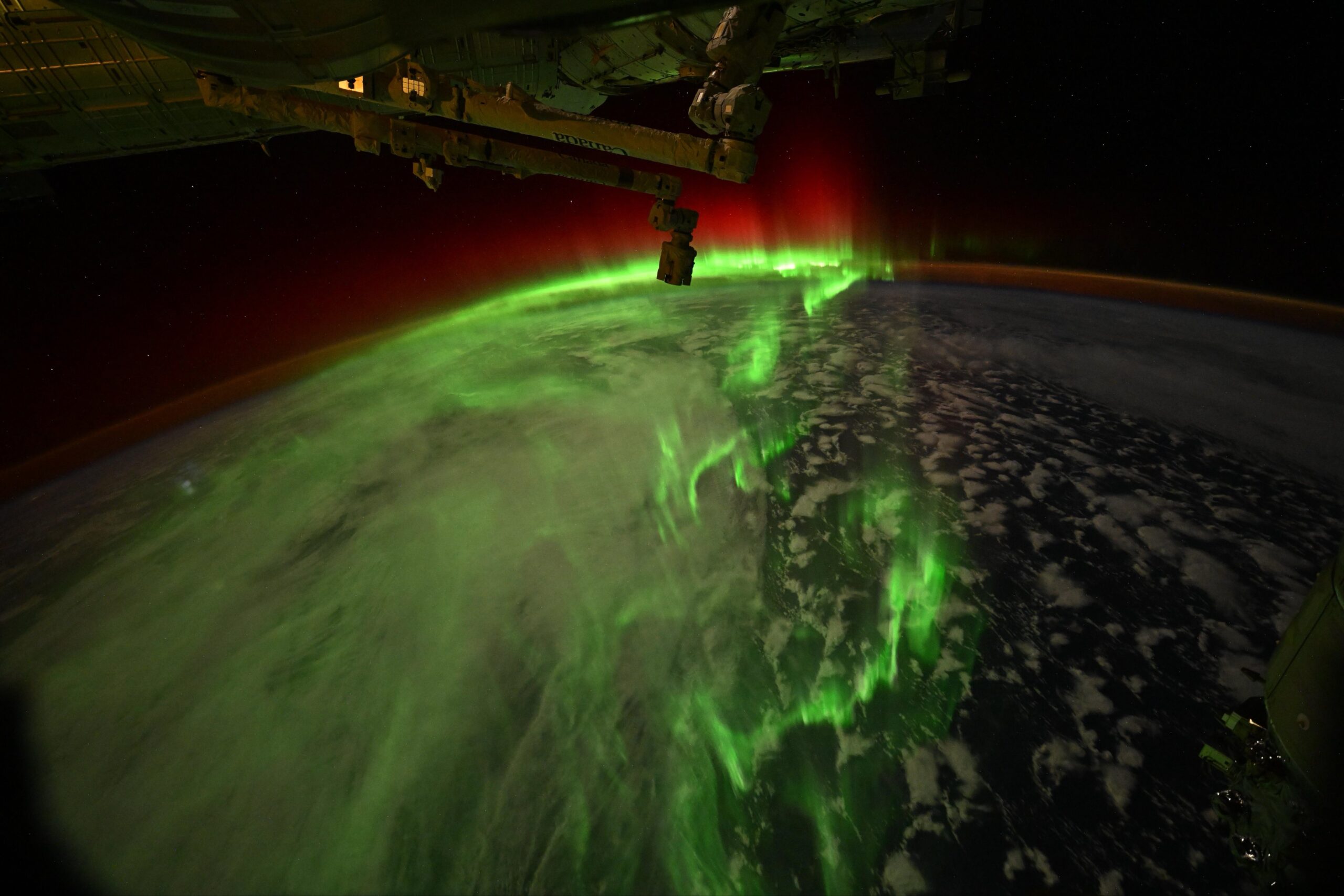
Also known as the ghost lights that dance across the night sky, the aurora australis are generated by interactions between the solar wind and the planet’s magnetic field. This phenomenon was captured from the International Space Station of the POT.
The aurora australis usually dance in the sky in intense waves of green, pink, red and purple tones, highlights Oceanwide Expeditions. This natural phenomenon is difficult to observe due to the absence of large populated land masses in the southern hemisphere.
The portal explains that these light waves are produced by the interaction between the solar wind and the Earth’s magnetic field. When charged particles from the Sun collide with oxygen and nitrogen atoms present in the atmosphere, they release energy in the form of light flashes that give rise to auroras.
Likewise, Oceanwide Expeditions points out that the colors of the auroras depend on the type of particles that participate in the interaction and the altitude at which the collision occurs. The combination of the solar wind with the Earth’s magnetosphere generates hues that can vary between green, red, violet and blue.
This phenomenon was captured by NASA astronauts from the International Space Station. NASA astronaut Jessica Meir shared an image of the aurora australis, visible on the southern side of the planet.
“There are a lot of things happening right now on the Space Station, but fortunately we are all safe and yesterday we were able to witness a spectacular aurora show thanks to a recent solar event,” he commented on X when sharing the images.
There is a lot going on right now on the @Space_Stationbut fortunately we are all safe and witnessed a spectacular southern aurora show yesterday thanks to a recent solar event. pic.twitter.com/25XaoMw2Rk
— Jessica Meir (@Astro_Jessica) June 6, 2026
He also released a video in which the bursts of light are observed. In it you can see how the southern lights dye the Earth’s atmosphere green and how this light meanders like the current of a river.
In another message, the astronaut highlighted an image taken from a SpaceX ship: “The dragon of the spectacular aurora australis… the result of a recent solar event. Unlike the previous auroras I have seen, this one danced and snaked just below us, offering an impressive spectacle,” she declared.
A timelapse view from our @SpaceX Dragon of the spectacular southern aurora seen in yesterday’s post, a result of a recent solar event. As opposed to the previous aurora I’ve seen, this one danced and snaked its way directly below us, putting on quite a show. I am in awe of this… pic.twitter.com/ReztjH3x9H
— Jessica Meir (@Astro_Jessica) June 7, 2026