
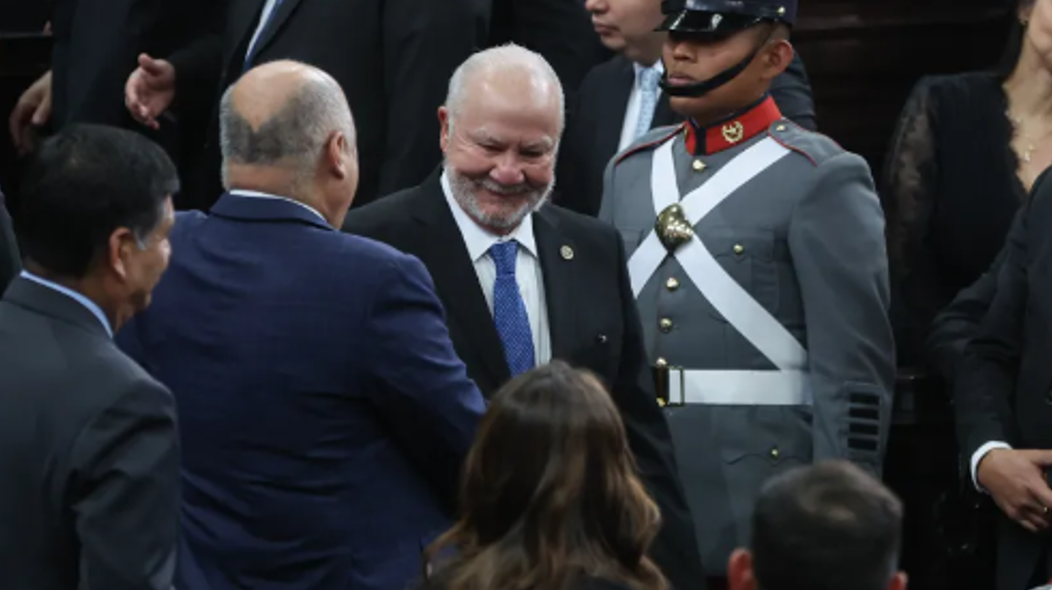
The magistrate of the Constitutional Court (CC), Roberto Molina Barreto, reported this Monday, June 15, that he will refrain from hearing any matter related to the process of election and appointment of the rector of the University of San Carlos de Guatemala (Usac), considering that there are circumstances that affect the exercise of his jurisdictional independence and freedom of judgment.
The decision was communicated through a letter addressed to the president of the CC, Gladys Annabella Morfín Mansilla, in which she also points out a series of irregularities that occurred during the processing of constitutional actions linked to the university election.
According to Molina Barreto, during the last few months, various amparos related to the election of the rector of the USAC were presented, which, in his opinion, were not timely sent to the competent first-degree amparo courts, despite the fact that this is established by the Law of Amparo, habeas corpus and Constitutionality.
In the letter, the magistrate states that both he and magistrates Dina Ochoa and Julia Rivera asked the Presidency of the CC to promote the processing of these files to avoid delays inherited from the previous magistrate; However, it maintains that these efforts were not attended to with the required promptness.
Question delays in signing resolutions
In the document, Molina Barreto also refers to a session held on May 25, in which the CC resolved several actions related to the university election and sent at least 10 files to protection courts.
According to the magistrate, on that occasion the signing of resolutions was postponed for almost 10 days for the first time, a situation that, according to him, was reflected in the reasoned votes that were signed until June 3. In his opinion, this delay contributed to increasing conflict and questions against members of the constitutional court.
Likewise, it points out that, in a subsequent session, held on June 1, the Court heard several files filed by applicants against the Higher University Council (CSU) and the Commission of the University Electoral Body of the USAC.
Molina Barreto indicates that the majority of the plenary session agreed to amend procedures and order first-degree protection courts to suspend certain actions without knowing the substance of the claims, because, according to the resolution, they did not meet procedural requirements such as finality, legitimation and connection.
Regarding these resolutions, the magistrate accuses the president of the CC of having again deferred the signing of the rulings.
Points against the Presidency of the CC
In the letter, Molina Barreto expresses his “absolute disagreement” with what he describes as an anomalous procedure on the part of the Presidency of the court, by not making the resolutions already adopted available to the magistrates for their immediate signature.
According to him, once a majority decision is reached, the signing of the resolution must be an immediate consequence and not an act subject to new deliberations or consultations. Furthermore, it considers that deferring the signatures under the argument of allowing the elaboration of dissenting reasoned votes affects the certainty and legal security of the resolutions.
The magistrate maintains that the administrative powers of the Presidency of the CC include the proper processing, convening, resolution and communication of files, especially in matters of high institutional conflict.
Molina Barreto assures that the events related to the files of the election of the rector of the USAC have generated a situation that affects the exercise of its jurisdictional independence and its freedom of judgment.
He also points out that the events have led to attacks, accusations and expressions that, according to him, affect his honor and personal dignity.
In the letter he announced that he will abstain from participating in the knowledge of any matter related to the election and appointment of the rector of the USAC.
In the final part of the communication, Molina Barreto urges the members of the CC to process and resolve in a diligent, objective and timely manner the constitutional actions submitted to their knowledge.
Furthermore, it considers that other magistrates should adopt a similar decision in case there is doubt about their impartiality, especially if they have previously expressed interest in the matter or participated professionally as lawyers, advisors or assistants to any of the groups involved in the university electoral dispute.
Resolutions favored continuity of Mazariegos
Molina Barreto’s statement occurs days after the plenary session of the CC resolved matters related to the election of the rector of the Usac.
On June 8, the constitutional court annulled the scope of two amparos, one provisional and the other definitive, that had suspended the re-election of Walter Mazariegos as rector of the university.
According to a constitutional source cited in the background of the case, the resolutions were signed after the plenary session resumed files that had been left pending due to observations raised by two magistrates.
The controversy over the election of the rector originated during the university electoral process and intensified after questions related to the integration of the Higher University Council and the exclusion of opposition sectors in the final vote held on April 8 in Antigua Guatemala.
So far the CC has not commented on the letter sent by Molina Barreto
*Stay up to date with the Now newsletter. Key information at the moment it happens. Subscribe here.