
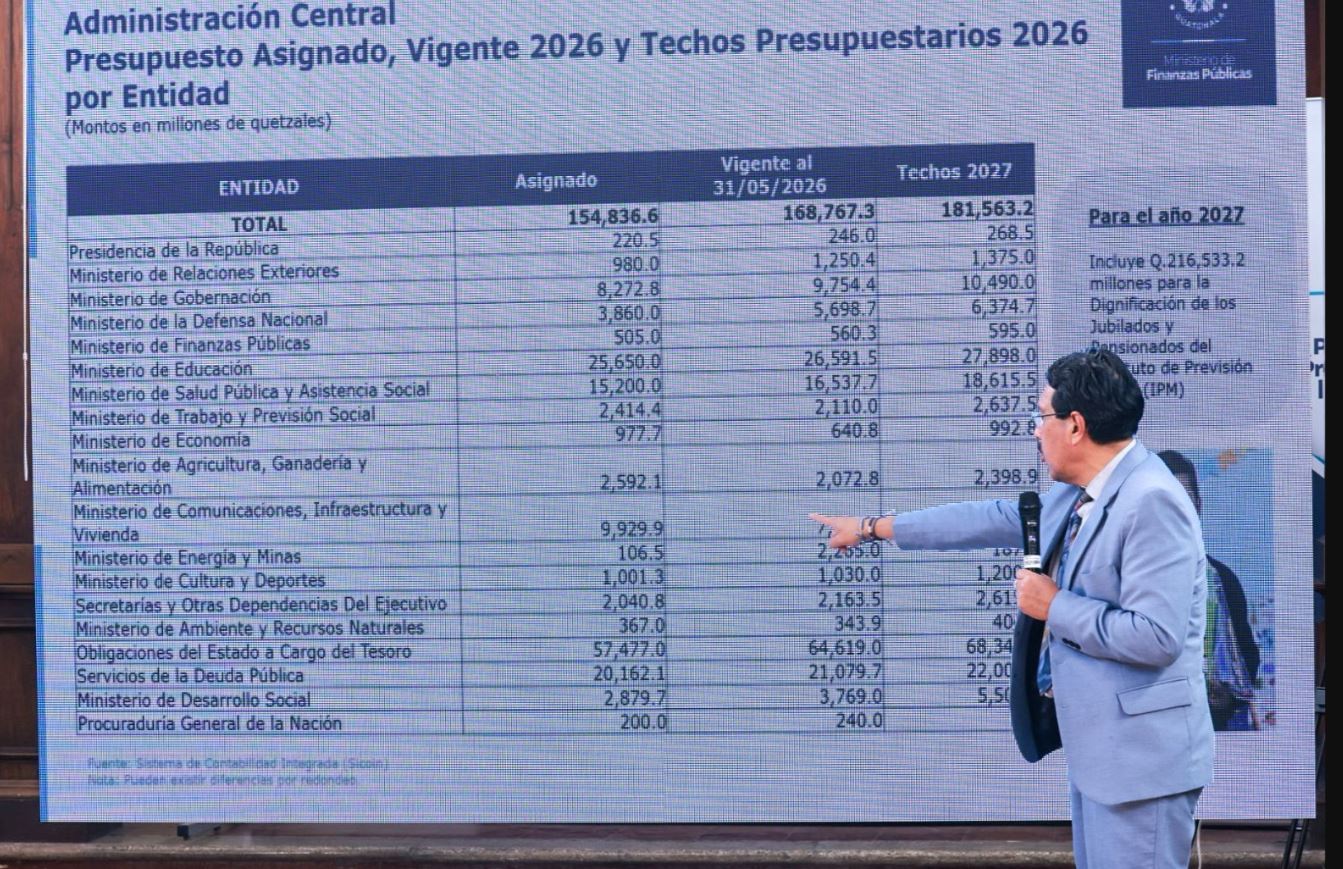
The Ministry of Finance (Minfin) yesterday made official a indicative ceiling of Q181 thousand 563 million and presented the preliminary breakdown of allocations for each of the ministries and other institutions.
The proposal for next year would represent an increase of Q12,796 million compared to the current budget of Q168,563 million, equivalent to 7.5% as of May 31, 2026. In addition, it would represent an increase of Q26,727 million compared to the assigned budget of Q154,836 million, that is, 26.7%, according to the data presented during the open budget workshop.
Now, the Technical Budget Directorate (DTP) will begin the review and adjustment of the figures for the formulation of the budget during July and August, in order to present the final version to the Congress of the Republic on September 2. The Legislative Body will have until November 30 to hear the proposal.
The figures presented could vary. Therefore, ministries and other agencies must present the prioritization of their programs based on the indicative ceilings and macrofiscal scenarios exposed this week.
Education leads ceilings
In general terms, the budget structure will not register significant changes.
According to the breakdown presented, five ministries will concentrate the largest allocations and, together, they will add up to Q73 billion, equivalent to 40% of the total.
The Ministry of Education (Mineduc) would have the largest allocation, with Q27,898 million; The Ministry of Health would follow, with Q18,615 million; the Ministry of the Interior, with Q10,490 million; he Ministry of Communications, Infrastructure and Housing, with Q9 thousand 668 millionand the Ministry of National Defense, with Q6,374 million.
The proposed allocations will have adjustments with respect to the current budget.
For Obligations Charged by the Treasury, Q68,340 million were programmed; for the service of the public debt, Q22 billion, and for Secretariats and Other Executive Agencies, Q2 thousand 615 million.
Q216 million were allocated to the dignity program for retirees and pensioners of the Military Pension Institute (IPM).
Infrastructure leads strategic assignments
The presentation explained the axes that will be implemented with the assignment of specific ceilings. For the Priority assignments amounted to Q19,122 million. and for the presidential goals, Q8,754 million.
For example, for priority allocations, Q4.8 billion were allocated to the modernization of the Quetzal Port Company (EPQ); Q3,517 million to the Priority Road Projects Fund (Fovip), and Q600 million to the modernization of the metropolitan transportation system, ports, airports and railways.
Five ministries will concentrate the largest allocations and, together, they will add up to Q73 billion, equivalent to 40% of the total.
The Vice Minister of Finance, Walter Figueroa Chávez, in charge of the financial administration area, declared that an impact equivalent to 1.8% of the gross domestic product (GDP) is projected due to these allocations and justified the proposed interventions.
The presidential goals contemplate Q3,243 million for the Routes for Development and Infrastructure program; Q1,205 million for rural electrification; Q654 million for the modernization of airports, and Q532 million for the construction of hospitals, among other projects.
These spending programs would contribute 0.8% to GDP.
Minfin identifies fiscal risks
Enrique Alejandro García, deputy director of Analysis and Fiscal Policy of the Ministry of Finance (Minfin), announced the fiscal risks for the 2027 budget. Among them he mentioned the international price of a barrel of oil, the El Niño phenomenonclimate change and the response that the State would have to give in the event that any of these events occur.
He explained that the impact could be reflected in lower tax collection, so it would be necessary to resort to public debt to attend to emergency programs.