
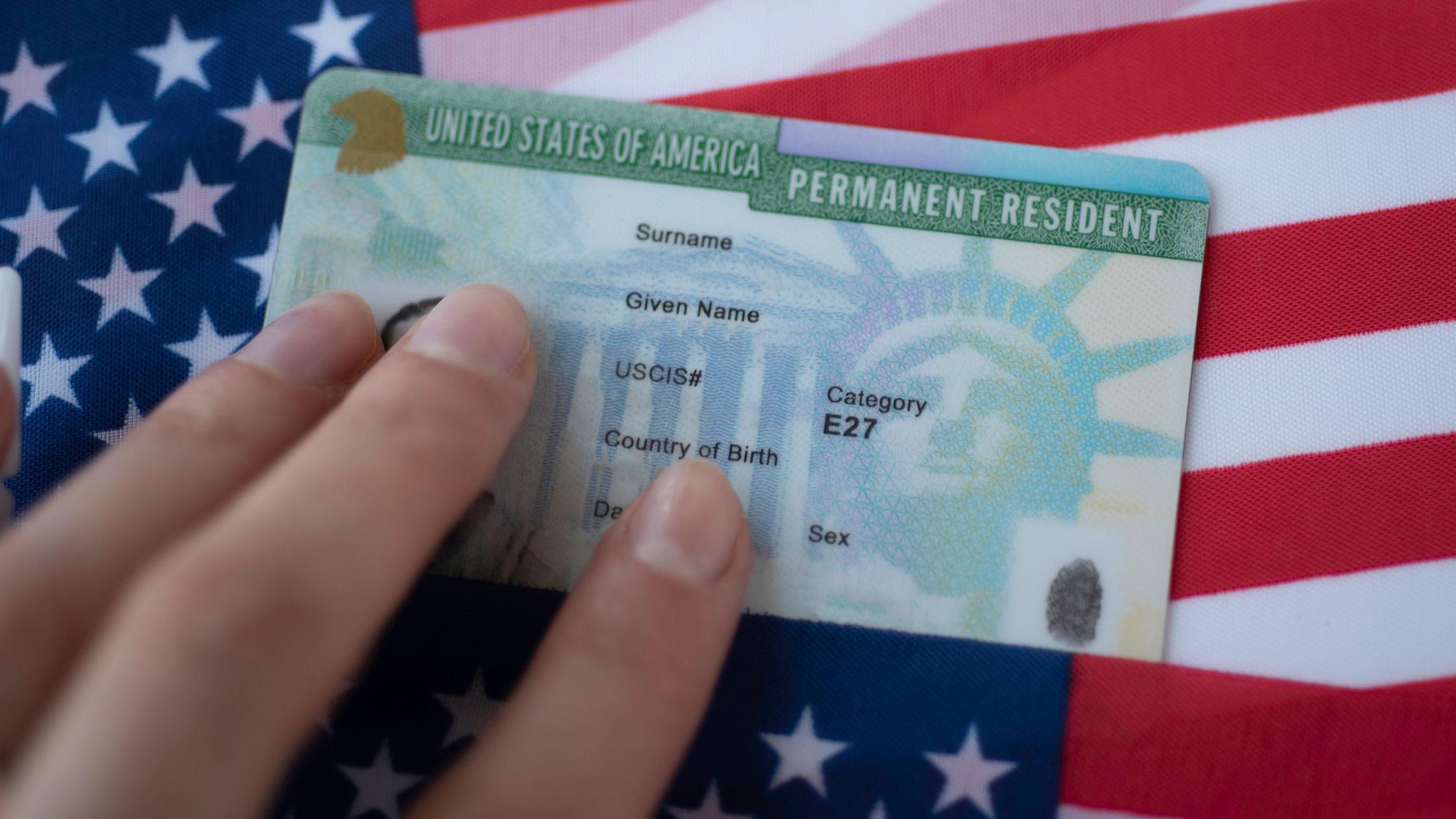
A new immigration policy promoted by President Donald Trump’s administration could force thousands of immigrants to leave the United States to complete residency procedures, a measure that experts say would increase prolonged family separations.
The measure has generated concern among lawyers and organizations specialized in migration, who warn that thousands of people could be forced to leave the country to complete their immigration procedures, with the risk of being separated from their spouses and children for years.
One of the cases that reflects the impact that this type of process can have on families is that of Virginia Carrillo, whose story was told by the news network N+ Univision.
Carrillo, originally from Mexico, experienced a decade-long separation from her husband, Mike Brown, a U.S. citizen, and her children due to immigration restrictions in force when she began her process to obtain permanent residency.
Brown applied for residency for Carrillo in 2007. However, because she had entered the United States irregularly, she had to return to Mexico to attend an interview at the U.S. consulate in Ciudad Juarez.
The couple hoped that the process would be concluded quickly and that Carrillo would return with his permanent residence card, known as green card. Instead, authorities banned him from returning to the United States for 10 years for having remained in the country illegally for more than a year.
The sanction was applied even though Brown was a US citizen and the couple had a son born in the United States.
During the separation, Brown remained in Mesa, Arizona, while Carrillo resided in El Nacimiento, a town in the Mexican state of Sinaloa. The distance forced the family to face economic and emotional difficulties for more than a decade.
Brown supported his wife and children financially and traveled several times a year to visit them. Finally, on April 9, 2019, Carrillo received approval for his permanent residence and was able to reunite with his family in the United States.
“It was difficult,” Brown recalled, recounting the years of separation.
New policy raises concern
According to immigration specialists, long-term family separations decreased after Barack Obama’s administration implemented changes in 2013 that made it easier for certain immigrants to apply for immigration waivers before leaving the country for consular interviews.
That year, Form I-601A was enabled, allowing certain spouses and children of US citizens to request an unlawful presence exemption before going to a consulate abroad.
However, the new policy announced on May 21 seeks to restrict the use of adjustment of status within the United States and move more cases to consular processing abroad.
According to experts, this decision could cause thousands of families to once again face scenarios similar to the one experienced by Carrillo and Brown.
Carl Shusterman, an immigration attorney in Los Angeles and former federal immigration prosecutor, warned the same outlet that the measure could force many families to remain separated for years.
“Families would be separated and children would have to be with one spouse, but not with both parents. This could be a real disaster,” he said.
Data from the Department of Homeland Security shows that between 2015 and 2024, nearly one million permanent residences were granted per year. More than half were approved through status adjustments made within the United States.
In fiscal year 2024 alone, around 800,000 immigrants obtained permanent residency without leaving the country. Of them, some 403,000 received the benefit due to direct family ties with US citizens.
Jeanne Batalova, senior analyst at the Migration Policy Institute, said the policy could result in months or even years of separation for families whose members must leave the United States to complete their immigration procedures.
The expert also warned that the measure could affect employers who depend on immigrant workers and generate uncertainty for hundreds of thousands of families seeking to regularize their immigration status.
Although the Trump administration has indicated that there could be exceptions for people whose permanence represents an economic benefit or a national interest, specialists consider that the main people affected would be undocumented immigrants or people who remained in the United States after the expiration of their visas.