
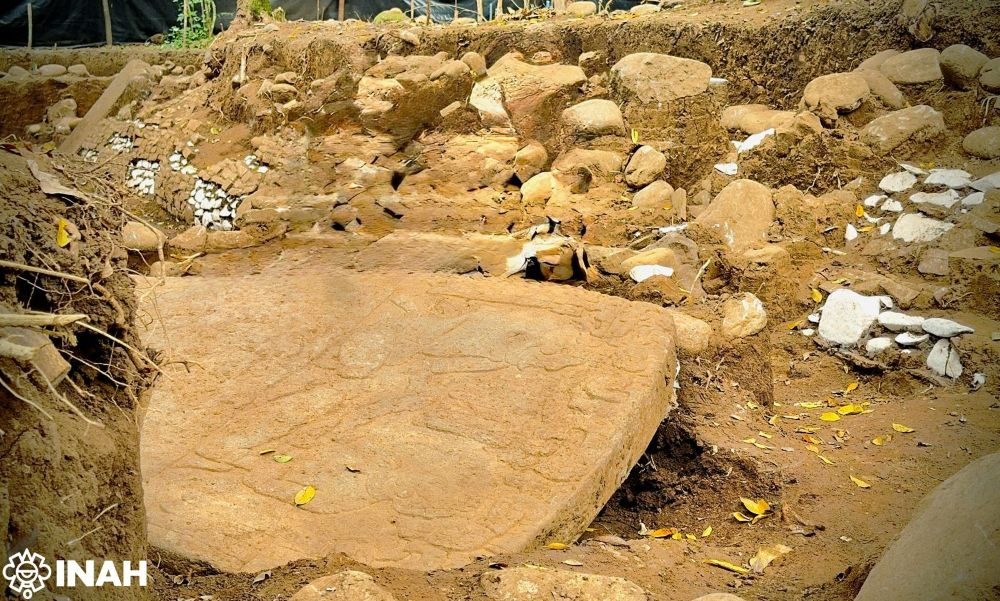
As part of the archaeological rescue project developed by the National Institute of Anthropology and History (INAH) in the San Lucas subdivision, in Coatepec, Veracruz, pre-Hispanic cultural vestiges were found, including remains of buildings of a civic-ceremonial nature that probably date from the Early Classic period (200-600 AD) and show characteristics never before seen in the region, according to an official INAH publication on its website. web.
“This discovery provides new knowledge about our past and reaffirms the importance of protecting heritage as a common good,” said Claudia Curiel de Icaza, Secretary of Culture of the Government of Mexico.
It is a platform—30 meters long by 12 meters wide—built with slabs and faceted limestone that is white in color and has a chalky texture. This characteristic was achieved in an induced way to decorate the walls, possibly through a type of firing. The ornamentation is made up of lines or figures similar to squares and circular stones on two of its sides, attributes that are not typical of the region and that had not been previously recorded, explains the INAH.
Associated with that structure was a monolithic sculpture measuring 1.88 meters high by 1.47 meters wide in its widest part and 0.68 meters in its narrowest part. Its thickness ranges between 22 and 25 centimeters and it has engravings that allude to a symbolic event, in which two elite figures, in a seated position and with elaborate attire, receive a fluid in a container from a divine entity located on a higher plane. One of them presents possible mayoid features.
Both the structure and the sculpture were found in good condition. The first will require restoration, consolidation and maintenance. Consolidants were applied to the second and any earth elements that could damage it were removed.
As part of the archaeological surveys that have allowed the recovery and identification of pre-Hispanic cultural materials associated with the structure, remains of charred corn deposited as offerings, buried vessels and a green stone bead fragmented into four parts were found. These materials will be sent to the laboratory for study, indicates the INAH publication.
The objects remain under the protection of the interdisciplinary group of specialists coordinated by the archaeologists of the INAH Veracruz Center Alberto Vázquez Domínguez and Lino Espinoza García, for their corresponding analysis.
Regarding the culture to which the materials could belong, although the term Totonac is recurrent to refer to the populations that developed between the Cazones and Papaloapan rivers, there is a lack of indicators of that civilization in the place. Therefore, specialists propose that it is a local culture with attributes of groups from the Gulf Coast.
The archaeological rescue work is carried out on a private property, which remains under field archaeological investigation since the end of 2025.
The project, authorized by the INAH Archeology Council, arose from a request for a change in land use to develop private urban infrastructure, since the area where the archaeological work is carried out, of approximately 12 hectares, is currently used for housing.
The rescue is part of the research that the INAH Veracruz Center has been carrying out on the periphery of the Campo Viejo archaeological site, where the San Lucas subdivision is located, since 2000. This work is aimed at research, protection and preservation of archaeological heritage, in addition to responding to the need to carry out more exhaustive studies.
It is worth mentioning that all economic, technological, specialized use resources, professional equipment, tools and support personnel have been provided by the owners of the property, who have shown interest in the discoveries and their subsequent dissemination, the institution explained in the publication.