
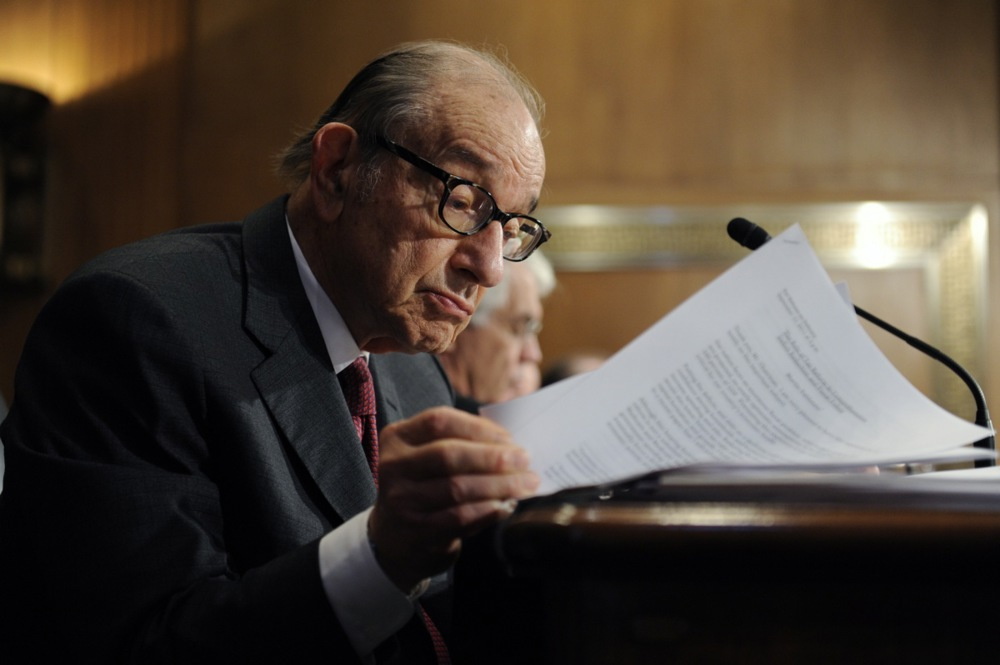
The American economist Alan Greenspan, one of the most influential figures in contemporary financial history and former president of the United States Federal Reserve (Fed), died this Monday at the age of 100 at his residence due to complications derived from Parkinson’s disease, reported his wife, NBC News journalist Andrea Mitchell.
Nicknamed the “Master,” Greenspan led the Fed from 1987 to 2006, becoming the second-longest serving president in the institution’s history, trailing only William McChesney Martin. During his 18 years at the head of the US central bank, he went through periods of unprecedented economic expansion, international crises and profound changes in financial markets, which established him as a global reference in monetary policy.
The Federal Reserve itself “deeply” regretted his death and highlighted that his contributions “to monetary policy and economic thought left a lasting mark on this institution, in the field of the economy in general and in the country.”
“During his 18 years at the helm of the institution, he guided the Federal Reserve through periods of notable economic expansion, as well as periods of considerable stress. Under his leadership, the Fed achieved a sustained era of price stability that favored economic growth and helped consolidate public confidence in the institution,” the agency said in a statement.
From jazz musician to architect of monetary policy
Born in New York in March 1926, Greenspan began his professional life far from the financial markets. He studied clarinet at the prestigious Juilliard School and served as a saxophonist in a jazz band that toured the United States.
As he recalled this Monday The Wall Street Journalwhile his groupmates took advantage of breaks to smoke or talk, Greenspan dedicated that time to reading books about great businessmen and financial figures.
That curiosity led him to study Economics at New York University, where he graduated in 1948. Later, he founded a successful economic consulting firm and began to get closer to national politics.
His influence in Washington was consolidated in 1968 as an advisor to Richard Nixon’s presidential campaign. He later held various positions during the administrations of Gerald Ford and Ronald Reagan, who finally nominated him in 1987 to succeed Paul Volcker as head of the Federal Reserve.
A key figure in the American economy
Greenspan served as Fed chairman during the administrations of Ronald Reagan, George HW Bush, Bill Clinton and George W. Bush, something unusual for such a high-profile economic figure.
Although he was identified with the Republican Party, he maintained a close working relationship with Democratic President Bill Clinton and his economic team, which reinforced his reputation as a defender of the political independence of the central bank.
During his management he faced challenges such as the stock market crash of 1987, the Asian and Russian financial crisis of the late 1990s, as well as the economic uncertainty after the attacks of September 11, 2001.
His ability to respond to these episodes earned him international recognition. The magazine time It even included him on its cover as part of the so-called “Committee to Save the World”, along with others responsible for global financial stability.
“He was an absolutely brilliant mind who saw the computer revolution coming before anyone else,” said Kevin Hassett, chief economist of the White House, in statements to CNBC on Monday.
The weight of the 2008 crisis
However, Greenspan’s legacy was marked by the events that followed his retirement.
A convinced defender of market self-regulation and financial deregulation, he promoted policies that allowed greater expansion of complex financial instruments and opposed imposing stricter controls on derivatives.
In addition, he supported aggressive cuts in interest rates that reached 1% in 2004, a strategy that years later was pointed out by some economists as one of the factors that contributed to the formation of the real estate bubble that led to the global financial crisis of 2008.
The criticism led many to consider him one of those indirectly responsible for the financial collapse. However, Greenspan rejected for years being attributed a decisive role in the crisis.
“I was praised for things I didn’t do. Now I’m blamed for things I didn’t do,” he said in an interview in 2008.
That same year, during an appearance before the US Congress, he acknowledged finding a “flaw” in his economic vision and admitted with “disbelief” that he had overestimated the ability of financial institutions to protect themselves and preserve the stability of the system.
A legacy of influence and controversy
Despite criticism, Greenspan remained a respected voice in international economic circles until his final years. His advocacy of central bank independence and analytical approach to monetary policy continue to influence the way many policymakers approach financial stability.
For the Federal Reserve, one of its main contributions was strengthening the credibility of the institution, an asset that it considers fundamental for the conduct of monetary policy.
With his death, one of the most emblematic figures of the modern economy disappears, admired for having guided the United States during a prolonged period of growth, but also questioned for decisions that continue to fuel the debate about the causes of one of the worst financial crises in recent history. His career encapsulates both the successes and contradictions of an era that transformed global finance.