
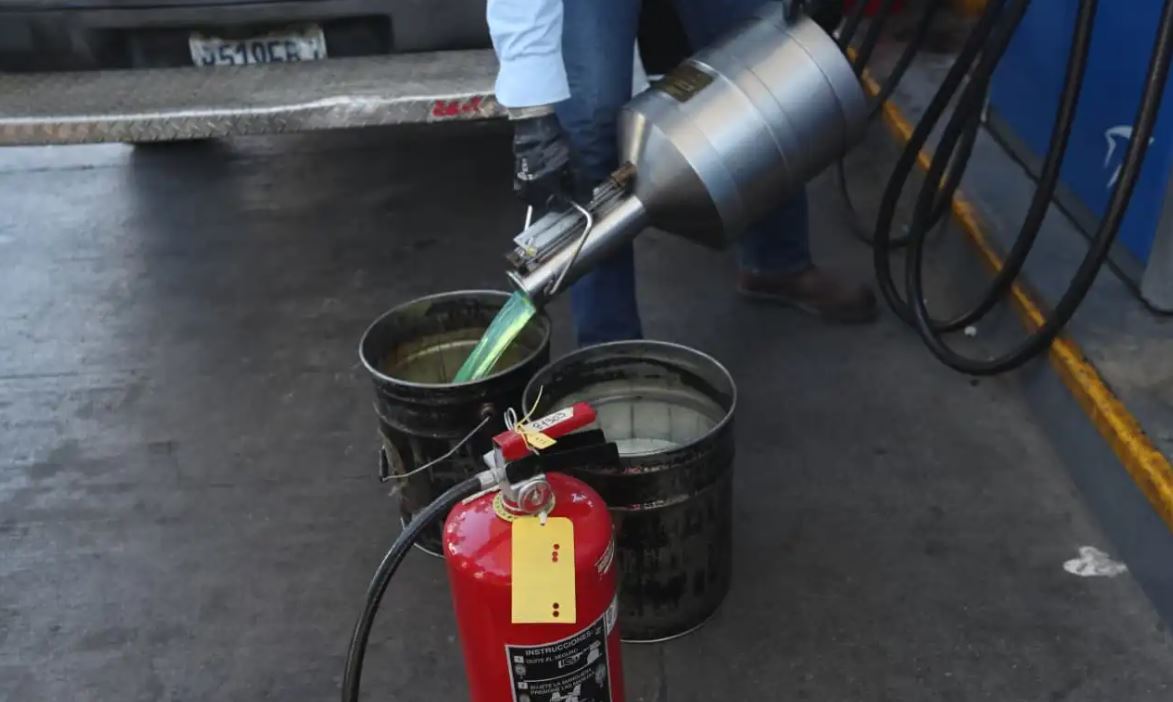
Around 500 service stations are not yet prepared to receive the gasoline mixture with 10% ethanol (E10) and they must carry out the cleaning and maintenance process, reported the Vice Minister of Energy and Mines in charge of Hydrocarbons, Erwin Barrios.
That figure represents around 25% of the 2,100 registered gas stations in the country.
“Removing the water from the tanks is the most important commitment that they must report so that we can validate the delivery of safe gasoline on August 21,” commented the MEM vice minister recently, after participating in a summons in Congress.
According to Government Agreement 257-2025, which contains the General Regulations of the Fuel Alcohol Law, the ethanol mixture policy comes into effect on June 30, but the Government reformed it through agreement 95-2026, with which between that date and August 21 the chain enters a stage of technical and operational implementation. Hence Availability for the final consumer at gas stations was postponed to August 21.
With the aforementioned modification, the National Fuel Alcohol Program begins this phase within the period established in the reforms, since the objective is to implement the technical verification, calibration, quality control, traceability and supply processes, aligned with the international standards applicable to fuel mixing programs, the MEM explained on June 4.
The official recently indicated that the gas stations are committed to achieving this and make the cleaning and maintenance report to the MEM, which, he explained, primarily refers to removing water from their tanks.
Barrios said that they look forward to the upcoming implementation of the ethanol mix and observe that all the actors involved in the chain have worked to be ready for June 30; However, he said that, as in any large project, there is a commissioning stage in which it is necessary to ensure that all parts, such as import, storage, transportation and delivery at the gasoline pump, work based on what is required.
During this period, we will work together with the entire supply chain so that “we can ensure that the gasoline that will be dispensed at all gas stations has regular and super quality, in accordance with the regulations,” said Barrios.
CONTENT FOR SUBSCRIBERS
“The government agreement did not remove the date of June 30 (for the validity of the mixture), it maintains it, but it gives a period of operationalization, that is, for all stages of the fuel to become operational: from the bringing of gasoline, the bringing of ethanol or the local purchase, the mixtures, transportation and delivery to the final consumer,” explained the official.
He said that it is a process that entails challenges, but Guatemalan fuel is being modernized, putting it in line with modernity, where more than 60 countries already use the mixture, including the US, Brazil, Argentina and Colombia.
Verifications
The entity in charge of verifying the 10% ethanol mixture is the MEM, which has responsibility for two fundamental aspects: quality and quantity, that is, that they deliver fully and that they comply with the characteristics established by the gasoline quality list, indicated the vice minister, and for this reason he insisted that the corresponding verification will be carried out, with sampling at all stages of supply.
He said that the mixture is made by the hydrocarbon importers and then the trucks or pipes in charge of taking the fuel to the gas stations receive it already mixed. Therefore, as mentioned as an example, at that time they can take samples to confirm that there is 10% ethanol, without prejudice to subsequent validations in transportation and at gas stations.
Regarding sanctions, he said that if any problem arises, those that already exist will be applied based on the Hydrocarbon Marketing Law. However, he warned that verification will be reinforced and “great attention will be paid to ensuring that those who are not prepared for it do not ship,” for which the tank must be completely clean of water. This requirement includes both import and storage facilities, as well as transportation pipelines and gas stations.
Retailers request specific protocols
Enrique Meléndez, executive director of the Guatemalan Association of Gasoline Retailers (Ageg), indicated that he still does not have information that would allow him to confirm or distort the figure.
The manager indicated that the records and level of preparation of the service stations are part of the verification carried out by the MEM, and that Ageg has been informing associates about the technical and operational requirements, in addition to promoting each operator to evaluate and adopt the corresponding measures according to their particular situation.
Last week he mentioned that information from service stations associated, as well as non-associated, who are approaching them to find out how the adaptation process is going.
CONTENT FOR SUBSCRIBERS
He added that in some stores the adaptation work is being done again because the process they carried out “did not suit them.”
Asked if all the stores could be ready by June 30 or until August 21, he commented that it was explained to them that the 30th is not a start date to ship to users and that for that date what the MEM set for them is that the tanks were free of water and had their respective controls; but within that period, until August 21, cleaning processes and other factors will still be implemented at service stations.
Officials from the MEM and the Ministry of Economy announced on June 18 that They are working with chain actors on a protocol for addressing user complaints.
However, Meléndez explained that the Ageg requests that adequate traceability of the product be ensured, they also request a specific protocol for the treatment of consumer complaints and that this define the responsibility of the service stations, which is limited to maintaining the stability of the mixture. This is because gas stations cannot assume responsibilities related to the condition of the vehicles or other aspects unrelated to the stability of the mixture, Meléndez added.
They also propose that there be an independent technical entity that determines these cases, to prevent the State from becoming judge and party, for which they will present a protocol proposal.