
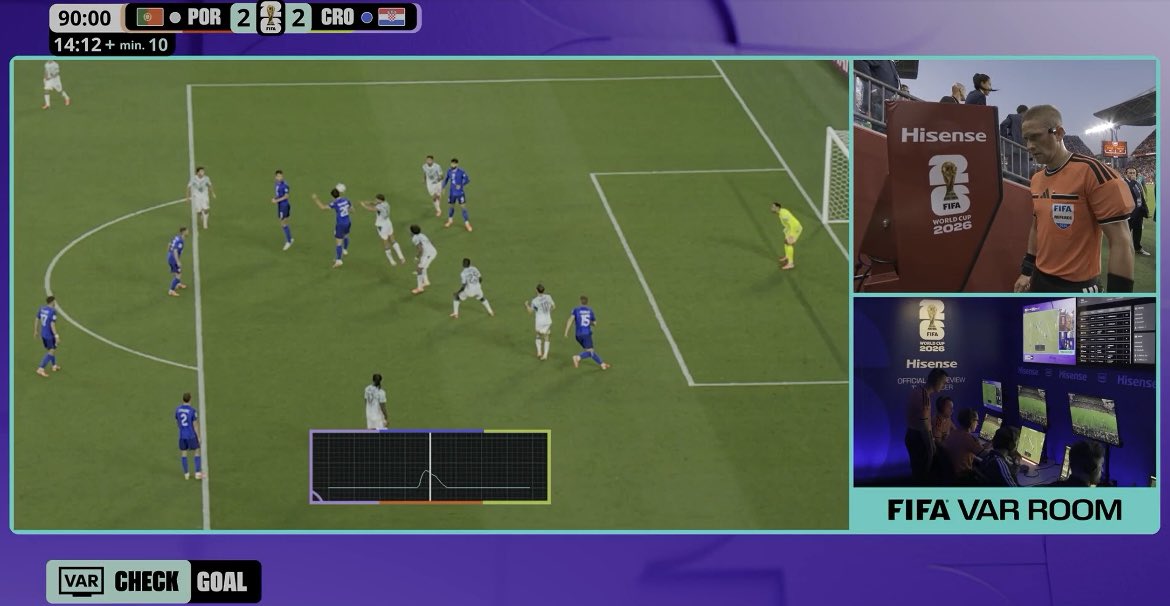
The controversy over the goal disallowed against Croatia in the final minutes of the duel against Portugal now has an official explanation.
This Thursday, July 2, FIFA published the data recorded by the technology Connected Ballincorporated into the official ball Trionda of adidas, to justify the referee’s decision that nullified the goal that would have meant 2-2 and sent the match to extra time.
According to the agency, the sensors installed inside the ball detected a contact of Igor Matanovićidentified with Croatia’s number 20, moments before the shot that ended up in the Portuguese net.
That touch, practically imperceptible to the naked eye, was enough to restart the action from a regulatory point of view and confirm that the scorer of the goal was in an advanced position at the time of contact with the ball.
“According to the data provided by the Connected Ball technology housed inside the Trionda ball, it was shown that there was contact by Croatia’s number 20, Igor Matanović, in the play prior to the goal against Portugal, which allowed the referee to correctly determine offside and disallow the goal,” FIFA explained on its official channels.
How does the smart ball work?
The official ball of the 2026 World Cup incorporates a Inertial Measurement Unit (IMU)a sensor capable of recording each contact with millisecond precision.
During television broadcasts, this information is represented by a graph similar to a heartbeat, which marks the exact moment a footballer touches the ball.
Combined with the semi-automatic offside system, this data allows the precise moment of contact to be synchronized with the position of the players, reducing the margin of interpretation in highly complex plays, according to FIFA.
A decision that changed the game
The action occurred in stoppage time, when Croatia was celebrating the tying goal that forced extra time against Portugal.
After the review of the VAR and the analysis of the technology Connected Ballthe goal was disallowed for offside, keeping the 2-1 score in favor of the Portuguese.
The decision generated intense debate among fans and analysts, especially since Matanović’s contact was practically impossible to detect without technological support.
With the ruling confirmed, Portugal sealed its classification to the round of 16 of the 2026 World Cup, where it will face Spain, while Croatia was eliminated in one of the most talked about refereeing actions of the tournament.