
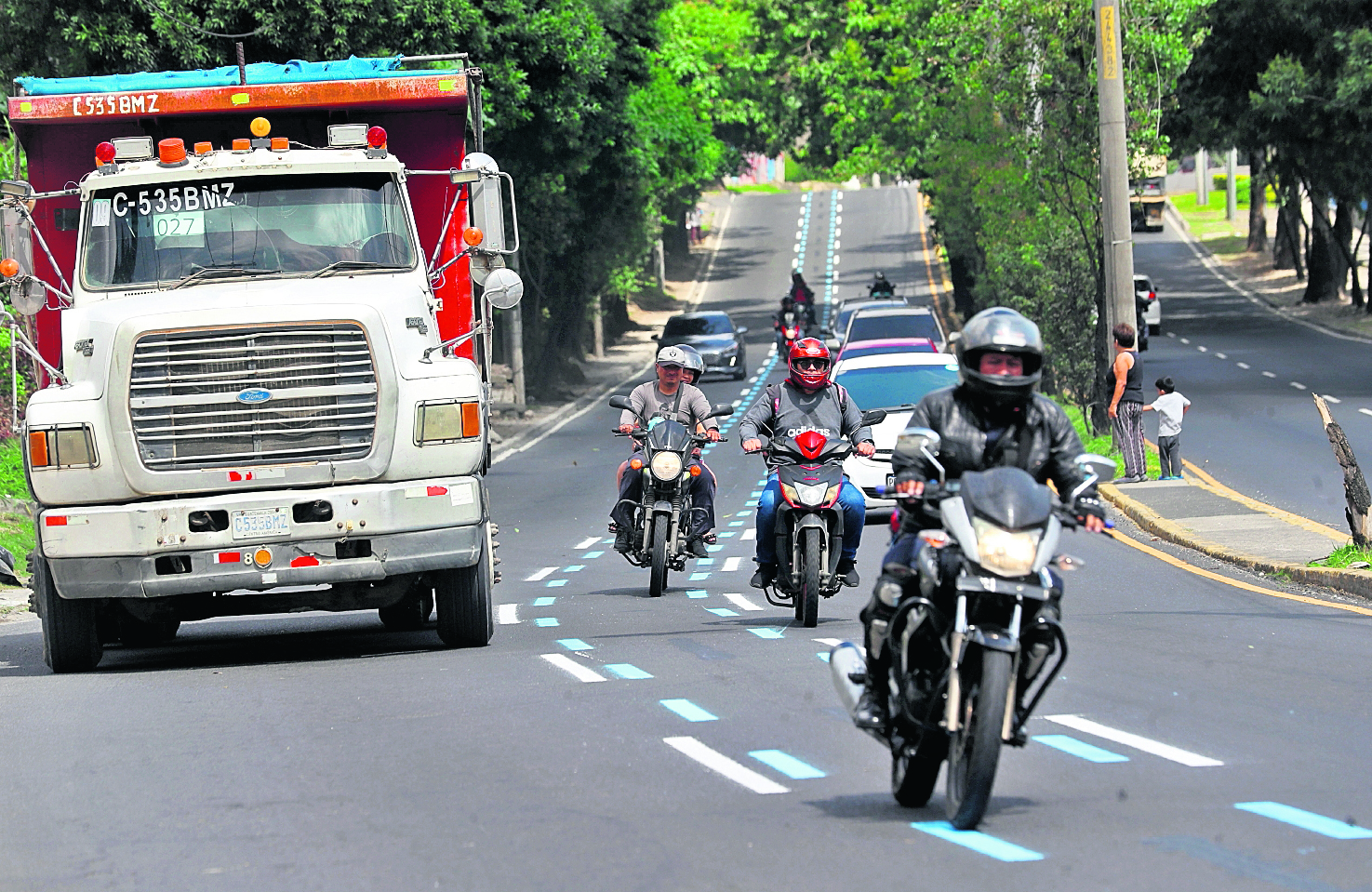
The fines imposed by the Traffic Department of the General Directorate of the National Civil Police (PNC) during the first five months of this year they increased by 37.8%compared to those applied to drivers in the same period in 2025.
According to the record of the National Traffic Safety Observatory of the PNC, between last January and May, 75 thousand 858 fines to vehicles of all types, 20,721 more than those recorded the previous year.
In the report, Motorists accumulate the highest number of violations: 61%. They are followed by trucks, with 11%; automobiles, with 9%; pickups, with 8%; trucks, with 6%, and other vehicles, with 5%.
In 2025, fines for motorcyclists were also at the top of the list, representing 52%, ahead of cars, which accumulated 13%; Trucks and pickups each accounted for 11%, and all other vehicles accounted for 13%.
That motorists are the most fined is related to the number of registered vehicles. The Superintendence of Tax Administration (SAT) reports that one of every two vehicles that circulate on the streets and highways of the country is a motorcycle.
Brenda Santizo, spokesperson for the PNC Transit Department, pointed out that the motorcycle is the most used means of transportation. In 2020, 1.73 million were circulating and, in 2026, the vehicle fleet amounts to 3.2 million, which represents a 85% growth. From that account, it is the vehicle with the highest incidence in traffic events.
Why are they fined?
The main violations are related to the driver’s license. Between January and May of this year, 37,020 penalties were imposed on drivers for not carrying the document during operations; he 68.9% of the cases corresponded to motorists. In addition, of the 15,564 sanctions for driving without having obtained a license, 75.5% also went to that group.
Santizo indicated that the fine for driving without a license is Q400, while driving with an expired document carries a penalty of Q300.
Another infraction that directly affects motorists is not wearing a protective helmet. In the five months analyzed, 1,608 fines were imposed, each for Q500as established by the Traffic Law and its Regulations.
Regarding this last aspect, the Motorcycle Study, prepared by the National Traffic Safety Observatory, indicates that, by 2023, only 41% of drivers of this type of vehicle used a helmet and that this practice was more frequent in Guatemala City than in the departments.
Santizo indicated that, in the operations carried out by the PNC Transit Department, it is also verified that the type of license corresponds to the vehicle that the person drives. In this case, 47 motorists were fined.
He added that the motorcycle is the most vulnerable vehicle when a traffic incident occurs: there is a 70% chance of injury to driver and passengercompared to 15% in a four-wheeled vehicle.
The National Traffic Safety Observatory reports that, in the period analyzed, there were 3 thousand 871 traffic eventsin which 3,231 motorcycles were involved. As a consequence, 2,768 people were injured and 654 died.
According to Santizo, the fine is a coercive measure that aims to make people aware and assume responsibility when driving. However, he regretted that this objective is not always achieved, since traffic events represent the main cause of violent death in the country.
“In the end, what is intended is to contain and reduce accidents, despite the growth of the vehicle fleet,” he added.
Operational
The Municipal Traffic Police (PMT)—there are 80 authorized—carry out operations within the urban area of their jurisdiction, where they can impose fines. The Traffic Department of the PNC, for its part, has jurisdiction throughout the national territory and can sanction on national and Central American routesaccording to Santizo.
Inter-institutional actions are also carried out in which the Traffic Department relies on the PMT to carry out routine operations, during which the vehicle documentation is verified and that drivers do not drive under the influence of alcohol. Likewise, operations are carried out against clandestine motorcyclist races in areas such as the Inter-American highway.
Santizo indicated that traffic is a system codependent on factors such as infrastructure, roads and climate, to which are added risks such as speed, alcohol consumption, fatigue, distractions behind the wheel and recklessness of drivers and passengers.
In this context, one of the main challenges of the Transit Department is the excessive growth of the vehicle fleet compared to the available human resource, which is insufficient to contain and reduce traffic events that happen daily.
“Here we are betting on conscience, on individual responsibility, that 90% of traffic events can be prevented, because they are not accidents as such, but rather traffic events in which people are more exposed, more vulnerable and, even so, they do not take precautions or prevent danger,” he said.
Part of the work carried out by the institution consists of providing road safety education to students in schools, as well as developing operations on the roads to prevent traffic events.