
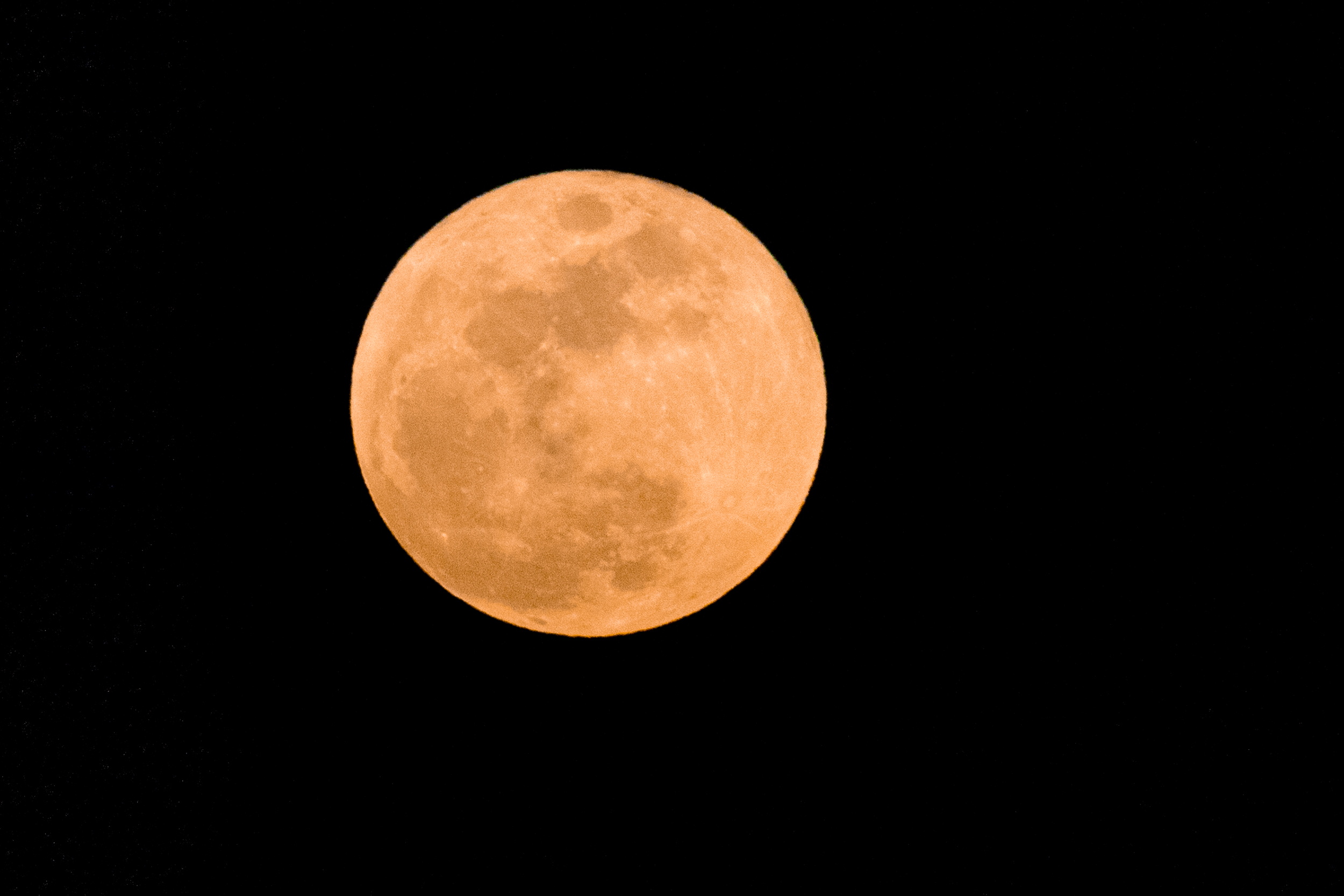
Lunar eclipses are among the oldest astronomical phenomena that humanity has observed and recorded throughout its history.
Since ancient times, different civilizations have interpreted these events as signs of a mystical or religious nature, while today science explains them as the result of a particular alignment between the Sun, the Earth and the Moon, in which our planet comes between both stars and projects its shadow on the lunar surface.
These types of events, along with solar eclipses, meteor showers or supermoons, are part of an astronomical calendar that arouses interest among both professional astronomers and amateur observers, since, on many occasions, they can be seen with the naked eye and without the need for specialized instruments.
In this context, Guatemala is preparing to witness one of these phenomena: a partial lunar eclipse that will take place on the night of August 27 to 28, 2026 and that, according to specialists, will offer a particularly notable view from national territory.
What does this phenomenon consist of?
A partial lunar eclipse occurs when the Moon passes through only a portion of the umbra, which is the densest and darkest part of the shadow cast by the Earth in space. Unlike a total eclipse, in which the satellite is completely hidden and adopts a reddish hue in its entirety—a phenomenon popularly known as a “Blood Moon”—in a partial eclipse, a portion of the Moon remains illuminated while the rest becomes progressively darker.
According to Eleonora Poitevin, president of the Guatemalan Astronomy Association (AGA), the eclipse on August 27 will reach a partiality of 96%, that is, almost the entire lunar disk will be covered by the Earth’s shadow. The entire event, from its beginning to its conclusion, will last approximately 5 hours and 38 minutes.
Schedules to observe it from Guatemala
According to the Time and Date site, in Guatemala the eclipse will begin around 7 p.m. and end around 1 a.m. on August 28, and will develop as follows:
- 19:23 – The penumbral eclipse begins, the moment when the Earth’s penumbra begins to touch the lunar surface. This phase, however, is not perceptible to the naked eye.
- 20:33 – The partial eclipse itself begins, when the Moon comes into contact with the umbra and begins to acquire its characteristic reddish tone.
- 22:12 – The maximum eclipse occurs, the moment in which the Moon is closest to the center of the Earth’s shadow, located at an approximate height of 53° above the horizon.
- 23:51 – The partial phase of the eclipse ends.
- 1:01 a.m. on Friday, August 28 – The penumbral eclipse concludes, bringing the phenomenon to an end.
During the course of the night, the Moon will gradually move across the sky, starting in a northeasterly direction and reaching heights of up to 66° above the horizon in the final phases of the event.
A visible phenomenon without the need for special equipment
Poitevin explained that, during this eclipse, the Earth’s shadow will cover a considerable part of the Moon, although there will be no point on the planet from where the satellite can be observed completely obscured. Despite this, the specialist highlighted that the magnitude of the phenomenon makes it “a beautiful spectacle” for those who have the opportunity to witness it.
As it is an event visible to the naked eye, no telescopes, binoculars or special filters will be required for its observation, which is why it is expected to be one of the most talked about astronomical phenomena of the year in the country, as long as weather conditions allow it.
Recommendations to enjoy the eclipse
For those who wish to witness this phenomenon, astronomy experts often suggest some basic considerations that make observation easier:
- Find a place with a clear horizon.
- Stay away from the light pollution typical of urban areas, since artificial lights can make it difficult to appreciate the reddish hues of the satellite.
- Check the weather forecast in advance, given that cloudiness is one of the main factors that can prevent or limit the observation of the phenomenon.
- It is not necessary to have telescopes or binoculars, although these instruments can help you appreciate the change in tone on the lunar surface in greater detail.
- Consider the duration of the event when planning the observation, since, as it lasts almost six hours, it is possible to choose to witness only the phase of greatest interest, corresponding to the maximum of the eclipse around 10:12 p.m.