
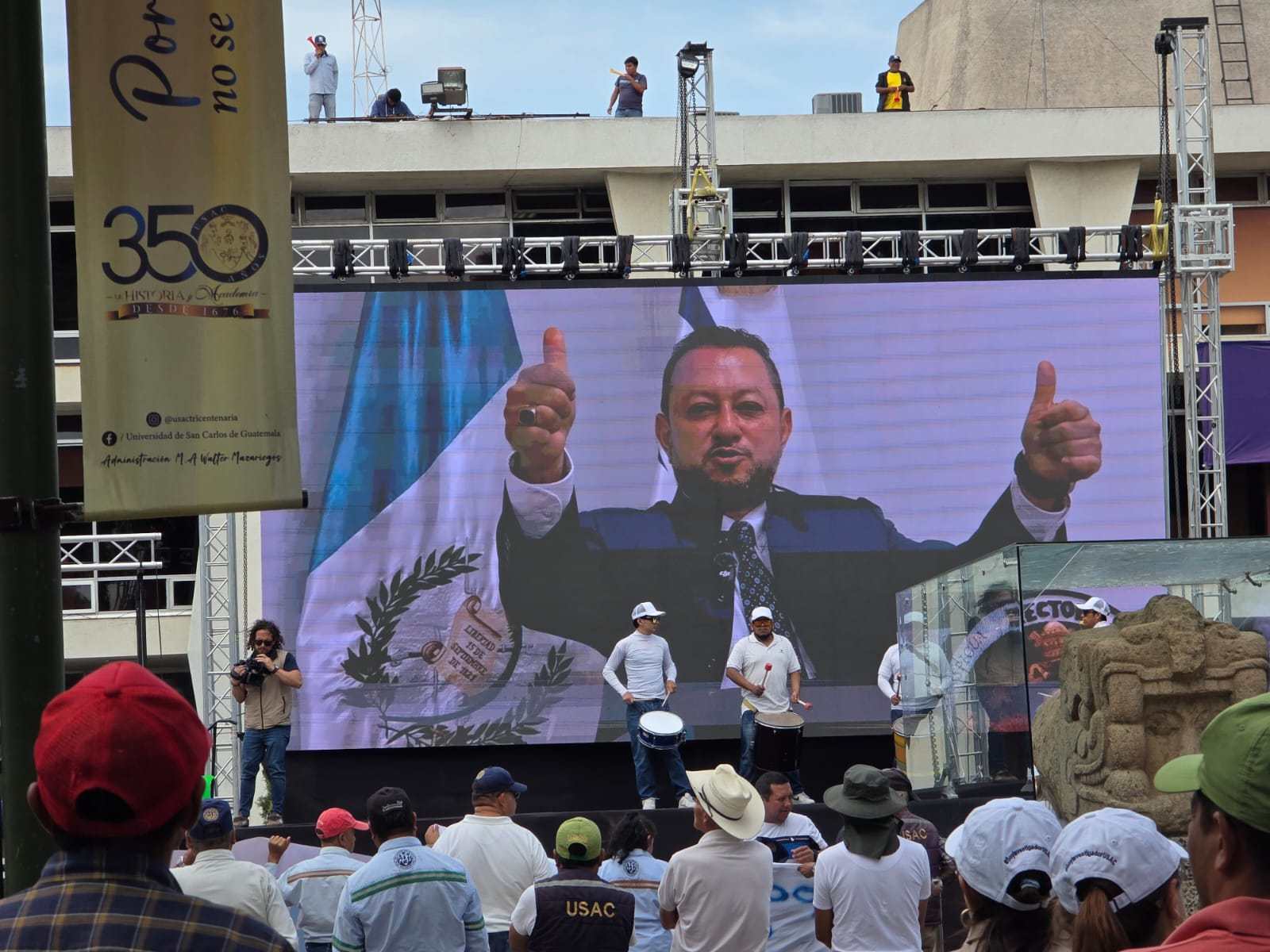
Walter Mazariegos He began his second term on July 1 as rector of the University of San Carlos de Guatemala (Usac) without presenting the settlement from the Comptroller General of Accounts (CGC). Hours later, during a session of the Higher University Council (CSU), the legal opinion was presented that maintains that this requirement is not required for the position.
In the session of the Higher University Council (CSU) on July 1, the director of Legal Affairs of the University of San Carlos de Guatemala (Usac), Astrid García Castillo, presented the opinion on which Walter Mazariegos based himself to begin his second period in the rectorate, despite the lack of settlement that the CGC extends to officials.
“The Transitory Certificate of Non-existence of Claim of Positions is not required for the position of rector of this house of higher education, since it is not established in the Organic Law of the University of San Carlos of Guatemala, which prevails over any other ordinary law, in accordance with the principle of legal specialty, which is also clearly regulated in article 13 of the Law of the Judicial Body,” said García, who acted as interim secretary of the Council while he was ratified in that position Luis Cordón Lucero.
The report that García read in the session, according to information that was accessed, indicates that the only ones required to present the CGC certificate are the candidates for popularly elected positions, according to the Electoral and Political Parties Law. Regarding the legal opinion, there was no deliberation or vote, and no document was shared with the advisors, according to internal university sources who asked not to be identified.
A representative of the professional associations before the CSU reported that the session began at approximately noon and lasted for two hours, but there was no mention that Mazariegos was taking office at that time; only issued a thank you speech.
“He was already self-appointed,” he said.
García said that the session was based on the minutes of April 8 and 17. With the first of the minutes, the University Electoral Body (CEU) declared Mazariegos elected and, with the second, the CSU ratified that decision. One hour before that meeting, Mazariegos posted a video on Facebook in which he assured that that day, at 7:30 a.m., he signed the administrative record with which his 2026-2030 period began.
The specialty of the Organic Law of the USAC, on which García based his argument, does not apply in this case because the functions of the rector are public and are subject to other regulations, as well as the supervision of the Comptroller’s Office, said Edwin Orozco, lawyer for the opposition movement San Carlos Dignidad y Rescate (Dire).
«Why did (the USAC leadership) indicate that the Administrative Litigation Law had to be applied for the exclusion of electoral bodies? […]”They are making selective use of the norm when it suits them for their perverse purposes,” said Orozco.
The Dire group maintains that Mazariegos’ permanence in the rectorship of the USAC is illegal not only because he came to office thanks to the annulment of opposition voters and the alteration of the quorum of the body in charge of the election, but because those who have managed State assets and lack settlement cannot apply for state positions or jobs, in accordance with the Law of Probity and Responsibilities of Public Officials and Employees.
They also consider that the lack of this record, added to the 17 complaints that the Public Ministry (MP) is investigating against the rector – among them the three presented by the CGC – causes him to fail to meet the merits of capacity, suitability and honesty required by the Constitution.
The defense of Mazariegos’ continuity was based on the interpretation that the Organic Law of the USAC prevails over other regulations. According to the rector during the first session of his new term before the CSU, this argument was prepared by the university’s team of lawyers.
Free press He sought Walter Mazariegos’ opinion on the development of the last CSU meeting but did not respond to the messages sent to his phone.
The team of lawyers
“If there is one thing that San Carlos has, it is a great team of lawyers and a great Directorate of Legal Affairs,” Mazariegos said at the first CSU meeting of the new rector’s term, after supporting García and ensuring that his legal team will continue to defend itself against “the narratives” about his lack of settlement.
“If San Carlos has something, it is a great team of lawyers and a great Legal Affairs Department.”
Walter Mazariegos, rector of USAC
The group of USAC lawyers has been key to the interests of the current administration. The opinions emanating from the Directorate of Legal Affairs have served for the CSU – leaning in favor of the rector, although with 24 of its 41 positions expired – to adopt decisions such as annulling opposition electoral bodies, endorsing the two questioned elections of rector, modifying internal regulations of the university or hiring trusted personnel.
The legal director herself is close to Mazariegos. García Castillo was a member of the Innova group, which promoted the candidacy of the current rector in 2022, and was one of the people who elected him four years ago.
Among the legal consultants is Adelupe Jocabed Rojas Castillosubstitute for the rector in the commission that nominated candidates to the Supreme Electoral Tribunal (TSE) this year and who, in 2022, as a law student, was a member of the commission that overlooked that Mazariegos did not meet the minimum number of years of teaching, one of the mandatory requirements to be rector.
Álvaro Ricardo Cordón Paredes has also intervened in legal proceedings promoted by opposition groups against the CSU. He was a substitute magistrate of the TSE and is currently secretary general of the Regional University.
Another advisor to the rector on legal issues is Juan Carlos Godínez Rodríguez, who assists him with situation analysis and in criminal, labor and administrative matters, according to his reports available in Guatecompras. In 2021, Godínez was included in the Engel List of corrupt and undemocratic actors in the United States, after the MP documented a meeting he held with businessman and political financier Gustavo Alejos Cámbara to, supposedly, manipulate the election of magistrates.
Likewise, one of the principal collaborators of the rector is Luis Cordón Lucero, ratified as general secretary of the Usac. Cordón is also secretary of the newly created Juan José Arévalo Bermejo University, associated with Mazariegos, and was the husband of Julia Rivera Aguilar, appointed five months ago by the CSU as a judge of the Constitutional Court (CC).
Mazariegos’ lack of severance pay was mentioned as a possible obstacle to assuming the position, but the rector has downplayed it, as he explained during the meeting.
They question actions of the Comptroller’s Office
Mazariegos and the director of legal affairs, Astrid García, pointed out to the directors that, with the three complaints that the CGC filed against the rector, due process and his right to defense were disrespected because, before denying the settlement, the institution should have notified him of the start of an audit, granted him a hearing and given him space to discuss the findings.
In the opinion presented by García, it is even questioned that the person who reported is a marketer and that this does not grant him legal competence to determine facts that may constitute a crime.
Furthermore, the analysis presents a contradiction because it asserts that the CGC transgressed the rector’s rights to opt for and hold public office by preventing him from extending the transitional record, for which he cited jurisprudence of the Inter-American Court. However, at the beginning of her argument, the lawyer assured that the settlement was not applicable to the rector of USAC.
Asked about this, the Comptroller’s Office responded that the complaints against Mazariegos originated in a special audit examination of the CSU, which the MP Anti-Corruption Prosecutor’s Office requested on February 26 and that at the request of that institution it is carried out under confidentiality, according to article 314 of the Criminal Procedure Code.
“In these specific cases, it is not up to the CGC to make notifications or any type of actions as in a normal audit, initiated ex officio by the entity,” the institution added.
On June 23, the director of Complaints Attention of the Comptroller’s Office, Nery De León, explained in a summons to deputies from the Vos party that the complaints against the Superior Council, chaired by Mazariegos, are for omission of calls for the election of representatives of academic units, approval of mechanisms for teacher hiring contrary to the Organic Law of the Usac and for the participation of CSU members with expired terms of office.
De León pointed out that Mazariegos did not have the qualifications to either opt for or be elected rector of the USAC because the complaints were filed between March 24 and 27, before the rector election held in Antigua Guatemala on April 8. A month after that act, the CGC ratified the complaints in the MP and the special examination continues.
During the CSU session in which the legal argument that allows him to occupy the rectorship without termination was presented, Walter Mazariegos also issued a warning about the questions and doubts about the legitimacy of his re-election.