
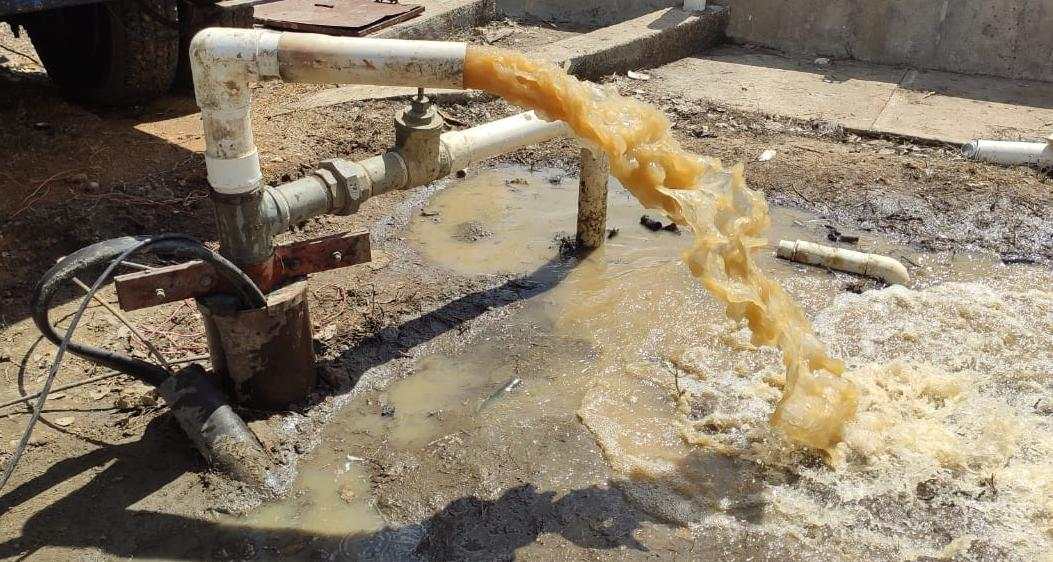
Angelica* approached, like every morning, to the artisanal well that supplied several families in a rural town north of the Guatemalan capital. The owner of the water fountain had generously allowed rowdy children and women to stock up on the liquid for years.
That morning Angelica got the surprise of her life. The night before, heavy rain caused the capacity of a drain from neighboring colonies that passed near the well and it had grown so much that it overflowed its channel and the sewage leaked everywhere.
Towards mid-morning, everyone around the well was already sadly seeing the water they were drawing: a cloudy liquid with a foul odor. Their major water supplier had become contaminated.
Angelica does not live in a water-poor country. Lives in Guatemala: one of the countries with great water wealth.
Despite this water wealth, Guatemala is the the only country in Central America that does not have a water law, which negatively impacts the quality of life of its population, that sees the resource increasingly limited, often contaminated or rationed.
What is the water law?
Since 2016, a document issued by the Congress of the Republic explains that the objective of the water framework law is to “regulate everything related in general to the existing water resources in the country, be they surface, underground, residual, atmospheric and of any other nature, in their different phases, forms and physical states, as well as regarding its public domain, conservation, protection, management, administration, exploitation, use and enjoyment.”
In one of the recitals, said document cites the United Nations, in its resolution 64/292, dated July 28, 2010, where it was recognized that the right to drinking water and Sanitation is a human right essential for the full enjoyment of life and all human rights, recognition assumed in turn explicitly by the Human Rights Council of that organization.
In an explanatory video, published on the Facebook network, in June 2025, the Ministry of Environment and Natural Resources (Marn), specified the water law as “the first step for Guatemala ensure water for present and future generations, putting clear rules in place to protect sources and ensure fair and equitable access for all.”
And in January 2026, the Economic and Social Council of Guatemala (CES) described the regulation and management of water resources as “one of the country’s most urgent historical debts.”
sterile attempts
Since 1985, the Political Constitution of Guatemala establishes, in its article 127, that there must be a specific law that regulates the water regime in the country: “All waters are public domain assets, inalienable and imprescriptible. Their use, use and enjoyment are granted in the manner established by law, in accordance with social interest. A specific law will regulate this matter.”
That is, the Constitution itself has more than 40 years waiting for Congress to legislate access and use of the liquid.
Since then, Congress has known at least 13 water law initiatives, but none has become a decree.
Between shadows and lights, each government promises. Each legislature postpones. And meanwhile, the water becomes contaminated, the aquifers drop, and the most vulnerable communities continue to pay the most the price, as studies by public and private institutions have already demonstrated.
As confirmed Free pressciting the agency EFE In a March 2017 article, Guatemala is the only country in Central America without a water law. Honduras, El Salvador, Costa Rica, Nicaragua, Panama, and even Belize, have some legal framework that regulates the use, access and protection of water.
Why is it not moving forward?
According to experts who have studied the issue for years, such as agricultural engineer Antonio Reyes Romero, there have been three forces blocking the law: the lack of political will of the Executive and Legislature, the opposition of wealthy sectors that do not want access to water to be regulated, and the historical mistrust of some indigenous communities who fear losing control over their ancestral sources.
For Reyes Romero, who for years has been dedicated to monitoring the resource in northern areas of the department of Guatemala, despite the fact that there have been working groups to address the issue, personal interests have prevented its approval.
“It is definitely urgent to approve this law as soon as possible. Why? Because water is a natural good that should be free for the population, because that is how it was created,” said Reyes Romero, who added that, unfortunately, today he profits from it.
Until now, The result of the efforts is a law that everyone says they want, but that no one ends up approving.
Science speaks, no one listens
In 2022, researchers from the Universidad del Valle de Guatemala (UVG), together with RTI International (Research Triangle Institutein English), analyzed the tap water in 113 homes in Guatemala City. The results were uncomfortable: in the 63% of households, At least one metal exceeded the maximum permissible limit established by Guatemalan law. Arsenic, a compound associated with neurological, kidney and cancer diseases, appeared out of the norm in the 33.6% of the samples. Lead, at 8.9%.
That same year, a consortium formed by the Foundation for Water Conservation in the Metropolitan Region of Guatemala (Funcagua), the Universidad del Valle de Guatemala (UVG), the Rafael Landívar University (URL), and the World Wildlife Fund (WWF), published the Report of the Water Status of the Metropolitan Region of Guatemala. His diagnosis was clear: The city grows, the demand for water grows, but the infrastructure does not. And on top of that, climate change will reduce the future availability of the resource.
In 2025, the Guatemalan Ministry of Health monitored 6,412 water supply systems throughout the country; the result, More than half do not meet quality standards.
Human Rights Watch (HRW) published a 92-page report in July 2025 titled Without water, we are nothing, based on interviews with 108 people in communities indigenous people of Jalapa, Santa Rosa and Totonicapán, and in requests for information from the Guatemalan government itself.
Guatemala does not have a sufficient system to measure the quality of its water. It does not measure residual chlorine systematically. It does not constantly evaluate microbiology, this is supported by reports from the Ministry of Public Health and Social Assistance.
Simply put, you cannot tell a community with scientific certainty: This water source is safe, or this one is not.
The cost of doing nothing
This is not just a technical or political problem. It is a problem of human lives.
According to the World Health Organization, the mortality rate in Guatemala from causes related to unsafe water and poor sanitation was 15.3 deaths per hundred thousand inhabitants in 2019. More than double that of any other country in Central America.
Almost one in two children under five years old in Guatemala he suffers from chronic malnutrition. And malnutrition and water are deeply connected: households without access to water and adequate sanitation are 70% more likely to be food insecure.
Women bear this burden the most, literally and figuratively. Two-thirds of adults who report carrying water are women. Hours that are not dedicated to studying, working, or resting. Hours that the system steals from them, because no one guarantees the right to water.
Another fact that puts the problem in perspective: Guatemala has more fresh water per person than most countries in the worldaccording to a report by Human Rights Watch, published in May 2025.
Likewise, the report of the Economic and Social Council of Guatemala warned of this abundance: “although Guatemala has a high availability of water, the storage capacity is less than 2%, which implies that about 98% of the resource drains away without being used (…) “Added to this is a crisis of contamination and overexploitation of groundwater.”
So, then, the problem is not the amount of water. The problem is management, or rather, the absence of it.
And now what?
The government of President Bernardo Arévalo announced in 2024 his intention to present a water law before Congress in 2025. To do this, the Ministry of Environment and Natural Resources launched a national participatory process, regional consultations, academic forums, working groups, and in this way build a proposal with consensus.
It’s a real first step. If there was real political will, the initiative I would already be in Congress. A participatory process that lasts months can be genuine progress, or it can be another way of postponing the inevitable, according to Reyes Romero.
Read also: El Niño will reduce rainfall and raise temperatures even until 2027
For engineer Reyes Romero, Guatemalan society must organize and put more pressure on Congress so that the water law is approved, “before all water sources, both underground and surface, are privatized.”
Meanwhile, residents like Angélica remain in limbo. The well, once cool and clear, remains contaminated.
Angélica and her family, like the neighboring residents, now must buy between Q10 and Q15 a barrel of water, and more than Q100 a water tank, from tanker trucks or from jugs filled with a liquid out of sanitary control from “purification plants” that have proliferated rapidly in the country, in areas where the minimum wage per day for non-agricultural activities is Q131.58 per day.
All because, as Reyes Romero recalls, the nation lacks a political will that, Unlike water, it does not fall from the sky…
*Angélica: fictitious name.
This is a collaborative report within the framework of the Scientific Journalism Course, taught by the Colombian social communicator, scientific journalist, researcher, editor and teacher Lisbeth Fog, sponsored by the National Secretariat of Science and Technology (Senacyt), of the Government of Gutemala.