
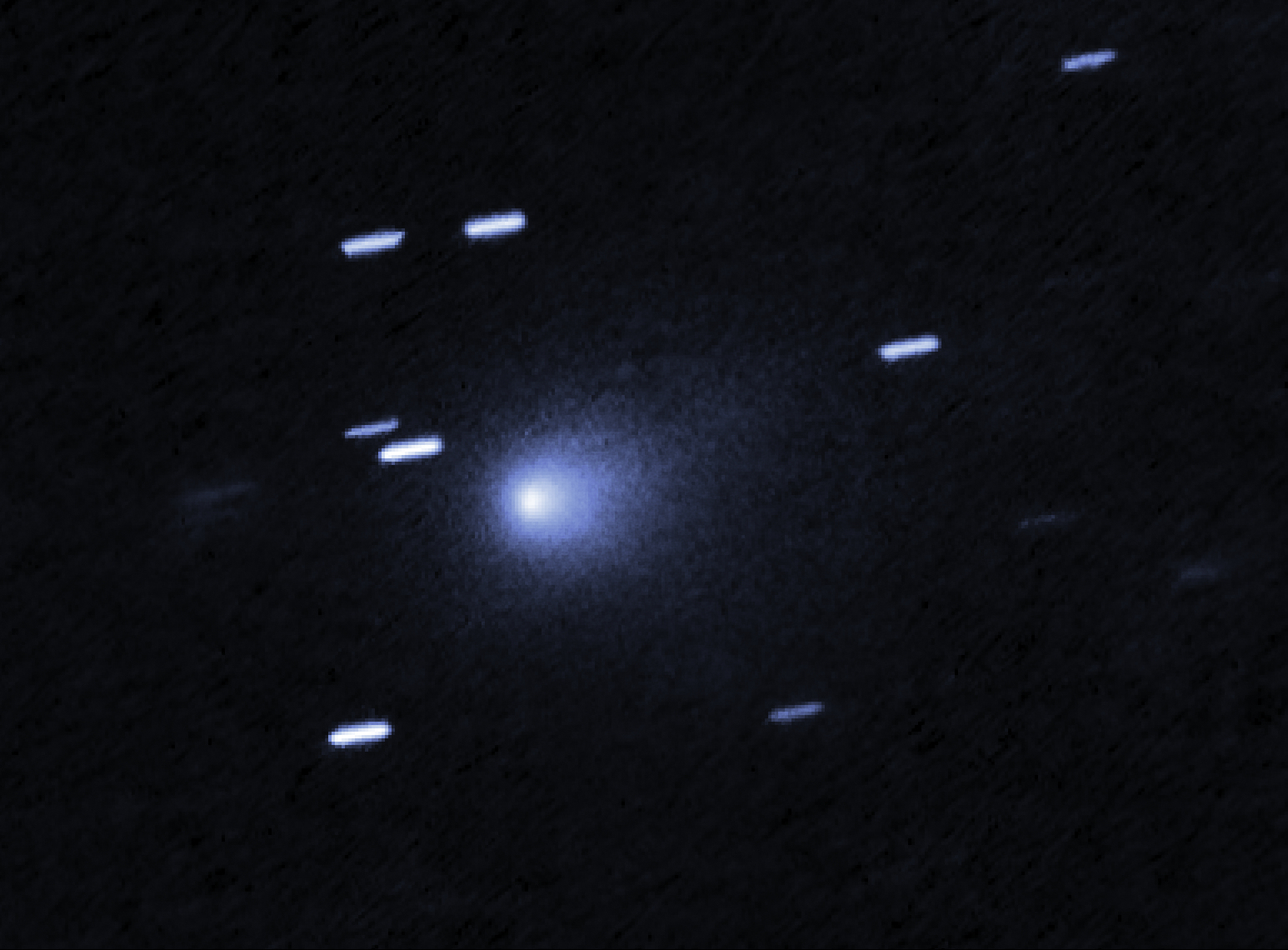
The world scientific and astronomical community analyzes the interstellar comet 3I/ATLAS to determine what its origin would be. According to experts, its characteristics suggest that it could be older than the Sun.
Last December, interstellar comet 3I/ATLAS began to move away from the Earth; However, the mystery surrounding this discovery has prompted new research into its origin, its characteristics, and even the star system from which it comes.
The chemical fingerprint of the comet could help determine its age, since, according to the National Aeronautics and Space Administration (NASA), it would have traveled for billions of years.
When was the interstellar comet 3I/ATLAS discovered?
NASA reports that the ATLAS survey telescope, located in Río Hurtado, Chile, reported on July 1, 2025 the first observations of a comet from interstellar space.
The agency adds that observations prior to the discovery were compiled through the archives of three ATLAS telescopes located in different locations around the world, whose records date back to June 14.
Why was it called 3I/ATLAS?
The name 3I/ATLAS comes from the fact that it is the third confirmed interstellar comet, reflecting its origin outside the solar system, according to NASA.
The object was first observed by the ATLAS telescope (Asteroid Terrestrial-impact Last Alert System). For this reason, it received the designation 3I/ATLAS: 3, as it is the third confirmed interstellar object; I, for interstellar; and ATLAS, for the telescope that made the discovery.
What are the known characteristics of the 3I/ATLAS?
NASA indicates that the color, speed and direction of 3I/ATLAS match the expected characteristics of a comet. It has “an icy core and a bright cloud of gas and dust that surrounds it, whose emission increases as it approaches the Sun.”
Another notable feature is that 3I/ATLAS follows a hyperbolic trajectory, “meaning it was moving too fast to be trapped by the Sun’s gravity and therefore did not follow a closed orbit around it.”
Where does the 3I/ATLAS come from?
Data from the space agency indicate that 3I/ATLAS formed in another star system and that, for some reason, it was ejected into interstellar space, where it wandered for millions or even billions of years before reaching the solar system.
We’re continuing to observe the interstellar comet 3I/ATLAS as it heads out of our solar system.
Have questions about the comet? Join us Friday, Dec. 19 for a 3I/ATLAS @Reddit AMA with NASA experts: https://t.co/yzlYmjbQki pic.twitter.com/TbBPj1cWeN
— NASA (@NASA) December 18, 2025
What does the analysis of 3I/ATLAS chemical fingerprints indicate?
According to a study carried out with the Very Large Telescope (VLT) of the European Southern Observatory (ESO) and published in the journal Nature Astronomythe unprecedented brightness of 3I/ATLAS made it possible to measure the comet’s isotopic ratios, that is, the relative amounts of different forms of the same element.
Using the VLT’s UVES instrument, researchers measured the ratios of carbon and nitrogen isotopes present in cyanide molecules in the gas surrounding the comet, which serve as an indicator of its origin.
“Unlike comets in our solar system, this interstellar visitor exhibits unusually high isotopic ratios of carbon and nitrogen,” says Aravind Krishnakumar of the University of Liège and co-author of the study.
The analyzes indicate that the comet probably formed in the outer regions of an ancient star with low metallicity, that is, with few elements heavier than helium. It is believed that this type of star formed when the universe was much younger and had less chemical richness.
Therefore, the team suspects that 3I/ATLAS originated around a star much older than the Sun. Although this hypothesis has not yet been confirmed, the researchers point out that the evidence obtained by different teams suggests that 3I/ATLAS could be more than twice as old as the Sun.
What is the chemical fingerprint that you analyzed?
The chemical fingerprint is a unique signature of light that functions as a kind of birth record and could help establish the origin and conditions under which the comet formed.
Using this technique, scientists analyzed the isotopic ratios, which allow us to infer the place and time in which it originated.
According to the analysis, 3I/ATLAS presents proportions of carbon and nitrogen that are different from those observed in the solar system, but compatible with those of a low metallicity star.
🚨 Scientists just uncovered another anomaly in the mysterious interstellar object 3I/ATLAS. 👀
New James Webb Space Telescope observations show its dust doesn’t match most known Solar System comets, raising fresh questions about where it came from.
Harvard astronomer Avi Loeb… pic.twitter.com/YZCBltImkl
— 3I/ATLAS updates (@Defence12543) July 1, 2026