
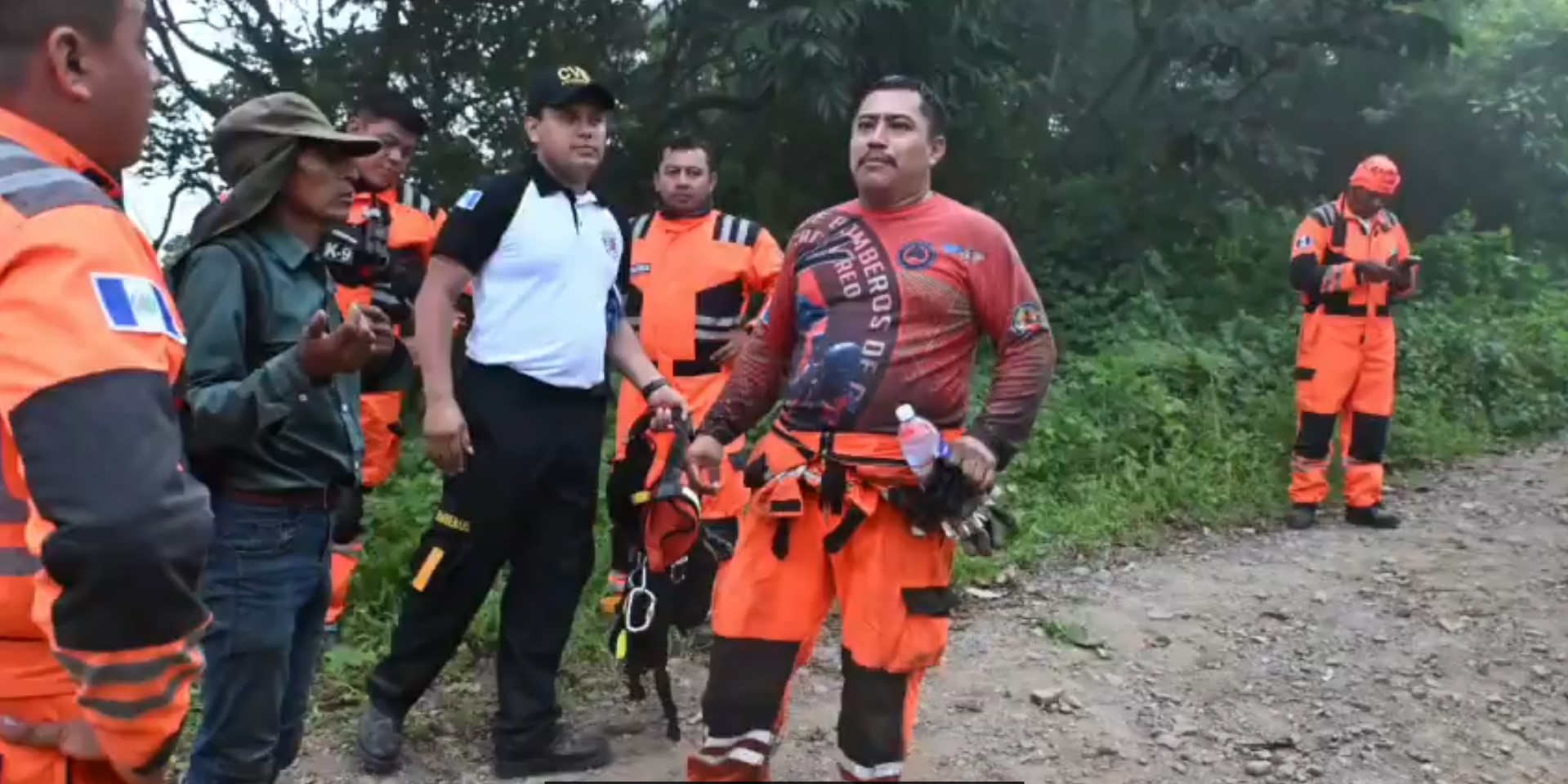
The uniform, helmet and rescue equipment often hide fatigue, fear and uncertainty. However, behind them there are people who also feel exhaustion, thirst and fear. That was the experience experienced by galonist Rogel Mazariegos, a member of the Air Rescue Section of the Benemérito Voluntary Firefighters Corps, who remained isolated in the mountain after bad weather forced the suspension of air operations during the recovery efforts for the victims of the TG-PIP aircraft accident, which occurred in San Miguel Pochuta, Chimaltenango.
The tragedy left four dead: the three occupants of the Beechcraft V35 Bonanza plane and the First Specialist soldier Nicolás Felipe Ordóñez Canto, a member of the Humanitarian and Rescue Brigade of the Guatemalan Army, who disappeared while participating in the operations and was later found dead.
Mazariegos remembers that the emergency call surprised him while he was stationed at the 24th Volunteer Fire Company, based in Cuilapa, Santa Rosa.
“When they activated us, I had to proceed to La Aurora Airport to board one of the aircraft destined for the rescue,” he says.
From the air the magnitude of the challenge was evident. The mountain was covered in thick vegetation and visibility was limited.
“It was a very wooded place, the vegetation was very high and there was very little visibility,” he remembers.
The experience accumulated over the years allowed the group to advance through the treetops until they reached the place where the remains of the aircraft remained.
The rescuers managed to evacuate three companions who had remained on the mountain overnight and recovered two of the victims of the accident.
However, the panorama changed suddenly.
Weather conditions worsened and fog completely closed visibility, forcing aircraft to leave the area for safety reasons.
Mazariegos was left alone.
From the air he received the instruction that every rescuer hopes not to have to put into practice.
“They told me to proceed to do what we as rescuers know how to do: apply survival or self-rescue techniques,” he says.
He then began a walk that, he assures, he will never forget.
On his shoulders he carried rescue equipment, known among first responders as “the jaw of life,” weighing approximately 70 pounds, as well as a backpack with specialized equipment.
For nearly three hours he advanced through the mountain.
There were times when he thought he wouldn’t make it out.
“I thought I wasn’t going to be able to get out. The load I was carrying was too much,” he remembers.
Physical exhaustion began to overcome him.
Dehydration and exertion made it increasingly difficult to continue.
It was then that several residents of the Unión Victoria village, the closest community to the scene of the accident, appeared.
There were about ten people.
They wore no specialized equipment or uniform.
They arrived with water, tortillas and a willingness to help.
“Those blessed tortillas took away my hunger. The water they brought took away my thirst,” he says excitedly.
During the descent they found small pools of clean water where they were also able to hydrate before continuing the walk.
When the neighbors noticed that the firefighter could no longer support the weight of the equipment, they decided to carry it among several people.
“They helped me. Together we managed to get the equipment I was carrying,” he says.
For the lifeguard, that gesture made the difference between staying on the mountain or making it back.
“Those people were angels that God put in my path. On that mountain I saw God’s mercy and I felt that he was going with me,” he says.
As he moved through the vegetation, there was an image that did not leave his mind. Your children.
Before leaving for the emergency they had made plans to share Sunday with their family.
The call for help changed those plans.
“I only called them when I was going to cover that service and I told them: I’ll be back, but I don’t know what time,” he remembers.
That promise became the strength he needed to keep walking.
“They were waiting for me and I had to go back because they were waiting for me.”
Mazariegos acknowledges that rescuers are usually seen as people accustomed to facing any emergency, but he insists that there are also human beings underneath the uniform.
“We, inside this uniform, inside this overall and under this helmet, are human beings. We also lose strength and become dehydrated.”
Now, after having returned alive, he assures that he maintains a moral debt to those who helped him.
His intention is to return to the community to personally thank the support received.
“I have to go back. I want to do something for them. Today they did something very big for a volunteer firefighter and this volunteer firefighter wants to return that favor. I want to bring them clothes, toys for the children and groceries with the help of those who want to collaborate.”
He also sent a message to new generations of first responders.
“Keep training and keep training.”
A tragedy that claimed four lives
The Ministry of National Defense confirmed on Tuesday the lifeless discovery of First Specialist Soldier Nicolás Felipe Ordóñez Canto, a member of the Humanitarian and Rescue Brigade of the Guatemalan Army, who disappeared while participating in the recovery efforts of the victims.
The institution reported that its location was the result of search operations carried out since the accident and noted that it will be up to the competent authorities to establish the causes of death.
With his death, the tragedy left four fatalities.
The Volunteer Firefighters and the General Directorate of Civil Aeronautics identified the deceased occupants as Javier Luengo Delgado and Juan José Barrera, in addition to a third victim later recovered during the operations.
A rescue in extreme conditions
The work began after the Beechcraft V35 Bonanza aircraft, registration TG-PIP, took off from La Aurora International Airport bound for a farm in Santa Bárbara, Suchitepéquez.
Hours later, the Emergency Location Transmitter (ELT) was activated, which mobilized the General Directorate of Civil Aeronautics, the Guatemalan Air Force, the Guatemalan Army, the Volunteer Firefighters and other institutions.
For several days, dozens of rescuers braved rain, fog, steep slopes and thick jungle to recover victims and evacuate personnel who remained on the mountain.
While the Air Accident and Incident Investigation Unit of the General Directorate of Civil Aeronautics continues with the investigations to establish the causes of the mishap, the rescue left a story that those who participated will hardly forget.
It is the story of a firefighter who went out willing to save lives and ended up fighting his own battle to return to his family.
*Stay up to date with the Now newsletter. Key information at the moment it happens. Subscribe here.