
The Supreme Court of Justice (CSJ) has been divided since its term began on October 13, 2024, and frictions have been increasing, to the point that one of them took legal action against the majority group.
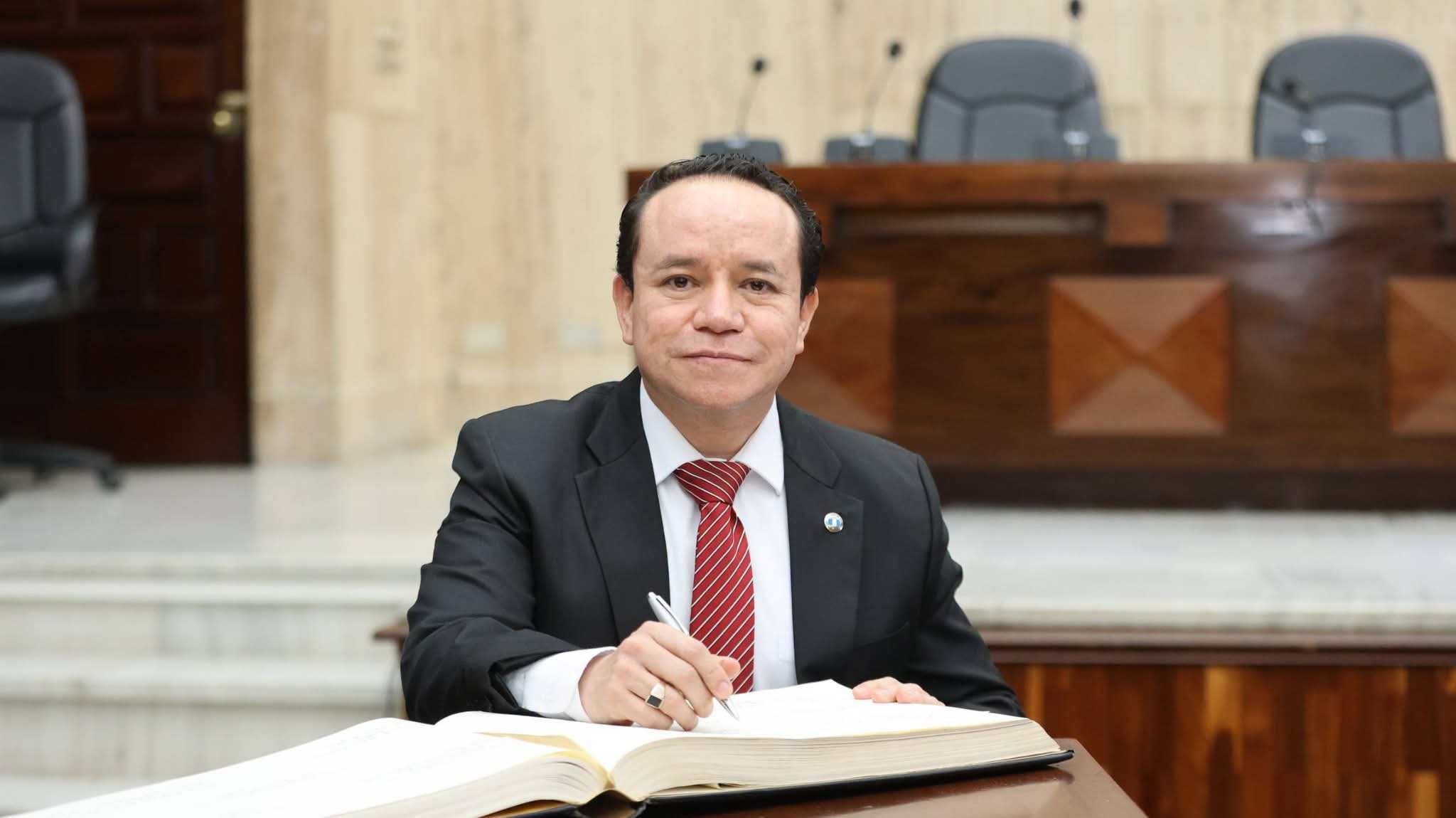
Estuardo Cárdenas, CSJ magistrate, reaffirms a division of the plenary session dominated by a group of 10 magistrates, who he assured, has taken retaliation against him for being a voice of opposition.
The magistrate denounced a change of chamber that he qualifies as “discretionary” in the framework of an interview to learn details of the protection that he presented to the Constitutional Court (CC) against the CSJ, to try to reverse the decision.
During a conversation with Free pressCárdenas exposed what he considers to be anomalies in the way in which the full Judiciary makes decisions, since it would be reaching agreements with actors external to the Judicial Branch (OJ) before resolving.
What is the work dynamic like considering that there were delays in the election of the first presidents of the CSJ?
From the beginning, cohesion and harmony have not been achieved as would have been intended, it has been with disagreements and many frictions since the first days of the administration starting October 13, 2024.
How much have these frictions escalated within the CSJ?
The tensions have risen in tone because it could not have been any other way, because at the end of the day something that I believe is the trigger for these frictions is what has occurred, which are the famous “pre-plenums.”
The plenary session that we normally have is one a week, but it turns out that since the Supreme Court of Justice was practically divided into two blocks, the majority and the minority, the majority has been carrying out what they themselves, in a form of derision or sarcasm, call “pre-plenary sessions.”
Those “pre-plenary sessions” that take place at least one day before the plenary session, review the agenda, see which topics are convenient for them and that are of interest to them, and they are circulating the agenda to us at the end of the day or minutes before the plenary session begins, but they already know what is being carried out and the way in which they will vote and approve what is of their convenience.
Question independence
Do these practices come from the first year of the CSJ or is it something more recent?
As far as I know, they began with the presidency of Judge Teódulo Cifuentes. I had the opportunity to speak with him, I greeted him and tried to address it so that this was not happening and that the plenary session worked as such, as it should in an orderly manner and respecting the spaces, however, it only remained in words, no actions.
Are the pre-plenary sessions held in the Palace of Justice?
As far as we know, they began to celebrate inside the Palace of Justice itself, in one of the councils they met and there they spoke and agreed on what was appropriate, and then legitimized it or tried to do so in the plenary session.
But lately. As I say, they themselves comment on it and believe that they are loyal among themselves, but they end up telling what according to them is not going to be known, and now it turns out that those pre-plenary meetings are precisely held outside the Palace of Justice. Normally they take the opportunity to have lunch and talk about it and with the added and eventual aggravation that sometimes there are external agents who join these meetings in order to be able to give certain instructions or opinions on certain topics, that is what is known.
Who are these characters external to the CSJ?
They don’t mention it, one could infer them, but in the end it would be conjecture, but well, there are sponsorships that are maintained. According to someone said, in those two pre-plenary sessions that they had to have to decide my exclusion from the chamber, not only were the positions of the majority group seen, but also the interests of certain actors or characters outside the plenary session of the Supreme Court of Justice itself who were interested in that movement for whatever reasons.
How have frictions been increasing in the CSJ?
It was expected that the Council of the Judicial Career, through our delegate, would comply with that obligation of informing Congress of the new chambers, however, by not doing so I was forced to safeguard my responsibility, and at the same time knowing of my commitment to the legal system to inform Congress of this irregular situation that was occurring.
All of this has been increasing and to lead to what is happening today, in an arbitrary, unprecedented manner and violating any applicable legal procedure which is the law of the Judicial Career, having always ordered in those pre-plenary sessions, and then legitimized an extraordinary plenary session, my transfer from the Chamber of Amparo and Pretrial to the Civil Chamber, simply because of that dissident voice that I have maintained within the plenary session and the chamber itself.
Points out retaliation
Were there reports or technical recommendations for the rearrangement?
It was discretionary and, to be honest, arbitrary, because there is no other way to qualify things. It was April 29. In fact, we were in an ordinary plenary session and at 10:30 a.m. they were telling us that an extraordinary plenary session was being called at 12 noon that same day.
The nature of extraordinary plenary sessions is that firstly they have to be urgent and secondly the reason for which they are being called must be indicated. In this case, the call only reached the secretariats of our members without specifying what it was for.
For this, the Law of the Judicial Career, which is a derivative imposed by the Constitution, establishes that transfers must be expressly governed by the law, invoking the causes or reasons that exist for it when one does not request it, and which was never done in my case.
You filed an amparo with the CC to reverse the transfer. What do you expect from constitutional justice?
When one is convinced that the Law assists him and that, on the contrary, he is being subjected to arbitrariness, he has no other alternative but to take action.
What is absurd, if you will, and painful, is having to do it against the collegiate entity of which I am a part, but clarifying that the action will go against the majority of the plenary session that made the decision to transfer me in an illegal and arbitrary manner.
Faith in the system must be had because one must be clear that the majorities of today are not the majorities of tomorrow, and at the end of the day the arbitrariness that is committed today by those who believe that they will always have that shelter of a majority, because sooner or later it will also be reversed.
The CC does not grant provisional protection, but maintains it for a future ruling. How do you receive that resolution?
He hasn’t officially notified me of anything yet, but in the same way on social networks one finds out about many situations and I think I have also seen something about it.
If that can be true, first respect that it is a jurisdictional decision and that in the end it is not definitive, it is a provisional matter, which can be reiterated as many times as necessary, but above all have confidence in the system that the substantive decision will be favorable.
Could it be possible to exclude him due to the cases that the Chamber of Amparo and Pretrials will see from the future electoral process?
There is already a good amount of blackberry in the chamber itself. When we entered in October 2024, there were approximately 10 thousand protections that were pending resolution and more or less in 2025 they had risen to 14 thousand.
The electoral event will bring a series of situations that will always end up going through both the Amparo and Pretrial Chamber and eventually being transferred for knowledge and decision to the plenary session of the Supreme Court of Justice, at least in the first instance to later be taken to the CC, but the fact that there is no dissident voice or at least a conscious and objective voice to make the corresponding decisions will surely have repercussions when this is finally reached.
The spokesperson for the Judiciary (OJ) and CSJ was asked for an interview with Judge Claudia Paredes, president of the Judiciary, to learn about the work dynamics of the plenary session, how they manage the agendas, changes in chambers and future plans of the institution, pending whether a possible date for the conversation will be granted.