
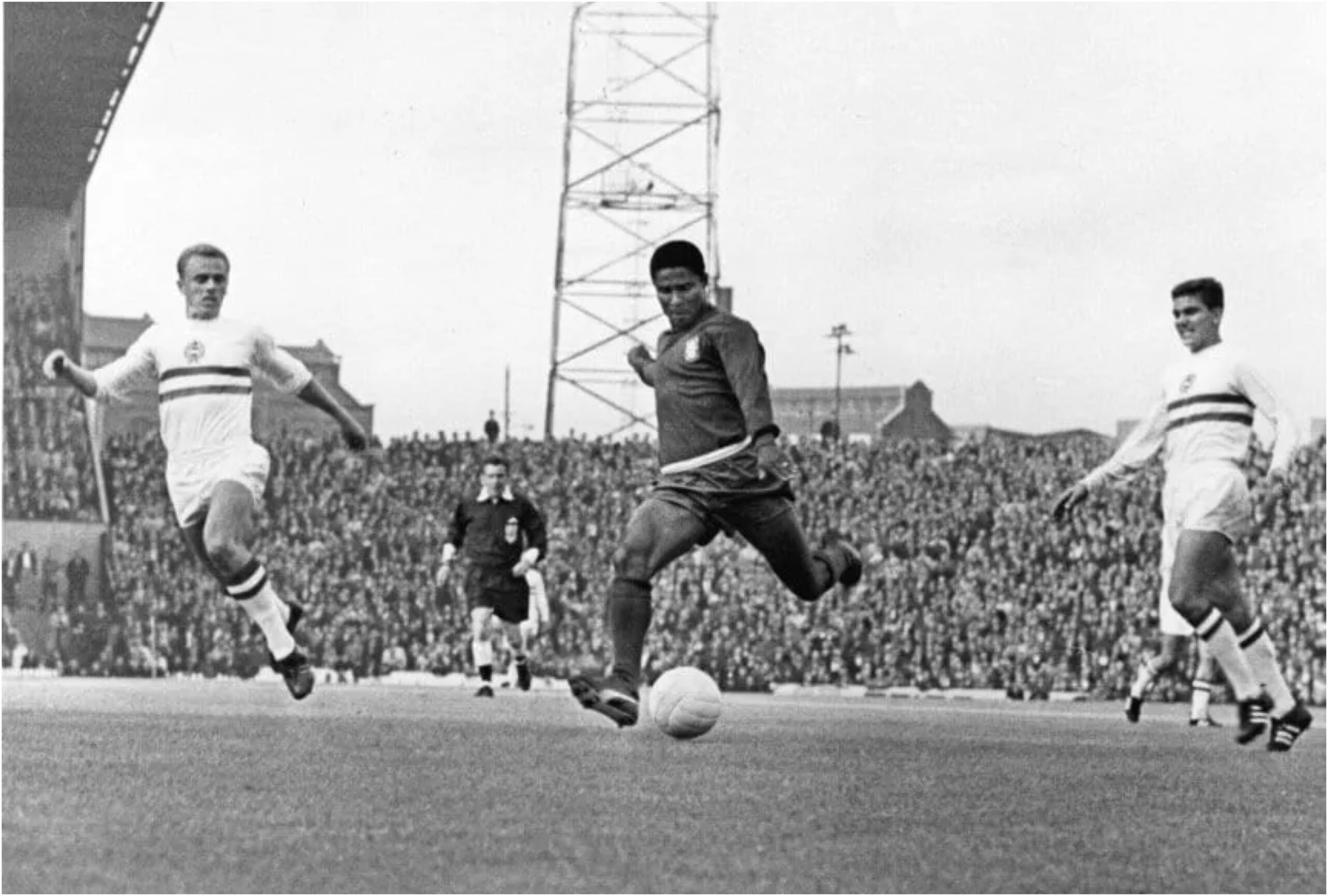
The last time England won a World Cup semi-final, they left out the team of the footballer who would finish as the tournament’s top scorer. Four days later, he won the only world title in his history.
It happened on July 26, 1966. England defeated Portugal 2-1 at Wembley, with two goals from Bobby Charlton. Eusébio scored a penalty and became the first player to beat goalkeeper Gordon Banks during that World Cup.
Portugal was playing its first World Cup and had reached the semifinals driven by Eusébio. The forward closed the championship with nine goals, all scored in his only World Cup participation, and won the Golden Boot.
The victory took England to the final against the Federal Republic of Germany. Alf Ramsey’s team won 4-2 after extra time, with three goals from Geoff Hurst and another from Martin Peters. Hurst scored the only hat trick recorded in a men’s World Cup final.
That remains the only World Cup final that England played in. They then reached the semi-finals again at Italy 1990 and Russia 2018, but lost to the Federal Republic of Germany and Croatia, respectively.
Messi now occupies the place of the great obstacle
Sixty years later, England once again find themselves in a semi-final with one of the championship’s main scorers.
Lionel Messi comes into the match against England with eight goals and two assists. He is tied with Kylian Mbappé in first place in the scoring rankings, but the Frenchman has already been eliminated with his team. Messi is, therefore, the only one of the two leaders who can still increase his tally in the tournament.
The parallelism with Eusébio is not intended to equate eras, selections or styles. It is limited to a historical coincidence: the only time England passed a semi-final they eliminated the team of the footballer who would finish as top scorer in that Cup.
Now he can leave out another of the tournament’s great scorers before returning to a final.
The Golden Boot is also played in Atlanta
The semi-final presents an important difference compared to 1966: England also has two candidates for the top scorer award.
Jude Bellingham and Harry Kane arrive with six scores each. It is the first time that a team has two players with six or more goals in the same edition of the World Cup, according to FIFA.
The race before the semi-final is headed by:
- Kylian Mbappé: eight goals, eliminated
- Lionel Messi: eight goals
- Erling Haaland: seven goals, eliminated
- Jude Bellingham: six goals
- Harry Kane: six goals
Thus, three of the top five scorers in the World Cup will be at the Mercedes-Benz Stadium. Messi can surpass Mbappé and be alone at the top of the standings; Kane and Bellingham have a chance to get close or catch up.
The semi-final will not only decide Spain’s rival in the title match. It can also define a good part of the race for the Golden Boot.
Two paths to a final
In 1966, England faced the match as hosts, at Wembley and with figures such as Bobby Moore, Charlton, Hurst and Banks. In 2026 it arrives under the direction of Thomas Tuchel, with Kane and Bellingham as the main references.
Argentina presents a different challenge than Portugal. They are the current champions, they won all six of their games and they have an attack that does not depend solely on Messi. The figure of the captain concentrates the attention, but Julián Álvarez, Lautaro Martínez, Alexis Mac Allister and Enzo Fernández expand the resources of Lionel Scaloni’s team.
Therefore, beating Argentina would not guarantee a repeat of 1966. Spain awaits in the final and represents a different obstacle than the Federal Republic of Germany six decades ago.
What England can repeat is a step that it has not achieved since that tournament: winning a World Cup semi-final.
In 1966 he left out Eusébio’s Portugal, the scorer who would end up topping the championship table. In Atlanta he will have to overcome Messi’s Argentina, while Kane and Bellingham fight their own battle to catch up with the albiceleste captain.
60 years ago, that victory paved the way to the only English title. The match against Argentina will determine whether 1966 continues as an unrepeatable memory or once again becomes the starting point for another final.