
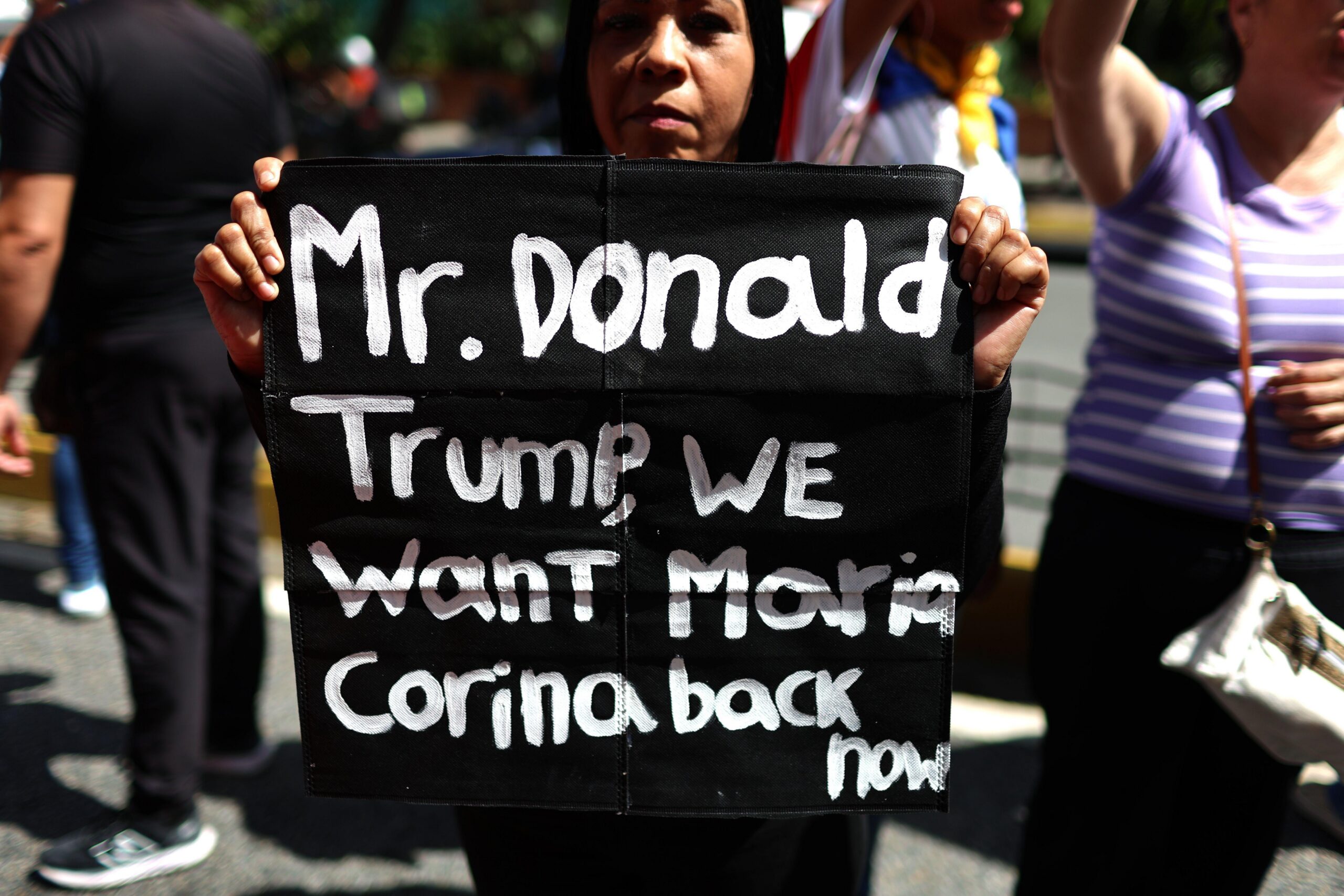
Opposition protesters gathered this Tuesday in Caracas to participate in the first demonstration of this type since the earthquake that shook Venezuela a little over a month ago and which, until now, has left an official toll of more than 5,000 dead, more than 16,000 injured and a still undetermined number of missing.
The protest, which according to the Venezuelan press was replicated in the country’s 335 municipalities, coincides with the second anniversary of the last presidential elections, held on July 28, 2024, in which the now deposed president Nicolás Maduro declared himself the winner in elections that international observers widely considered were neither free nor fair.
According to the electoral records compiled by the opposition, its candidate Edmundo González prevailed over Maduro with a resounding advantage.
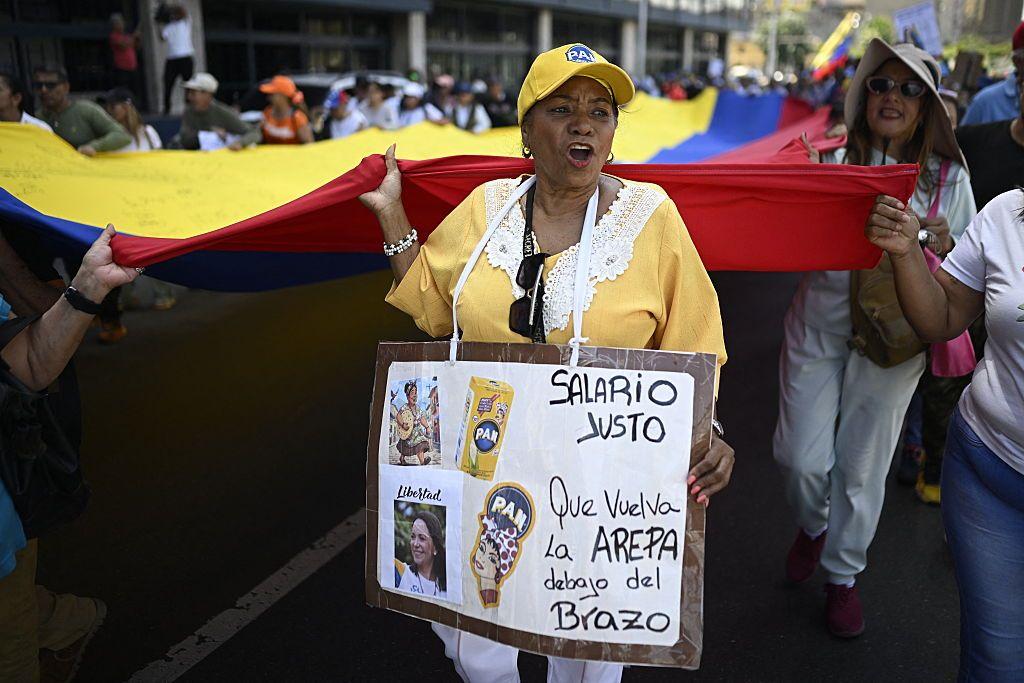
The demonstrations were called by the opposition group Vente Venezuela, which demands a schedule for holding democratic elections, in addition to other demands such as salary increases for public sector workers.
Since the United States attacked Venezuela in January and detained former president Nicolás Maduro, its former vice president, Delcy Rodríguez, assumed power with the support of Washington.
However, neither the United States nor the interim government have set a timetable for holding elections.
A few days ago, Donald Trump stated that Venezuela “is not yet ready” for the elections.
Gabriela Velásquez, a protester in Caracas, tells the BBC: “We elected a president and that election was taken away from us.”
“Twenty-seven years of history is not going to be undone in two days, but at least now we are seeing some movement. We will have to wait for the process to begin to see how the whole situation develops,” he adds.
Romer Martínez, another protester, said that one of the reasons for the protest was to ask that the dialogue table scheduled to be set up starting August 1 between a part of the opposition and representatives of the interim government be inclusive.
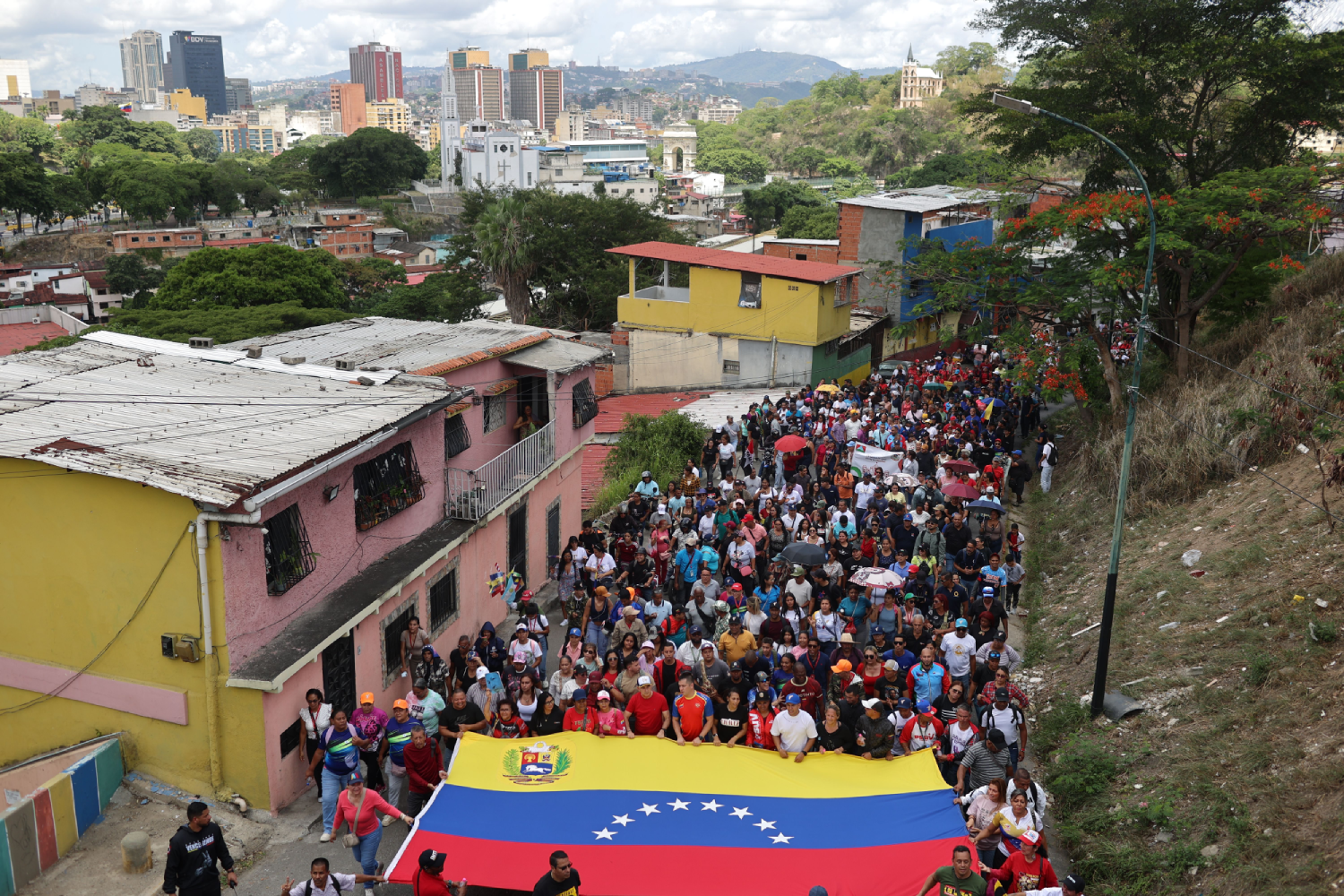
In parallel to the opposition protests, the ruling party called a demonstration in another area of Caracas to commemorate the birth of its late leader, Hugo Chávez, who would have turned 72 this July 28.
“We are asking that at this dialogue table all the democratic and political factors of the country be taken into account, so that we can move towards a path to transition, but a well-conducted path and that there be no improvisations,” Martínez told the BBC.
“And, of course, first of all, the release of political prisoners. That as a point of honor,” he added.
According to the NGO Foro Penal, in Venezuela there are 368 people imprisoned for political reasons, despite the fact that an Amnesty Law was approved in February of this year.
Start of dialogue
The formal talks that the interim government will begin with some members of the opposition starting August 1 are aimed at discussing a roadmap to democratic elections, with the backing of the United States.
The opposition group is made up of former legislators who were elected to the National Assembly (AN) in 2015, the last parliamentary election whose result was recognized by all parties and in which opposition parties obtained a decisive majority.
The National Assembly elections held since then have been boycotted by the opposition or widely regarded as processes that were neither free nor fair, while Maduro and his party, the PSUV, consolidated their control over all branches of public power.
The opposition delegation will be led by Dinorah Figuera, who returned to Venezuela in June after spending almost eight years in exile.
Figuera was the last president of the AN elected in 2015, which has earned her recognition from the United States as a figure that represents that institution.
Upon his arrival in Caracas, Figuera told reporters that he had traveled to his native country “at the invitation of the State Department.” [de Estados Unidos]” with the aim of promoting the renewal of the National Electoral Council (CNE).
The CNE has been dominated for years by staunch supporters of Chavismo.
It was the CNE that declared Maduro the winner of the 2024 presidential election, even though voting records compiled by election observers and independently verified showed a landslide victory for the opposition candidate, Edmundo González.
It was also the CNE that prevented the candidacy for the presidency of the opposition leader, María Corina Machado, who at the end of 2023 had won the opposition primaries with more than 90% of the votes.
After that CNE decision, she gave decisive support to González’s candidacy and toured Venezuela at his side during the electoral campaign.
Neither Machado nor González will participate in the dialogue with the interim government of Delcy Rodríguez.
In a statement released on July 26, both leaders pointed out that they did not participate in the dialogue mechanism created between representatives of the AN 2015 and government representatives.
However, they stated that they will not hinder “any initiative that produces real progress.”
“We will evaluate it based on concrete and verifiable achievements: the recovery of democratic institutions, the release of all political prisoners, real guarantees for all actors without exclusions, a timely presidential electoral schedule and full respect for popular sovereignty,” they wrote.
Claiming 28-J
Machado and González are outside Venezuela, where they cannot return due to lack of guarantees regarding their freedom and safety, given that the country’s judicial authorities – controlled by Chavismo – have issued arrest warrants against them.
Despite this, both published messages on social networks in which they claimed both the results obtained in the elections of July 28, 2024 and all the work done to reach those elections.
“On July 28, we Venezuelans changed history. We did it, together, with our own hands. Everyone did their part. The 600K Platform, the commandos, the Venezuelans abroad, all organized, coordinated. Everyone assumed their own responsibility, the reins of their destiny. That day Venezuela changed forever,” Machado said in a video published on X.
The ruling party also wanted to claim 28J, but not on the occasion of the 2024 elections but because it is the day of the birth of its leader, Hugo Chávez.
For decades, presidential elections in Venezuela had been held in December. This changed starting in 2012, when they moved forward to October, thus allowing a cancer-stricken Hugo Chávez to compete for a new presidential term that he did not manage to serve as he traveled to Cuba at the beginning of December of that year – before the start of the new term – and was never seen in public again until his death in March 2013.
The July 28 election for the 2024 elections was considered by some opponents and analysts as a mechanism used by Chavismo to load the elections with a certain symbolism that would supposedly serve to stimulate the participation of its voters.
However, the CNE did not make reference to Chávez’s birth when choosing the date and, in any case, it does not seem to have had much effect, if the electoral records presented by the opposition are accepted.

Download the new BBC World Service app. Choose BBC News Mundo and receive news alerts, documentaries and analysis, all in one place. Important: The new app is not available in the United Kingdom or the United States.
You can also follow us on YouTube, instagram, TikTok, Facebook, x and in our whatsapp channel.
And don’t forget subscribe here to our newsletter to receive a special selection of our best content every Friday.