
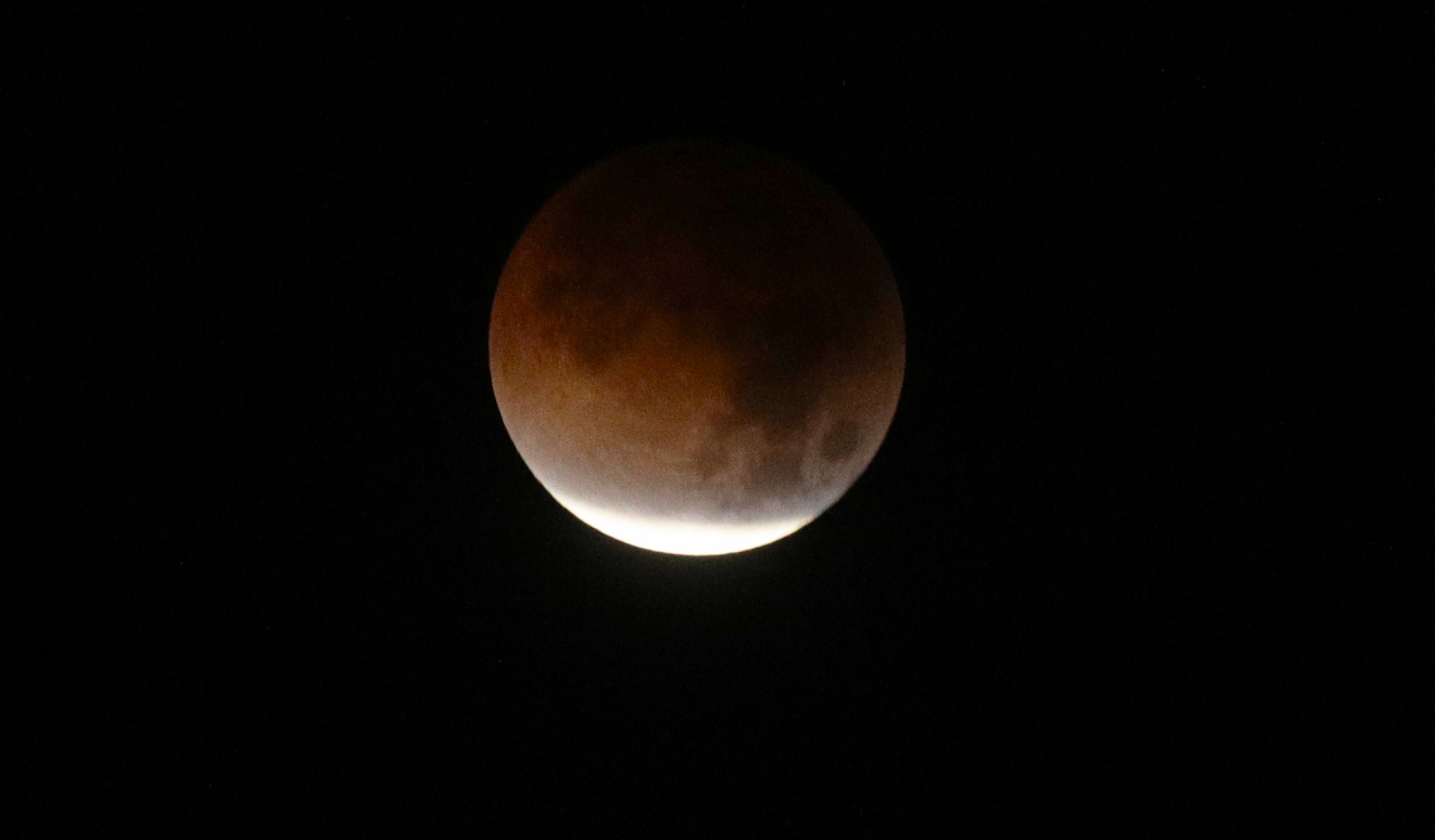
Guatemala will be able to enjoy one of the most striking astronomical phenomena: a partial lunar eclipse which will happen this month of August. This phenomenon will be partial, meaning that only part of the Moon will change color.
According to the National Aeronautics and Space Administration (NASA), during the eclipse more than half of the Moon can be seen in an orange tone, while the rest will retain its usual appearance.
This phenomenon occurs during the full moon phase, when the Earth is between the Moon and the Sun. At that time, the Earth’s shadow is projected on part of the lunar surface and gives it an orange tone for a few minutes.
The lunar eclipse will be visible in Europe, Africa, Western Asia and America, including Guatemala. The director of the Institute of Earth Sciences and Astronomy of the Galileo University, Edgar Castro, explained that in Guatemala the phenomenon can be observed on August 27.
Castro commented that the threshold magnitude of the partial lunar eclipse will be 93%, practically approaching totality. The eclipse will take place between 8:33 p.m. and 11:52 p.m. and will reach its peak shortly after 10 p.m., when the natural satellite will be high in the sky, towards the southeast-south.
As August is one of the months when the sky tends to remain cloudy and rain is recorded, weather conditions could make observation difficult. However, if the sky remains clear, the eclipse can be seen throughout the country.
Even so, there are areas where it could be observed in better conditions due to its location and less light pollution. In addition, the expert offered recommendations to better enjoy the phenomenon during its different stages.
At the beginning of the eclipse, the Moon can be observed in its full moon phase. As the minutes pass, it will begin to lose its fully illuminated form and change color until it reaches the peak of the eclipse.
Places in Guatemala where it could be best observed
The astronomer detailed some places where Guatemalans could better appreciate the partial lunar eclipse, which will mark the closing of the 2026 eclipse season:
- The Motagua Valley and Arid Zones of Zacapa (Estanzuela, Teculután, San Agustín Acasaguastlán)
- Chiquimula and Esquipulas (Eastern Dry Corridor)
- Sierra de los Cuchumatanes (Mirador Juan Diéguez Olaverri / Llanos de San Nicolás, Huehuetenango)
- San José Pinula Plateau or Altos de Fraijanes (For residents of the Capital)
Areas with greater difficulty to observe it
Depending on the weather forecast, observing the eclipse from Guatemala City will be possible if the sky remains clear. If conditions are cloudy, Castro recommends moving somewhere in the interior of the country to observe the phenomenon.
Likewise, he highlighted that, if it is not possible to travel to the east of the country, the high points in the east of the department of Guatemala “have a slight microclimatic advantage compared to the center and south of the department, since the cloudiness that enters from the Pacific usually collides first with the slopes of the Agua and Pacaya volcanoes.”
How to observe the partial lunar eclipse?
Experts emphasize that no special equipment is needed for this phenomenon; However, they recommend:
- Have binoculars or a telescope on hand to better appreciate the eclipse.
- Look for spaces away from intense lights, such as street lighting.
- Dress appropriately.
- Bring an umbrella if you plan to stay outdoors.