
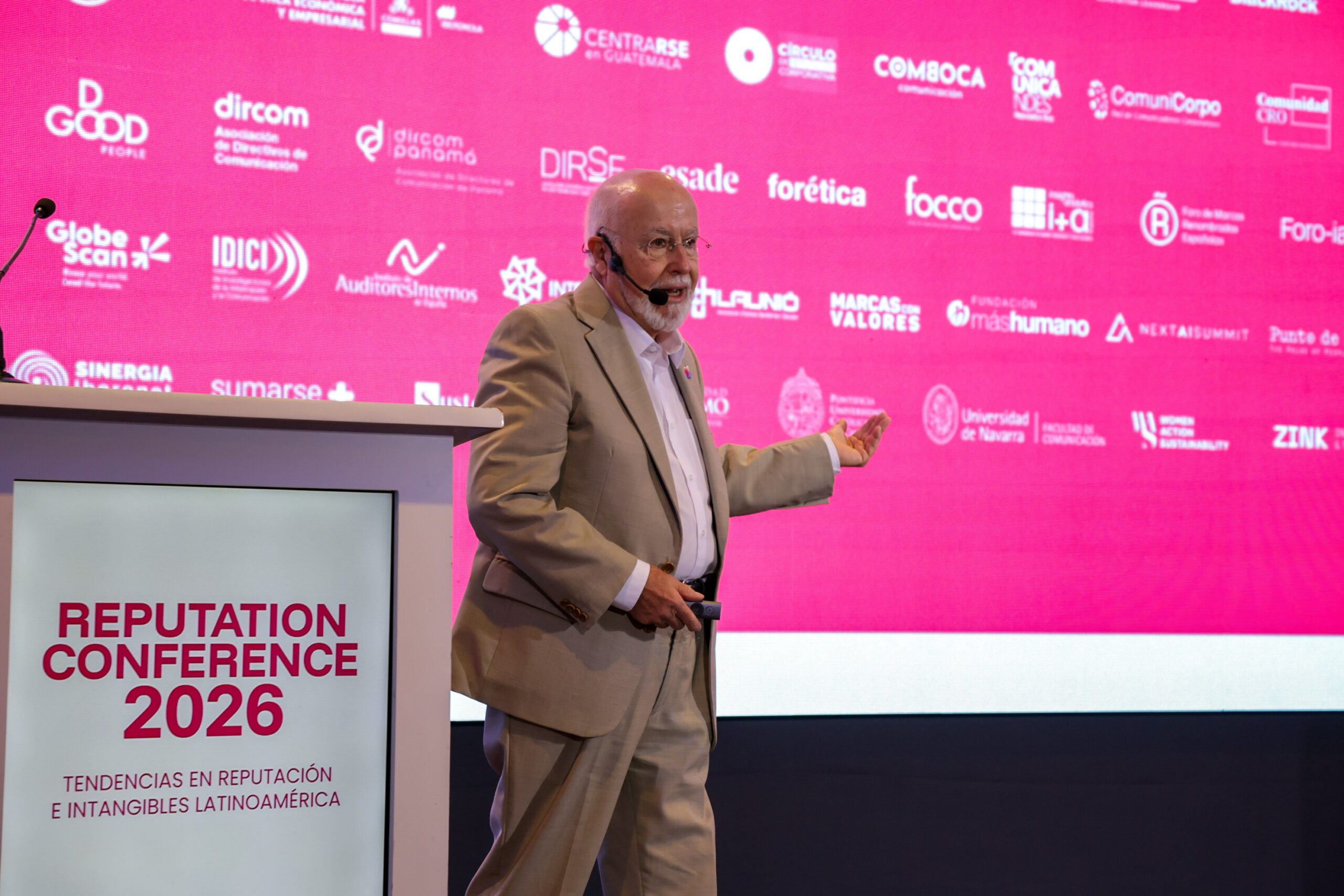
The study Approaching the Future 2026 (Getting closer to the future 2026) that identifies the trends that transform business management in Latin Americawas presented during the Reputation Conference Latam 2026made in Guatemala.
In the 2026 edition of the study, released on Wednesday, July 29, nine factors or areas were analyzed, for which more than 1,400 professionals from Latin America were consulted, including 140 representatives from Guatemala.
Ángel Alloza, CEO of Corporate Excellence – Center for Reputation Leadership, analyzes, in the excerpt of this interview, the results of Guatemala, which refer to trends in reputation and management of intangibles
What does the research consist of?
We are a business foundation, created by large companies from both Spain and Latin America, a non-profit organization. From Latin America there are Corporación Multi Inversiones (CMI) and Castillo Hermanos. We present from Guatemala the results of Approaching The Future on trends in reputation and management of intangibles for Latin America.
We believe that excellent management of intangible (assets) is key to the future of companies and organizations because we are convinced of the importance that intangibles have in the total value of companies.
We see that 20 or 25 years ago intangibles barely represented 10% of the value and risk of companies and today that figure ranges between 54% and 90% of the value of organizations.
What are the three most important trends you found in Guatemala?
Nine areas are analyzed. For Guatemala, one of the most important points that emerge in the results, The first is reputation and reputational risk. We have been conducting this study for 11 years and it has always been this way.
Secondly is the corporate purpose, that is, the reason for being of an organization, its principles and its values. Thirdly, responsible leadership, such as leaders who listen to the expectations of their stakeholders, who are committed to creating value in the long term.
CONTENT FOR SUBSCRIBERS
This is followed by sustainability, artificial intelligence, communication, talent management and new work models.
For the first time, this idea appears that it is not just about talking about the convenience or not of working in the office or having teleworking, but about something much more relevant, which is the need to break down the (organizational) silos that exist between the different departments and make organizations flatter and more horizontal.
Then we have a topic that we incorporated as new in the research, which is corporate affairs and, finally, the corporate brand.
Read also: How an executive leader’s reputation can impact your company’s image
What difference is there in Guatemala compared to the rest of the region?
They differ from Latin America in that, in Guatemala, corporate purpose and responsible leadership are given more importance than in the rest of Latin America. And artificial intelligence still appears a little less important (it appears in fifth place) than in the rest of the region, where it is the second most important topic.
Could Guatemala fall behind in this aspect of artificial intelligence if this trend does not change?
When we consult senior management, artificial intelligence It appears as the first priority and, furthermore, as the priority to which the most resources are dedicated. Therefore, it is not that it has been left behind and that Guatemala is going to lose an opportunity, but that it has a more balanced vision of the importance of all intangibles.
We ask senior managers in Guatemala what you are dedicating more resources to, and first of all to artificial intelligence. Second, to reputation, third to talent management, fourth, to purpose and, fifth, to communication.
Design Free Press
They mention that the results paint a scenario of great complexity and highlight three major structural forces such as artificial intelligence, geopolitics and geoeconomics, in addition to talent management. In this panorama, how is Guatemala and how should companies and the Government manage it?
The Government part is not (it is analyzed), because our research is focused on companies, but the idea of the three great forces that influence the future of organizations and, as you say, also government policies, are the same in Latin America as in Spain and in Guatemala, and they clearly place the emergence of artificial intelligence like the first topic.
The second is the economic logic, which has changed and in which all issues that have to do with geopolitics and geoeconomics are becoming very important.
Hence, this year we have incorporated into the analysis the importance of public affairs, because we are seeing that the profession of public affairs, which is precisely something that allows companies and organizations to read and understand very well the geopolitical and geoeconomic context, as well as the relationship of the company with public administrations and governments, has become a profession that has grown in importance and that is why it appears for the first time in this research.
And the third aspect, which is also common, is the challenge of retaining talent and attracting talentin the sense that new disruptive technologies and artificial intelligence appear, and then all companies and organizations in the world are making it a priority to have professionals trained to manage technology and for it to become a competitive advantage.
And, furthermore, these three aspects and the importance of retaining and attracting talent have a direct effect on intangibles because they multiply the value they have.
Is business reputation well positioned in Guatemala or what should be done?
Yes. In Guatemala, in terms of importance, according to the study, reputation and reputational risk appear as the first issue.
10 years ago, when we started doing this research, reputation was seen as reputational risk; That is, companies were, above all, concerned with the idea of protecting their company from possible reputational risks.
And what we have seen in Guatemala is how it grows increasingly the idea that reputation is not only about protecting oneself from risk, but about creating competitive advantages over competitors.
Guatemala has become aware that reputation is a source of value creation for organizations and that is a very positive element.
We find that eight out of 10 organizations are measuring their reputation, and they do so directly through surveys with their different interest groups or by measuring those aspects that influence reputation.
An issue that causes a lot of concern is human talent. Can artificial intelligence reduce jobs? What emerges from the study?
It is an issue that arises in all countries. With a historical data series of 11 years we can prospect for the future. We can find out, and we have done so, which are the three topics in which companies will invest the most in the future.
Firstly, it appears that they are going to invest more in measurement systems and in the creation of non-financial indicators to incorporate into the dashboards that set the company’s strategy and the remuneration policies of managers.
The second issue, which is given a lot of importance in Guatemala, is the orientation of companies towards the creation of value in the long term and the distribution of that value in a more balanced way among interest groups.
And the third is the attraction and retention of talent. This has to do with the fact that it is not only related to artificial intelligence, but to something very simple, and that is that new generations are more attracted to working in companies with which they share values.
When artificial intelligence is incorporated into all companies and public institutions, it is a bit like what happened with the industrial revolution: a paradigm shift in the profile of the people we need at the head of organizations and among our collaborators.