
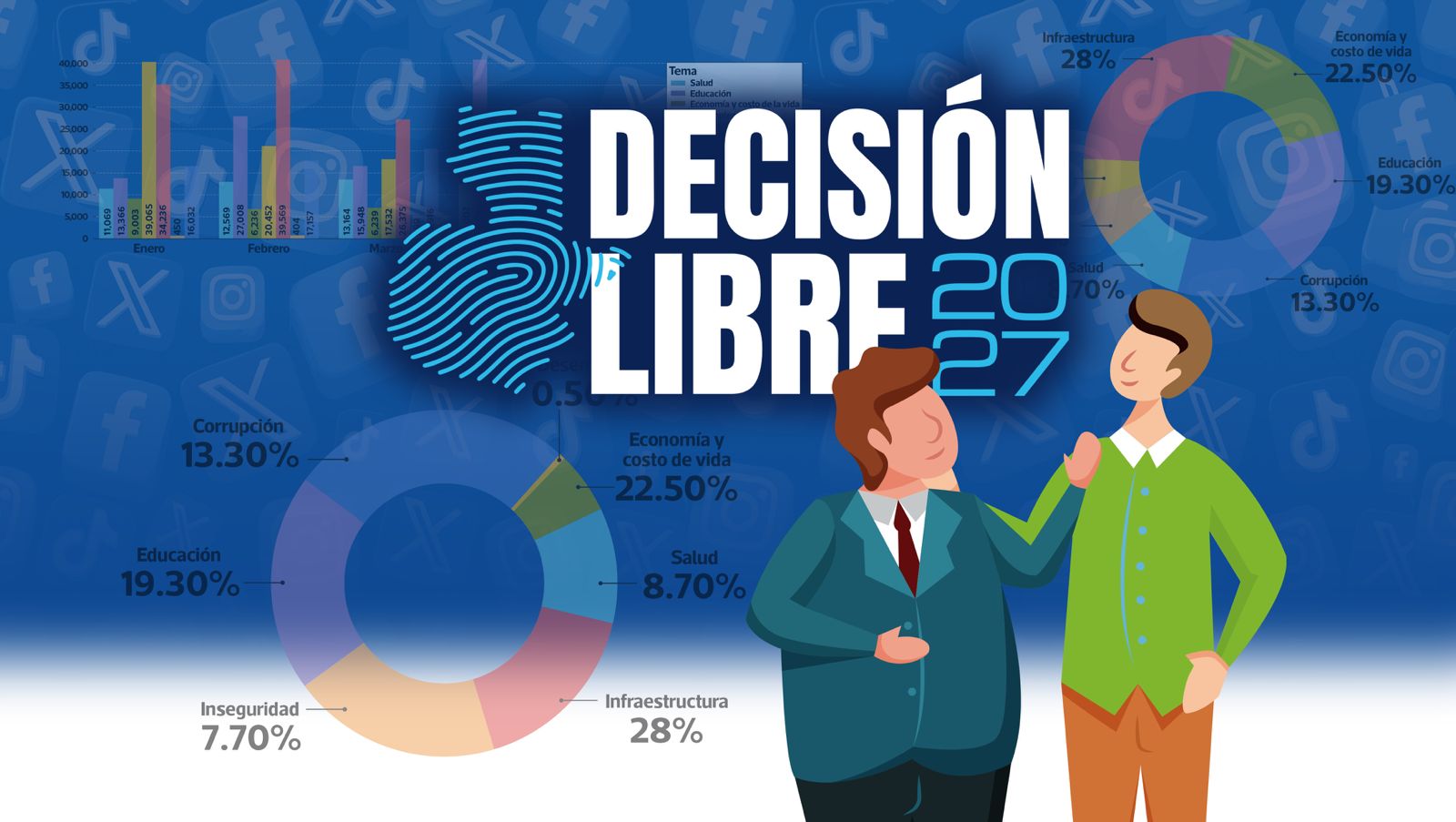
Corruption, education and insecurity are the topics that most concern social network users, according to a social listening, content analysis and study developed through the Goo tool to Free press during the first half of 2026. The study also notices a divorce between what users talk about and what political actors publish on digital platformsbecause for them the main issues were infrastructure, the economy and the cost of living.
Social listening identified seven themes in the content of Facebook, Instagram, Twitter and TikTok, both from individual users and from 30 figures with political aspirations in the face of the next general elections.
For digital users, the corruption was present at 26.6% of conversationswith messages of distrust towards the justice system and the Public Ministry – during the administration of María Consuelo Porras -, institutions that were accused of favoring impunity and stopping the anti-corruption fight.
Mentions of the so-called “corrupt pact” dominated the narrative on social networks. In these publications, he is attributed the responsibility of slowing down any change and maintaining the privileges of groups that hold power in the country.
The political actors They also talked about corruption, but they occupied 13.3% of their publications.
The analysis shows that January and February were the months in which the topic of corruption registered the most mentions with 34,236 and 39,569 mentions, respectively. By June, messages decreased to 15,423.
He 98.5% of conversations related to corruption had a unfavorable tone and, according to the analysis, there is a perception that it is a problem that extends to all the work of the State.
Digital debate
Another of the issues that most concerned users during the period analyzed was the education: two out of 10 messages They were referring to that area. However, far from focusing on educational access or quality, the publications focused on the institutional crisis at the University of San Carlos de Guatemala (Usac) and on the re-election of Walter Mazariegos as rector for the period 2026-2030.
The election of the rector was described as “fraudulent” by students and opposition groups, after the electoral bodies that would counterbalance the decision were not accredited and due to accusations about the lack of Mazariegos settlement to assume a new period at the head of the Usac. The conflict escalated into demonstrations and legal actions, some of which remain pending resolution in the Constitutional Court and in the Appeals Chambers.
The timeline analyzed establishes that April was the month in which education was most talked about, with 39 thousand 539 messageswhich coincides with Mazariegos’ re-election on April 8.
Furthermore, the content was linked to the possible relationship of the university authorities in corruption networks that would have intervened in the application committees to elect the members of the Constitutional Courthe Supreme Electoral Courtthe attorney general and head of the Public Ministry, processes developed during the first half of 2026.
For political actors, education was the third most mentioned topic, while for users it ranked second.
According to the analysis with the Goo tool, the insecurity It is another of the “pains” identified among users. He 96.1% of the messages published on social networks about insecurity were done under a negative feelingfueled by acts of violence, murders, extortion and the perception that organized crime operates with impunity, without the authorities having the capacity to address the problem and apply justice.
It was in January when the topic was talked about the most, with 39 thousand 65 mentions. Precisely during that month, simultaneous riots in three prisons in the country and, in retaliation for the authorities’ takeover, 10 police officers were killed in the streets in attacks attributed to gangs. The wave of violence led the Executive to declare siege status for 30 days.
The population perceives that the corruption and the criminality are linked to insecurity and that the institutions in charge of security and dispensing justice are weakened, the report states.
The theme of insecurity was present at the 19.6% of published messages by the population, which contrasts with the 7.7% of the conversation of the political actors.
Other problems
The problems of mobility and the deterioration of the road network They are claims that users also express on social networks, and the content is associated with the infrastructurepresent in the 16.5% of comments. There is talk of acts of corruption, lack of planning and execution by government authorities, which impacts the economy and the mental and emotional well-being of the population.
He monthly average of publications related to the topic was 16 thousand 541 between January and June 2026, and 81.2% of the messages had a negative feelingmainly due to traffic congestion and unfinished works that erode citizen confidence.
Infrastructure problems occupy the fourth place on the list of complaints of Guatemalansbut for the politicians The issue escalated to second place and was present in 28% of their conversations on social networks, which again reflects the disconnection between the issues that concern the audience and those that predominate on the political agenda.
According to the analysis, this difference is evident again when talking about economy and cost of livingwell for the users The topic appears in 5.9% of messages, while it represents the 22.5% of the publications of the actors who seek public office.
The narrative focuses on the high salaries of officials, such as the deputies to the Congress of the Republic, who went from earning Q29 thousand to Q66 thousand per month. The non-compliance with the promise of austerity by the Government authorities and the increase in the prices of basic basket products are also questioned.
Between January and June, 35,791 messages about the economy and cost of livingand the 88.9% reflects a negative perception.
The themes of health and unemployment They appear to a lesser extent on the agenda of digital users and political actors, and no specific event was identified that triggered the conversation during the months analyzed.
10.8% of the audience’s messages are related to health issues, while among politicians it represents 8.7%. There is discontent over the mismanagement and corruption of the authorities, which causes failures in patient care in public services, but there is also talk of high price of medicines.
Of the 6 thousand 154 publications about health, eight out of 10 reflect a negative feeling among Internet users.
Unemployment has minimal weight in the digital conversation, since among users the messages about it represent only 0.3% and among the political class, 0.5%.
Although 22.1% of the comments on this topic are positive, these are related to people who share their satisfaction at having found a job after a long search process. However, in the rest of the messages a predominant negative feeling due to the uncertainty in the labor market and the economic instability that the country is going through.
According to the social listening carried out for Free pressthe negative perception of the digital audience predominates in the seven categories analyzed, and more than half of the mentions reflect criticismfrustration or concern about structural problems that persist and generate inequality in society.
Divorce on the agenda
The sociologist and analyst Luis Mack points out that social networks are “a very diverse universe” and that what is said in the digital space does not necessarily reflect the interests of the average citizenas content around a topic can be driven by individuals with specific interests.
On the other hand, in Guatemala there is a notable difference between what people think in the capital city and in the departments, because, while the conflicts in the USAC can generate debate among the capital’s residents, the concern in the rural area is the rise in the prices of the basic basket or fuel.
In Mack’s opinion, politicians distancing themselves from the issues that occupy social media users is because, in pre-electoral times, they want to connect with “more electoral realities” and not with issues of interest to certain niches.
“It does not mean that social networks do not represent reality, but it is not exactly everyone’s reality. Politicians privilege issues of greater coverage or concern among ordinary voters, not necessarily those who use social networks,” he indicates.
He adds that politicians usually conduct opinion polls about what worries the population in everyday areas, and that is where they direct their campaign strategies. They tend to ignore issues that are complex, such as corruption, because they know that they won’t be able to solve them.
From this account, a disconnection is observed between what users talk about on social networks and the conversation of politicians, since they prefer to “choose” topics that are easier to handle in a campaign and that have an immediate return. Therefore, they can “get on” or “get off” a topic depending on their interests.