

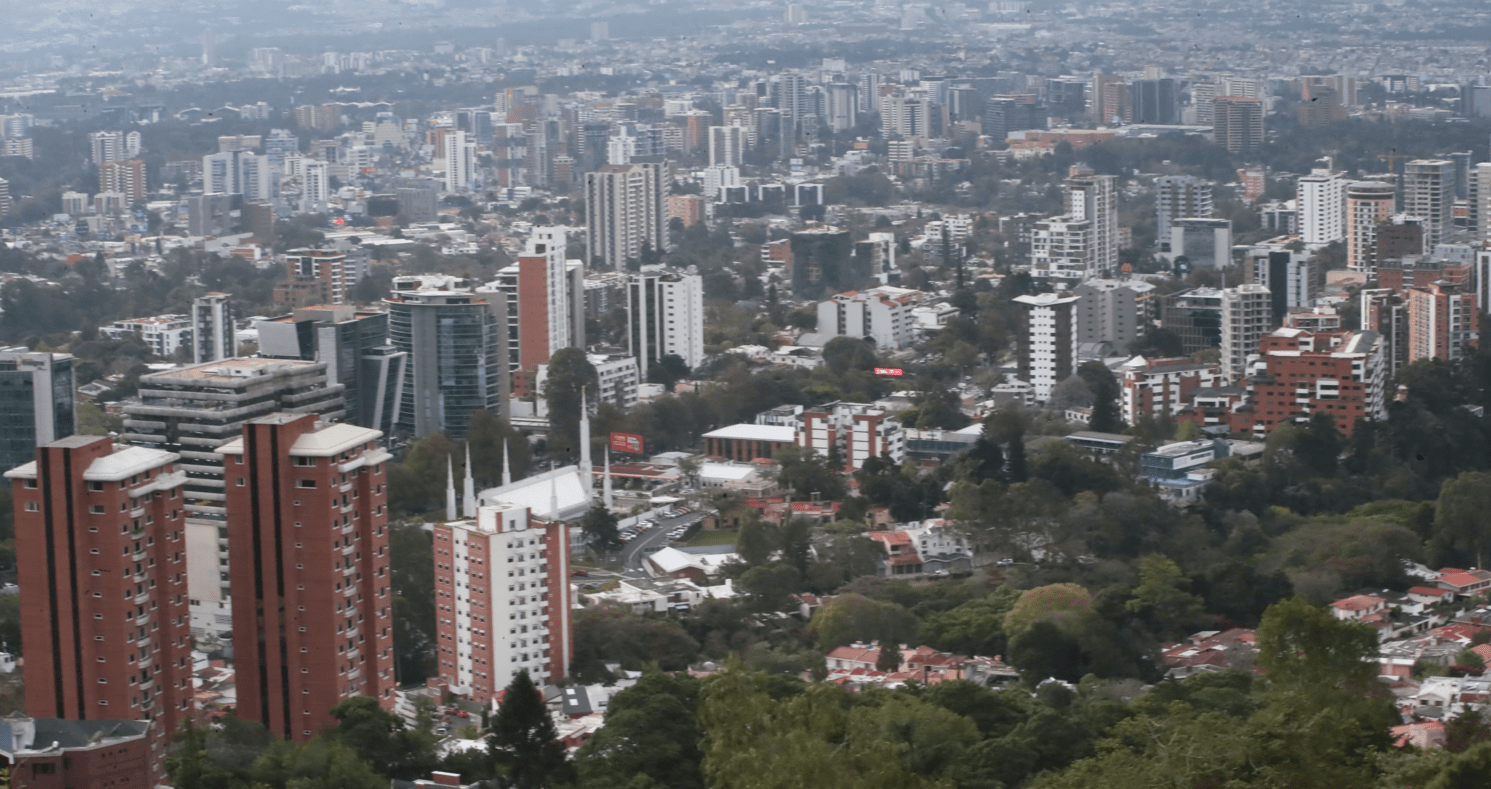
The city of Guatemala and some surrounding municipalities experience urban growth that takes strength, since the last decade, with the highest number of vertical housing projects in the main urban areas, although without greater integration in the territorial planning plans.
The foregoing is evidenced in the increase in income in municipal coffers, both for construction licenses —Totals -, and by the collection of the Single Property Tax (Iusi).
The maximum use of housing spaces, no longer horizontally as it used to be a few years ago, but up can be seen with the naked eye, as confirmed with the data of the Guatemalan Chamber of Construction (CGC).
In addition to the city of Guatemala, this phenomenon of the real estate market for supply and demand occurs in Mixco, Villa Nueva, San José Pinula, Santa Catarina Pinula, Villa Canales and San Miguel Petapa, which are also the municipalities that have the greatest population density. Together, these seven municipalities have an estimate of 2.7 million inhabitants, and that is where the country’s greatest economic activity is concentrated.
It is in these urban points that most real estate developers focus their market studies and investments in vertical housing, in addition to “these corporations are those that offer a dynamic and availability for information collection,” explained José Morán, data analyst at the CGC.
In positive, they are figures that account for the sustainable growth shown by the construction industry in the economy, employment generation and the trust index that this sector generates to invest in Guatemala.
On the other hand, there are also implications for this real estate growth, which is reflected in the income of each municipality; And there is a question in relation to how this is harmonized or not, with territorial planning plans, as well as in the demand for services such as water, drainage, waste management and the problem of road mobilization.
A solid industry
In the last 10 years, the construction sector has shown constant growth, – with the exception of 2020 that had a 2.4% drop -, according to statistical data of the CGC until November 2024. Therefore, it is considered one of the most constant and sustainable economic activities over time, with an average participation between 4% to 5% of the national gross internal product, except for a slight fall in 2024, according to the CGC.
The confidence index of construction activity is another indicator that shows good health of the sector. Until November 2024, it stood at 78.23 points. Expectations foresee an important recovery and growth in 2025.
Regarding employment generation, the construction industry reports an average of 155 thousand 139 workers, of which around 20 thousand are affiliated with the IGSS, according to CGC data, based on the National Statistics Institute (INE).
The National Employment and Income Survey of the INE placed the construction with 8.6% of the population occupied in this sector, this being the fifth economic activity of the informal sector.
Housing has become the main construction trend in these seven municipalities.
Vertical growth
The CGC has compiled in recent years the history of construction licenses authorized for housing – general – in the seven municipalities under analysis. For example, since 2021 more than 4,000 licenses exceeded; Until December 2024 there was a slight decrease with 3,340 authorized licenses. 15% less compared to last year. The CGC considers that this was due to the fact that last year there were longer procedures for licensed authorization, which affects the general volume of the sector.
In the same period, the amount of square meters of construction was also downward in relation to the previous year. However, the trend is of less licenses, but more square meters of construction. This is attributed to the projects of rooms combining commercial and housing activities.
When classifying the square meters by type of project, multifamily homes – apartments – were 17%; 14% serial homes and single -family housing of 23%. These three classifications exceeded the square meters of commercial construction – 23% -. Therefore, the data confirms that housing has become the main construction trend for these seven municipalities.
Demand
Market studies expocasa 2023 and 2024, carried out by the CGC allow to take the pulse of this scenario, which has also focused on seven municipalities in the department of Guatemala.
By portraying the profile of this demand, it is revealed that 52% of people looking for housing have a partner. It is one of the main drivers of the search for new housing; Meanwhile, 47% are also single people seeking to become independent from the family nucleus.
40% of this group (it is at the ages of 26 to 35 years, followed by those aged 36 to 45. Seven out of 10 have bachelor’s studies and are salaried, and half is in the range of income averaged from Q5 thousand to Q15 thousand per month. In addition, only 2 of 10 do not have their own car.
Among other important findings is that half of interested people already have their own home and are looking for a new housing for investment. Also, 61% of people looking for a house privilege the location in the central area. This occurs in all areas of Guatemala City, except zones 17, 18, 24 and 25, cites the survey.
While in the East area, as a road to El Salvador, in the municipalities of Santa Catarina Pinula, San José Pinula and Fraijanes have less demand.
They ask for houses
As for the housing offer, 37% of housing projects are in the central area, the main solution being the 2024 apartments.
The ranges of measures of these properties have varied, and have been reduced. In a sample of 67 projects, the third is located in houses from 51 to 80 square meters of construction.
The housing offer remains limited for the majority, with accessible prices only for a small sector of the population. Of the 58 projects analyzed, most of them is aimed at buyers of high purchasing power, concentrating on high surplus value such as 4, 9, 10, 11, 13, 14, 15 and 16.
The most common apartments in the market exceed Q600 thousand, while the most exclusive options exceed the million Quetzales. In contrast, only eleven projects offer alternatives below Q600 thousand, with just two of them in the most affordable range of Q200 thousand to Q400 thousand.
As for the type of housing, although more than half of the offer is concentrated in apartments in the central area; The study showed that 80% of the demand requested housing solutions in houses.
Transit
Without a doubt, the scenario today is that many inhabitants of neighboring municipalities seek to live in the capital. Traffic has become unsustainable, spending hours in the vehicle to move from the house to work or studies, which become stress every day and less hours of sleep.
The Department of Guatemala brings together 42.59% of the National Vehicle Park, according to the Bulletin of December 2024 of the Department of Traffic of the National Civil Police (PNC).
In addition, in the last 10 years traffic has doubled. In 2014, the Superintendence of Tax Administration (SAT) registered 1.2 million vehicles. Ten years later, in 2024, the figures closed with 2.4 million.
A transit occupied mostly by motorcycles, and also where the greatest amount of accidents is recorded. Accidents that when they occur turn mobility into a nightmare for thousands of drivers.
Waste
The increase in the population brings the increase in the volume of solid waste. Most of these are destined for landfills, a management that causes more and more concern about the scarce treatment of these deposits.
The waste of 14 municipalities arrives at the sanitary landfill 3. And in that of Villa Nueva, those of other municipalities and departments.
Jaqueline Rodríguez’s research for the National Problem Institute of the University of San Carlos de Guatemala (IPNUSAC) covers the history of the volume increase of both landfills, reaching the year 2023, in which the one in Villa Nueva was 166 thousand 962 tons, while Zone 3 reached 608 thousand 333 tons.
The problems with waste management begin from the long lines that the collection trucks must do in zone 3, with the consequent protests and threats. They have reached diplomatic conflicts with neighbor Honduras due to the pollution that the cows and Motagua rivers drag to the Coasts of the Atlantic.
A measure that is expected is relieved with the mandatory implementation of the classification of solid waste, of the Ministry of Environment and Natural Resources (MARN).
Water trust
The new vertical housing developments are required to excavate their own wells to obtain groundwater. The drilling of wells, both public and private and domiciled, is a constant, without greater regulation.
In its conclusions of the Water State Report in the Metropolitan Region of Guatemala 2022, of the Foundation for Water Conservation in the Metropolitan Region (Funcagua), it indicates that the great void of reliable and updated information for this region related to water resources was evident, which is worrisome.
The Doctor of Hydraulic Engineering and Environment, Marco Morales, begins by questioning where the plans to increase these water sources in each of the municipalities are found. And he replies that simply: “do not exist.”
He states that the water reports of the metropolis studied by Funguagua show that the supply of the vital liquid has already collapsed in many sectors, in addition to revealing contamination in some areas. “Thousands of people do not receive water or it is very little. Only the sectors with a high purchasing power are living from the wells as a private solution, which in some sectors already begin to give problem, warns.
For Morales an answer is needed beyond the municipal. This must be regional and national because otherwise the supply will be unsustainable. “I have been saying it since 2008, and nobody is still doing it. There is no public or private institution that has strength or capacity, ”he said.
Missing coordination
The architect and urbanist Miguel Ángel Santacruz is difficult to do the exercise of evaluating the positive aspects of urban growth in the metropolis.
In his professional experience he collaborated with two municipalities in territorial planning plans, but “it is one thing to do the plan and another is to fulfill it.”
Especially highlights the lack of coordination between the 17 municipalities of Guatemala, from matters such as road infrastructure, water, health, education and more. This is reflected in vehicular chaos, hindered by the lack of road -off -rings solutions for heavy transport, for example.
He questions that housing solutions are only directed towards the highest income groups, sacrificing valuable green areas; When the demand is really in the less favored strata.
It coincides with Morales that aspiring to one day in cities in developed countries goes through coordination beyond the municipal. Without going any further, the case of the mayors of El Salvador, where there is a council of mayors of the Metropolitan Area that coordinates infrastructure, services and urban growth. “There is no hierarchy. Each, with the same authority, at a joint table plan actions and projects every year, ”he explained.