

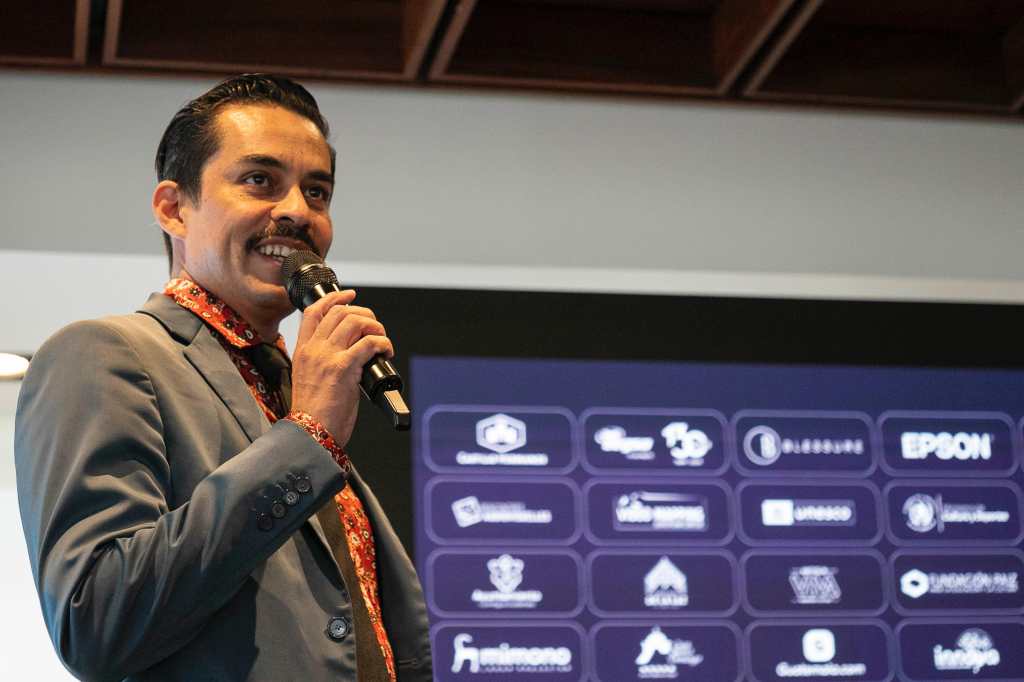
Willy Posadas was recognized on Thursday, June 12 with the Order of Arts and Letters in an act carried out in the residence of France. It was delivered by the France ambassador to Guatemala, Frédéric Clavier.
The Order of Arts and Letters is an honorable distinction granted by the Ministry of Culture of France and was instituted on May 2, 1957. “This order is intended to reward people who have distinguished themselves by their creations in the artistic or literary field or by the contribution to the irradiation they have given to the arts and letters in France and in the world.”
Clavier made a reflection on the life of Posadas, in addition to highlighting that this tribute recognizes him as a tireless ally of culture, “he is a bridge builder and a visionary. His career is an inspiring example of what can be achieved when passion joins the commitment,” said Posadas, founder of Antigua Viva with whom they have developed more than 300 projects, including the Festival de la Luz which attracted in the first edition in 2024, almost 70,000 visitors to the city of Antigua Guatemala.
The ambassador acknowledged that Posadas has contributed to promoting public policies for the prevention of violence through art, has collaborated with local cooperatives, tourism guide and specialist in Tecnotourism and Bird Observation … and has announced the beauty of Guatemala.
At the time of the words of Posadas he welcomed his guests, moving the people who have accompanied him throughout his life, and gave a special recognition to the old -live team, “we have known how to bear the name of Guatemala in high with dignity and always with much cultural relevance and remarking what Guatemala contributes to the world and not only what the world contributes to Guatemala,” he said.
He also emphasized the words of the Gospel of Luke, in which Jesus says that “nobody is a prophet in his own land”: “But, in the end, what really does the land of one really mean? Is it just that piece of almost 109 thousand km² where we were born, called Guatemala, with their volcanoes, lakes, mountains and monuments? Or rather the people who live it, who give it life and meaning to every corner?
The Minister of Culture and Sports, Liwy Grazioso, thanked the France Embassy for making visible the Guatemalan talent with such generosity, and addressed Posadas saying that this recognition is also a responsibility: “Thank you for reminding us that art is not only created, but is cultivated, shared and defended,” he said.
This recognition has also been received by Guatemalans Pamela Guinea, María Mercedes Coroy, César Díaz, Carlos Chaclán, Sara Curruchich and Jayro Bustamanteto mention some.
Why does Willy Posadas stand out?
In a recent interview with Free press, Posadas is described as passionate about life and the city that saw him born: Antigua Guatemala.
Dreamy, photographer and cultural manager, every year, as director of Antigua Viva, continues to attract relevant tourism to the colonial city, as well as to other projects in different parts of the country and internationally.
Leading the second edition of the Festival de la Luz, In the colonial city where art, architecture and videomapping will merge. This event will tell stories through light in the most emblematic spaces, on July 18 and 19.
Currently it is also part of the organization of the immersive experience Frida Kahlo and Diego Rivera: Elephant and Paloma, which between May and August present about 60 works of the controversial painters in the Mexico Embassy in Guatemala. In 2023, Posadas also received the Senate Medal awarded by this European country.
In this interview he talks about his way in culture, as well as the futuristic vision to reach more people and a project that is being developed on the island of Martinica.
What did you represent for you to grow in Antigua Guatemala?
Here is a place where we all greet ourselves with a “good morning.” We all know each other; We have grown and studied at the same school. The place has a lot of history and is living culture. However, over time I realized that this city is a perfect setting for many things that could happen. It has impressive monuments, but much of what is here lacks content.
Between 18 and 20 years of age I lived in Germany, as part of a program to learn the language. It was there that, perhaps, the concern to do what I do today was woke up: to boost the city. There I realized for the first time of the number of festivals that exist, from art, music; Festival of dogs, beer, anything. The excuse is to meet as a society and have places to share, everyone on their own subject.
That does not happen here in Guatemala, and in Antigua Guatemala, less. We are used to living inside our houses. Our houses in Antigua are very beautiful, drinking coffee with bread is like the number one activity of the antiques. But, little by little, the concern to boost the city through festivals and cultural activities was born in me. That is why we founded, in 2016, with a group of friends, the ancient association Viva, and hence the name, how to give life to this place.
Is this where art is integrated?
I don’t have an art -linked childhood. I am an ordinary person for Guatemala, who did not have access to art and culture. He had never gone to the theater, he had never heard opera or ballet until he had founded Antigua Viva. From there arises a little that need to democratize accesses to art, to make it more digestible and more accessible to the entire population, including my person. With Antigua Viva we have developed about 380 projects from 2016 to date. At first, 90 founders, today we continue only six. We are a legally constituted association of 2016 and a producer of digital art events.
To achieve this, we always team up with other institutions; For example, the Light Festival, which is approaching, includes about 20 institutions working together for a common goal: for a couple of days bring happiness to the Guatemalan people.
How did they survive the pandemic?
He locked us between four walls and the association died. They even sold us that there would never be events again. I do not know if he remembers, but they said: “The world changed, people are no longer wanting to join,” and they said that there were no mass events. So far away that that time is seen now. How much lie! Because, in reality, I think it was a parenthesis in the history of mankind; However, the human seeks human and the evidence is that our events returned with more force than before the pandemic. We got creative because we did not believe that we were no longer going to the face -to -face and began to look for the virtual.
We apply to several projects with UNESCO, with the France Embassy in Guatemala and with that of Germany, to learn about new technologies linked to heritage. And that was how the association took a 180 degree turn to devote, more than anything, to the innovation of heritage through new technologies and we began to go to the European Videomapping center, in northern France. I’ve been learning to produce this type of event for four years.
We learned from augmented reality, virtual reality. We have projects in Antigua Guatemala, such as the writers’ route, for example. The person arrives at the house, scan the QR code that is on the platelet and there can see the photo, hear a text of the writer and other experiences.
The objective was transformed and now we want to make an innovation capital old. We want them to stop calling us the outdoor museum stopped in time, where nothing has happened. We want, little by little, position ourselves as that capital that we once went.
The first University of Central America was here, the first place where currency was coined was in Antigua, the first printing press that arrived in the region was also in this place. So, we were the capital of innovation and now we want to position ourselves again as that city that is creating and constantly reinventing.
Do they also develop projects outside Guatemala?
We work where they call us. Our farthest project for now is in Saint-Pierre de Martinica, an island in the Caribbean. We have a virtual reconstruction project of buildings there. The island suffered in 1902 an eruption of its volcano that marked them in history.
European countries go ahead in the subject of virtual reality and immersive experiences, how much do we have to move forward and what is needed?
They are not knowledge that is listed as in a book, but are open to those who intend to learn. We are already referring to this Martinica project, it is we who will go to virtual reconstruction. It is a case of international cooperation where Guatemala will cooperate with the island. Recall that Antigua Guatemala was destroyed in 1773. But with this virtual reality project we can have an approach to how it looked in its splendor. Within two years we will see this culminated project. It is like a trip to the past using virtual reality and will be applied in both countries.
How far will technology get in this aspect? What are we going to see later?
The way children approach reality is no longer like we experience it in our time. This time, if it is no longer seen through a screen, if it does not move, if it is not touched, if it does not interact with one, it does not attract. I think the evolution goes towards interaction. Once I saw an analogy that seemed like a joke, but said: “If all this is still in the line in which we are going, we will stop inventing the theater.”
The theater is already in 4D, there are already real people; So, the future will lead us to the past. As much as we are speaking and seeing through screens, the human being always has the need to look for his community and his peers. Videomapping is digital, but last year 70 thousand people attended our Festival of Light. You should not lose sight of the fact that the goal is for humans to learn and live better.
@ingridreyes_art What to do in Guatemala? The works of the controversial #fridakahlo and #Diegorivera They will be in Guatemala almost three months in this immersive exhibition that lasts about 18 minutes. There is also a parallel room to learn more about artists and even see a replica of Frida’s bed and Diego’s workshop. If you want more information visit to shorten.link/ohzlns Guatemala #Inmersiva exposure ♬ Mestiza Land – Terceto of guitars of Mexico City
And now how does culture see?
No one forces us to be in art. It is its own choice, and yes, being a conscious choice recognizes what entails being an artist. It is the same in France, in Italy, in Germany, Spain, in the United States. Art is a difficult path. It is an choice that I did by passion and where I think that the figure to martyr does not fit.
“It is that in this country they do not support us, it is that in Guatemala it is very difficult” are phrases that are heard, but that does not go with us. They do not have to support me in a special way for being an artist, but they have to give me the opportunity to develop industry.
I believe that what is needed in Guatemala is a cultural industry, in general. Here is a public policy of free access to art and someone is paying for it. In this country, much is being done that one has free access, but not for those who create art can live from it. At the population level, we should gradually get used to paying all these activities, and that artists can live autonomously, without the need to be asking for subsidies.
I also consider that it is more difficult to live from art in Paris than in Guatemala. In our case, while the competition becomes against 10 people, in France there will be a hundred producers of immersive works events. So, I have it easier in my country than in Paris.