

Adorning the sky with its bluish lilac tone and covering the soils with a natural carpet of fallen flowers, the jacaranda marks the beginning of spring and the proximity of Holy Week.
In tune with the liturgical color of Lent, which symbolizes penance and vigil, its flowers embellish the streets where processions take place, especially in Guatemala City and Antigua Guatemala.
Often unnoticed in urban environments, the jacaranda tree becomes the protagonist during spring, when its flowering begins. His glasses are covered with an intense bluish lilac, transforming the landscape and captivating those who contemplate it.
The color of its flowers varies according to environmental factors and its genetics, which allows it to exhibit shades ranging from bluish lilac to a more intense violet blue.
Experts point out that their flowering has the ability to adapt visually to the environment, combining with heaven, light and weather, which makes it unique.
This species, which adorns the landscapes of Guatemala and has come to symbolize Lent, is not originally from the region. Therefore, in this note we tell you more about this tree and its relationship with Holy Week.
Jacaranda tree and its history in Guatemala
The Jacaranda tree, known in Guatemala as giant or q’ojom chés, is originally from the tropical areas of South America, especially from the Gran Chaco region, which covers Argentina, Bolivia, Brazil and Paraguay.
Although there are at least 50 species of Jacaranda, which predominates in Guatemala is the Jacaranda Mimosifolia, also called Jacaranda Azul, a species that has achieved a global distribution thanks to its beauty, comparable with that of the cherry tree in Japan.
It is believed that this species was introduced in different regions of America to evaluate its adaptability, which it successfully achieved in Guatemala due to its favorable soils and the predominant humid climate in the country.
This species is of slow growth and its life exceeds 100 years, reaching more than 20 meters high in its adulthood. It is considered a late expiration, since in its early years an accelerated growth experiences, but over time this rhythm slows down.
Coming from South America, the Jacaranda tree blooms in Guatemala for two seasons: spring and autumn. (Free Press Photography: Juan Diego González)
Characteristics of its flowers
One of its most fascinating characteristics is that it blooms in two seasons of the year: the first occurs with the arrival of spring, when it is associated with Lent; The second, in autumn, although in the latter its flowering goes unnoticed by mixing with the tree leaves.
In both seasons, it produces its flowers or gamosépalas (United Petals), which measure between 3 and 5 centimeters long and form a tubular structure that attracts bees, playing a key role in pollination.
Its characteristic bluish lilac color is due to the high presence of flavonoids, natural pigments present in some fruits, such as grapes, and on leaves such as jamaica.
When flowering reaches maturity, corollas emerges from the tree, announcing the appearance of new leaves of an intense green, which can measure up to 60 centimeters long. Its trunk can reach up to 30 centimeters in diameter.
Experts detail that its flowering predominates between February and April due to the characteristic dry climate of this era.
Jacaranda flower cycles
The biological cycles of the jacaranda begin in August and September with the defoliation (fall of leaves), a process that prepares the trunk and branches for flowering during the dry and temperate era, between February and April.
As of April, coinciding with the rainy season, the tree begins the growth of its leaves. Thanks to moisture, it produces fruits that encapsulate the seeds, which can germinate in fertile soils and start a new cycle.
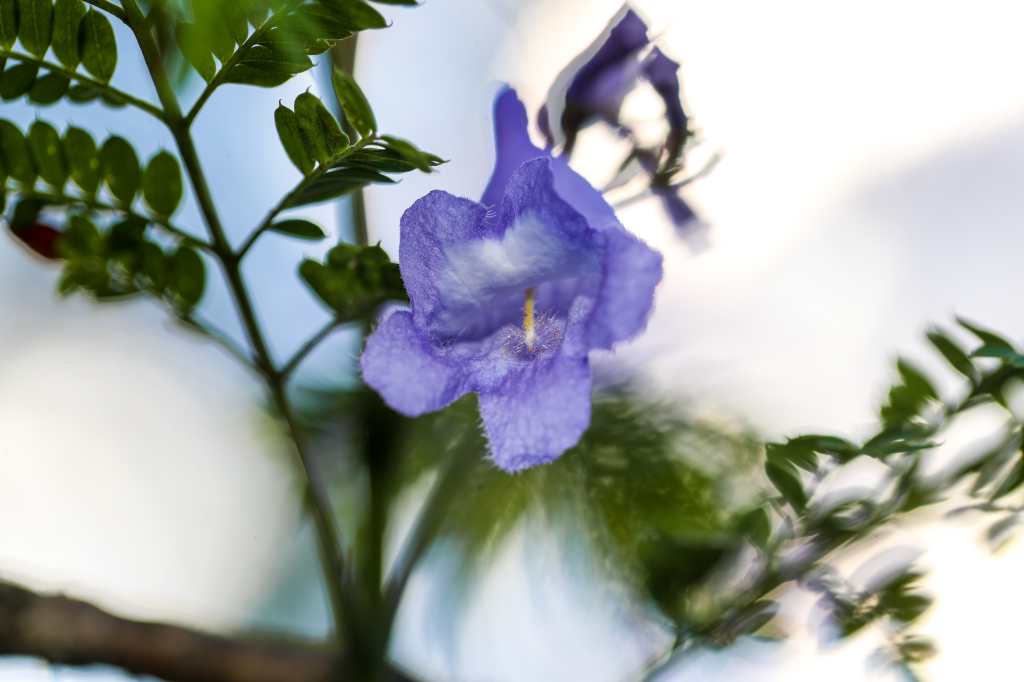
Its flower has the purpose of helping with the pollination of other species. In addition, it has healing effects when consumed in infusions. (Free Press Photography: Juan Diego González)
Health benefits
In addition to beautifying streets and parks, the jacaranda also helps the environment to absorb carbon dioxide.
But its benefits do not end there. Its flowers have medicinal properties and are used to treat amoebiasis, a disease caused by parasites that affect the large intestine and can cause pain, diarrhea or inflammation in the colon.