
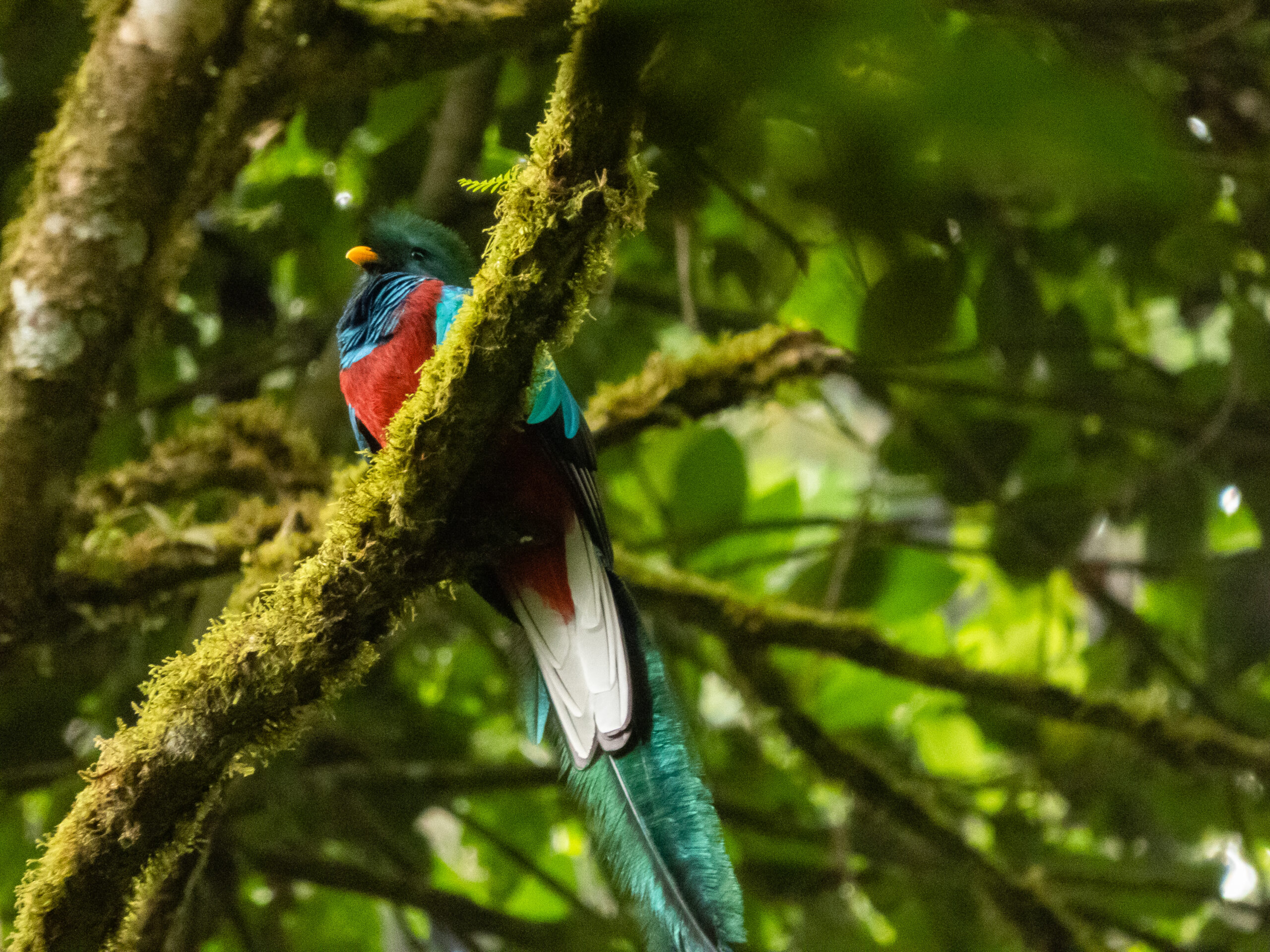
“Ave Indiana who lives in your shield, paladion that protects your ground; hopefully he will go back his flight, more than the condor and the real eagle!”, It is sought in one of the last verses of the National Hymn of Guatemalain which tribute pays To Quetzal.
Under the scientific name Pharomachrus mocinno, The Quetzal was declared a National Ave on September 18, 1871. Subsequently, it was established on September 5 as National Quetzal Day, a date that pays tribute to this species and seeks to foster its conservation.
According to information from the National Council of Protected Areas (CONAP), the Quetzal is an endemic species of Mesoamerica considered threatened, and is located in category 3 of the red list of that institution.
Although the amount of quetzales that exist in the country is unknown, the German ornithologist David Unger assured, in a Article published by Free pressthat since the 1990s to date, the population of this bird – the largest in the trogones family – has been reduced considerably.
Among the main reasons is the destruction of its natural habitat, since the cloud forest in which it resides has also decreased over time.
Meaning of Quetzal in culture
Although it is present in everyday life – because its beauty is exalted in the national shield and the currency of the country bears his name – the quetzal was considered by the pre -Columbian civilizations of Mesoamerica as a divine bird, associated with Quetzalcóatl.
According to information rescued by the Congress of the Republic, for the ancient Maya the green and red plumage bird was considered a deity of the air and an emblem of goodness and clarity. His long green feathers of the tail were the object of veneration, since they represented the rebirth of the vegetation during spring.
In the historical field, the rulers of Mesoamerica and some members of the nobility used plumes made with Quetzal feathers, as a symbol of their link with Quetzalcóatl and Kukulkán. According to historical records, since that time it was forbidden to kill this bird: only some feathers were extracted and then released.
Where to see a quetzal in Guatemala?
According to information from the National Council of Protected Areas (CONAP), in Guatemala the Quetzal dwells mainly in the cloud forests located between 1,500 and 2,700 meters above sea level, although its distribution also extends from southern Mexico to northern Panama.
Within the Guatemalan territory, it is located in the volcanic chain, the Sierra de las Mines and surrounding areas, including the cloud forest corridor. It is also present in smaller areas, such as trifinio, Huehuetenango; the Quetzal refuge, in San Marcos; and the Rey Tepepul Municipal Park, in Sololá.
The sighting season generally occurs between March and June, depending on the location and environmental conditions. During those months, the quetzal reproduces and moves to lower land within its distribution range, allowing greater visibility.
Curious data on Quetzal
According to the National Council of Protected Areas (CONAP), the Quetzal belongs to one of the 758 species of birds that inhabit Guatemala.
In addition to majestic, the national bird is also considered wise. In a Report made by Free pressthe Quetzal shelter’s guard, Saúl Sandoval, identified three types of Quetzal songs, according to the situation:
- WARNING SONG: issued when perceived danger in your environment.
- Courtship song: used during the copulation stage.
- Communication song: It serves to interact with other quetzales while looking for food or water.
On that occasion, Sandoval also explained that during the incubation period the parents turn equally to take care of the eggs and feed the pigeons.
One of the least known, but more striking characteristics of the national bird is its emotional sensitivity. During the courtship stage, some males that are not accepted by the female manifest extreme behaviors: there are quetzales that, when renouncing the possibility of looking for another couple, rise to high height and then throw themselves into minced without stopping, causing their own death.
