

With the same faith, talent and creativity inherited from their parents and grandparents, representatives of ephemeral art in Guatemala are preparing, once again, to decorate the Lent and the Easter week With the majestic carpets, living symbol of the cultural essence of the country.
As every year, artists and devotees are given to the creation of symbolic portraits of the life of Jesus Christ, capturing on the streets an art deeply rooted in spirituality and in the Guatemalan tradition, which is already an essential part of the liturgical celebrations of this era.
For its elaboration, hundreds of Guatemalans join with a common purpose: beautify the passage of Processional courtshipscarried on their shoulders by faithful devotees, and keep alive a cultural manifestation that has been recognized as Intangible Cultural Heritage of Humanity.
Made with dyed sawdust, flowers, fruits or grains, these carpets not only evoke mysticism, the ancestral tradition and spirituality of the country, but also express a faith that becomes art. Although for some they represent an artistic expression, for the devotees they constitute a sacred offering, a symbol of thanks and link between the divine and the earthly.
History of carpets in Guatemala
The origin of the carpets in Guatemala has been a reason for debate among historians, since there is no official document that accurately establishes the beginning of this tradition.
There are two predominant versions: one is based on the writings of the Spanish conquerors of the 16th century and another in the indigenous records. According to colonial documents, priests and colonizers performed religious ceremonies on flowers of flowers and quetzal leaves, a practice that merged with the ceremonial rituals of the original peoples.
With the adoption of Catholicism, the elaboration of carpets with sand, flowers and aromatic plants began, integrating symbols such as shields, arabesques and filigree inspired by sacred art. Later, dyed sawdust, together with fruits and flowers, especially to beautify the passage of processions, such as those of Corpus Christi.
However, the Ministry of Culture and Sports points out that this tradition could even go back to pre -Hispanic era. In reports presented to UNESCO, pieces of ceramics and graphites are mentioned where Mayan sovereigns carried out on walks, with their passage adorned by flower and leave carpets.
A remarkable sample is found in Tikal temple, where a wooden lintel represents a sovereign – K’ul Ahaw or Sacred Lord – carried on shoulders, on a surface decorated with flowers and feathers. This evidence supports the idea that Guatemalan carpets are the result of the encounter between Mayan mysticism and the Catholic tradition.
The Arc Street is one of the most representative locations, where carpets full of color decorate the passage of processional andas. (PHOTO FREE PRESS: PL hemeroteca)
The evolution of this pre -Hispanic artistic practice has had great advances, through the development of sawdust techniques that show the ancestral legacy of art in Guatemala.
The artists of ephemeral art: carpets born from faith and talent
The elaboration of carpets during Lent and Holy Week in Guatemala is more than a tradition: it is the art of transforming faith into visual expression.
Every year, dozens of devout artists express their spirituality, their cultural roots and their love for customs in designs that decorate streets and avenues where processional courtships travel. Accompanied by The chorozo aromathe clouds of incense and the Solemn Cucuruchos costumesthe carpets make up one of the most emblematic cultural manifestations in the country.
Poststick artists
Behind each carpet there is a story, a creator and a spiritual motivation. Erick Escobar, director of the Committee of the Corps of the Correos Arc, found his vocation in 2017, during the centenary of the Candelaria holiday. Inspired by the processional step, he decided the following year to elaborate his first carpet as an offering of thanks, a tradition that has kept alive year after year.
His first work, a 40 -meter carpet made with sawdust and patterns, was only the beginning. Today, his team makes one of the most imposing carpets of Holy Thursday in the historic center: it measures 110 meters long by 3.5 meters wide, fully made with wooden chip, molded with technical precision, practice and dedication.
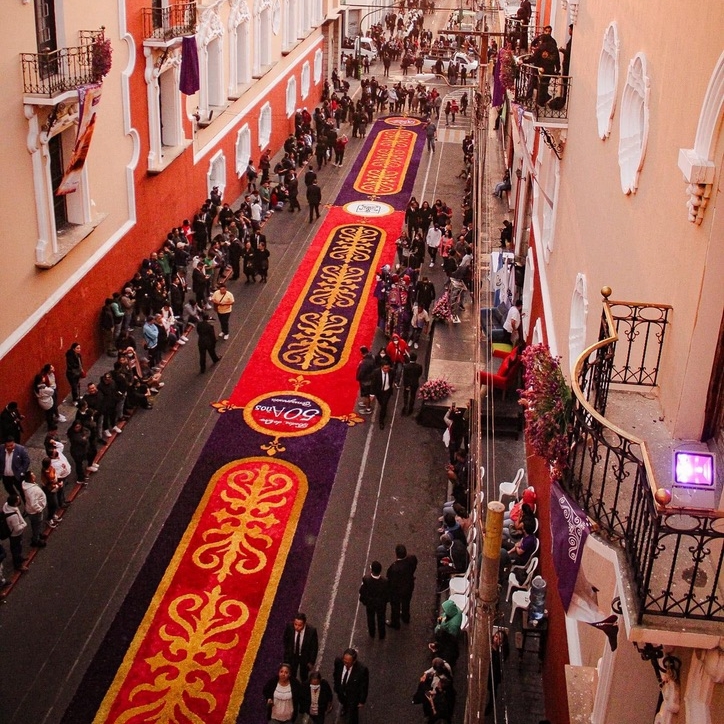
Carpet of more than 100 meters created by the Committee of the Corps of the Post Office on Holy Thursday of 2024. (Free Press Photo: Courtesy Erick Escobar)
For Escobar, this art remains a form of spiritual gratitude for the blessings received throughout the year. That devotion drives the team to renew and present new creations every Holy Week.
The creative process behind the arc carpet
Formed by about 50 people, the Committee of the Corps of the Correos Arch begins its preparations one month before Holy Thursday. The design is defined, they are sent to manufacture the molds and the materials are acquired, including chip, flowers and sawdust.
Escobar details that the real work begins on the same day of the procession, directly on the asphalt. “First we draw the center, place the templates and redraw the designs with plaster, differentiating them by colors. Then we begin to place the chip according to the assigned tone ”, a process that can last about 10 hours explained Escobar.
A 100 -meter carpet can reach a cost between Q10,000 and Q12,000, depending on the level of detail and the materials used.

The lighting of the post arc, its high walls and its imposing architecture enhance the majesty of the ephemeral art of carpets. (Free press photo: courtesy Erick Escobar)
Tradition in the form of tribute
Behind each carpet are also interwoven acts of faith, gratitude and spirituality. Ricardo Chinchilla found in ephemeral art a way of paying tribute to Jesus of Consuelo and the Virgin of Dolores. His inspiration emerged 15 years ago, during an activity with the choir of his church, where he learned the techniques of this art that, since then, practices without interruption.
His motivation is born from faith, which has led him to perfect new techniques already design each creation from scratch, which reflects in the atrium of the church of the collection. “Making a carpet is not just an artistic task, it is an expression of faith, love and commitment to our traditions. Each one lives as a way of thanking, asking or penance, ”he says.
Each Holy Week, Ricardo Chinchilla and the group of carpets of the Atrium of the collection prepare two carpets such as offering to Jesus of Consuelo and the Virgin of Dolores. The design, prepared by Chinchilla, guides the collective work that begins the night prior to the Friday of Dolores.
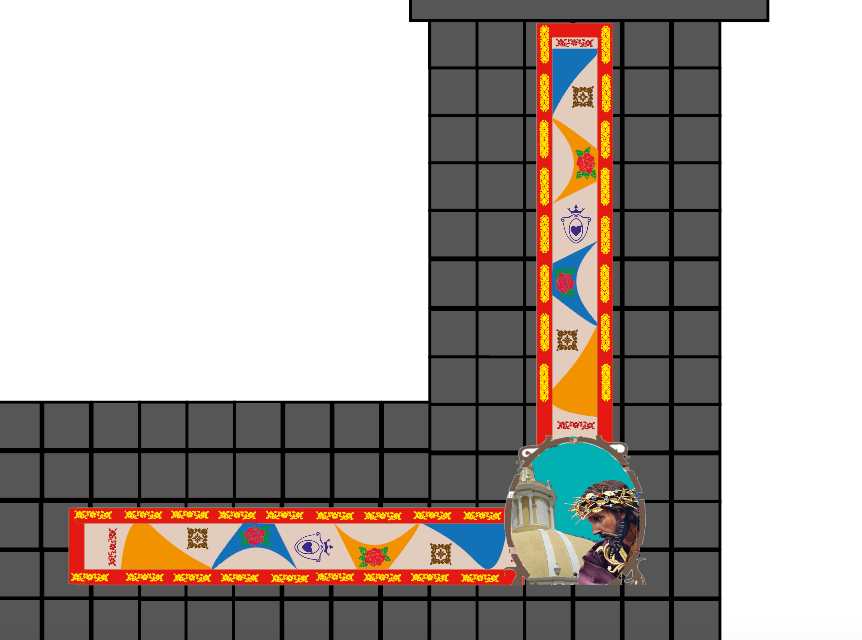
Illustrated sketch of the 2023 carpet design of the carpet group of the collection atrium. (Free Press Photo: Courtesy Ricardo Chinchilla)
The artistic process combines technique and tradition, which begins with the drawing guides previously established that will work to integrate the sawdust, by color, shape and section.
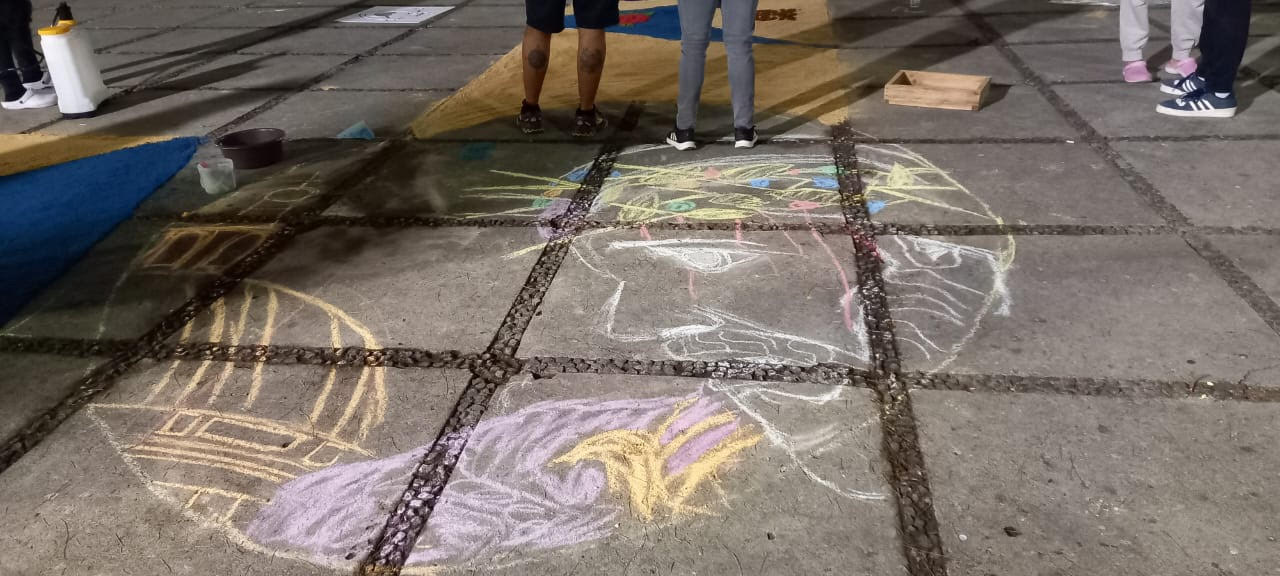
Base of Jesus of the Consuelo for the carpet of the atrium of the church of the collection. (Free Press Photo: Courtesy Miguel Polanco)
With the previously drawn design, the artists apply the sawdust with sifters and mold the details with PVC templates, ending with a spray of water to fix the colors, which carries the art designed to reality.
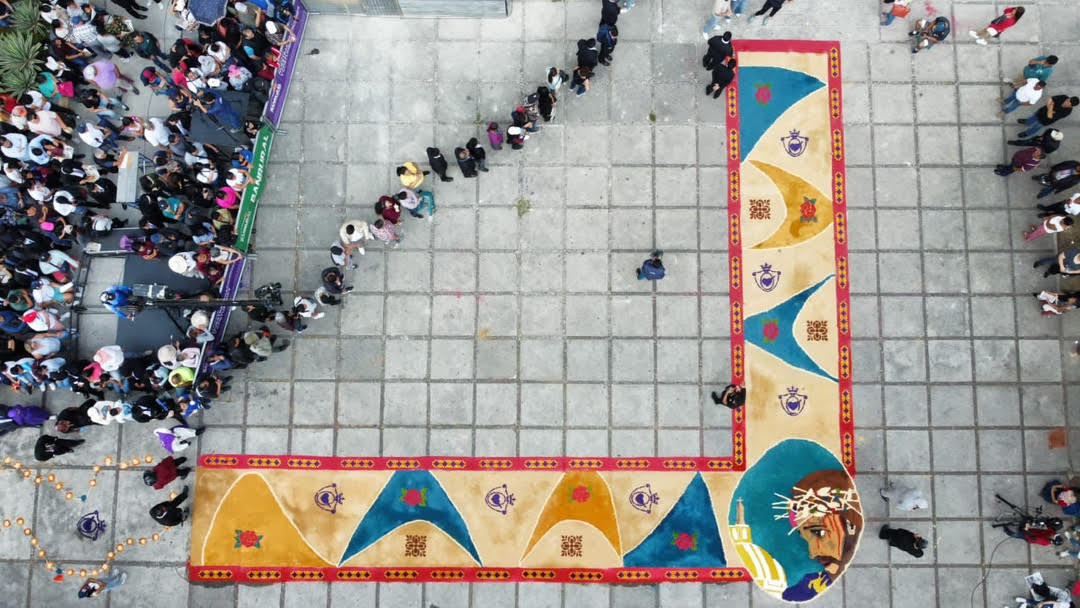
Carpet in the atrium of the church of the collection, before the departure of Jesus of the Consuelo, on Friday of Dolores del 2024. (Photo Free Press: Courtesy Miguel Polanco)
Minutes after the passage of Jesus of Consuelo, they make a second carpet, adorned with sawdust and flowers, to receive the Virgin of Dolores. Both works, loaded with symbolism and spirituality, represent a tribute to faith
The main carpet, shaped like a “L”, measures 25 meters long by 4 wide and is prepared by 20 people for seven hours, exceeds Q5,000 in materials.
Ephemeral art reinvention
For artists of ephemeral art, innovating is an essential part of the cultural legacy. Although each carpet is unique and unrepeatable, some creators have transcended the traditional, taking this artistic expression to canvases that cross borders.
Jorge Corleto, one of the founders of the Chucho street collective, recounts that his passion for carpets was born in 1984, during his school stage, when he proposed a visual commitment inspired by this art. Over time, his work as an artist evolved until a group of visual creators committed to the reinterpretation of this tradition.
In 2015, the group moved ephemeral art to the streets, presenting live a contemporary interpretation of traditional carpets, becoming masters of hyperrealism.
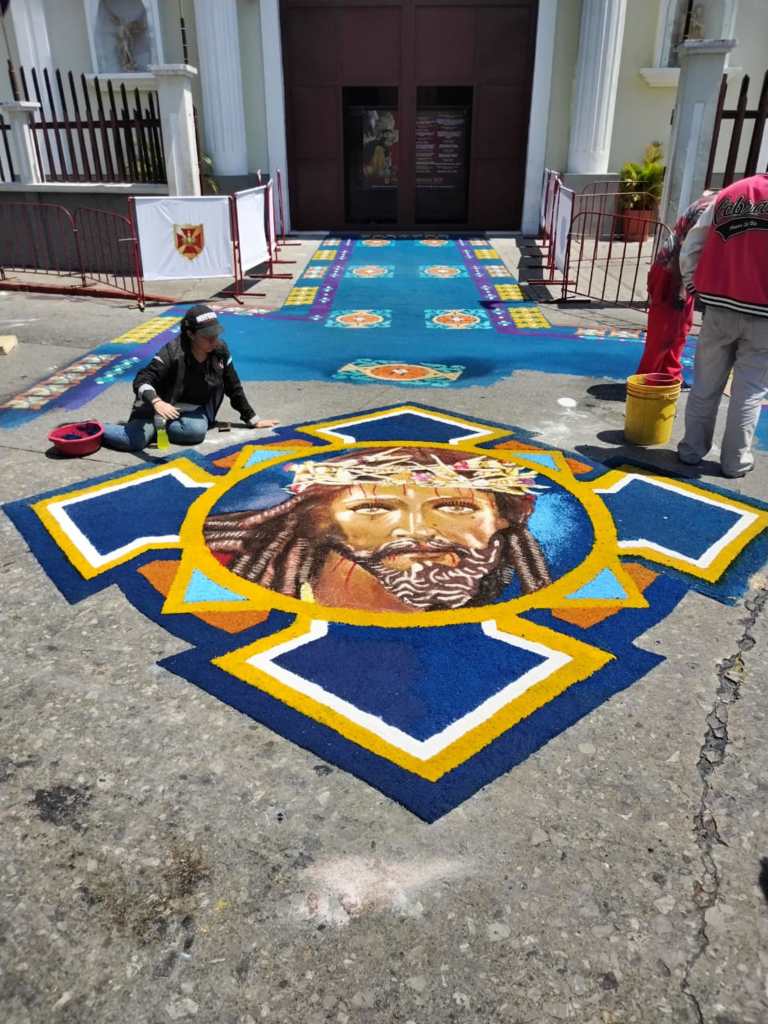
Portrait Hyperrealism created by the Chucho street collective. (Photo Press Free: Courtesy Jorge Corleto)
Thinking about an idea of transcending this art, they occurred to elaborate painting with sawdust, flowers and other characteristic elements of this cultural manifestation, which subsequently allowed them to represent Guatemala in international stages.
“We do not compete with traditional carpets; We seek to enrich this ephemeral expression with a visual proposal, ”says Corleto.
Over time, ephemeral art has become part of its identity as artists, who every year elaborate more than 11 carpets during Lent and Holy Week, contributing new designs to the cultural exhibition.
Jorge Corleto explained that the ephemeral art of carpets begins long before the sawdust touches the ground. It all starts with the creation of a sketch, in which artistic portraits of religious images are delineated that, beyond the aesthetic, evoke devotion and collective memory. That design, loaded with symbolism, moves to the pavement and comes alive through the hands that stain, trace and mold the sawdust.
A carpet 10 meters long by 3 wide, such as those made on the Paseo de la Sexta, requires about seven hours of artisanal work, made by a team of six people, Corleto detailed. The work, although passenger, demands precision and coordination.
“The materials go beyond sawdust: between 14 and 16 dyed bags are used – with an approximate cost of Q980 – in addition to traditional elements such as Corozo, white stones, water and, sometimes, fresh flowers. Depending on the level of detail, the total cost can range between Q1 thousand 500 and Q2 thousand, ”he said.
In cities such as Antigua Guatemala, history is also imposed in the process: cobbled streets force a natural sawdust base to level the surface. In contrast, in the capital, the smooth pavement directly facilitates creation.
For Jorge Corleto, visual artist and defender of this tradition, the value of carpets transcends his fleeting character: “It is an ephemeral, but deep art, which unites families and represents our essence as a people.”