

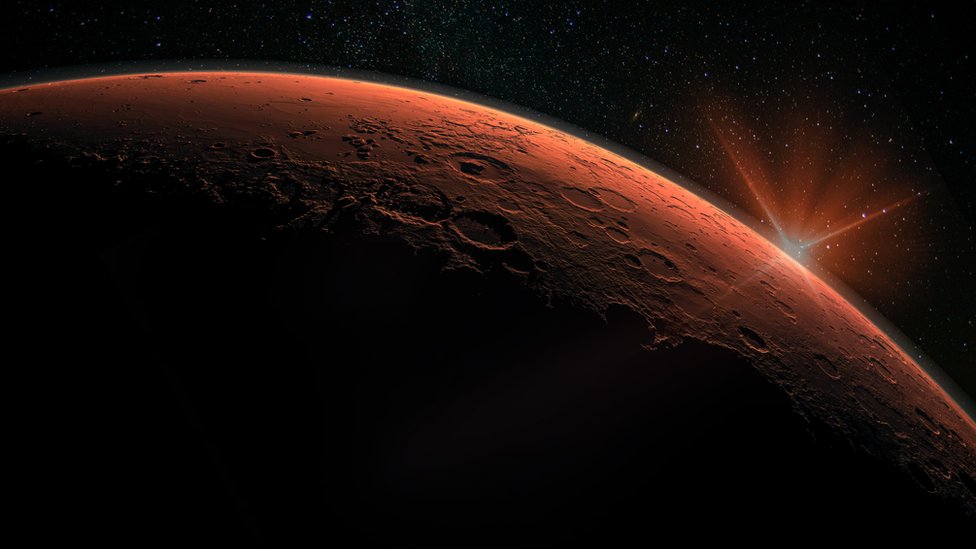
Mars is characterized by being a planet that keeps certain similarities with the earth. According to NASA, it has annual stations, polar caps, volcanoes, cannons and has a certain weather.
According to information from the world entity, the average temperature of this planet is -65 degrees Celsius, an amount well below the freezing point. In addition, It is estimated that their days have a duration of 24.6 hours.
Until recently, the red color of Mars It was due to oxidized iron found on its ground. According to scientists, it is a mineral called hematite to which this coloration was attributed.
However, new findings reveal that their hue could be associated with another iron mineral. Also, scientists have confirmed new discoveries around the nucleus of this planet. Next, we explain what is currently known about one of the most captivating planets in our galaxy.
Why is Mars red?
The red color of the planet Mars has fascinated scientists always, but now a new finding could change the explanation that until now had been handled to explain that alive tone: It may be due to ferrihydrite iron ore, instead of hematite as thought.
The results of a study collected on Tuesday in the journal Nature Communications and led by researchers from the American University of Brown and the University of Bern (Switzerland) suggest that the ferrihydrite, rich in water, It can be the cause of the reddish color of the dust that covers Mars.
Ferrihydrite is an iron oxide mineral that is formed in water -rich environments. On earth, It is usually associated with processes such as the weathering of volcanic rocks and ashes.
Although there were scientists who suspected that Ferrihydrite was the reason for the tone of Mars, the theory has not been able to advance until now that researchers have managed to manufacture Martian dust in the laboratory imitating NASA’s Mars Reconnaissance Orbiter observation data, Together with the land measurements of the Curiosity, Pathfinder and Opportunity explorers, of the same agency.
The final confirmation will come from the analysis of the Mars samples that the Perseverance is currently collectingtogether with the results of the next missions, such as the Rove Rosalind Franklin of the European Space Agency (ESA in English) and the Mars Sample Return of the NASA and ESA.
Previous studies had suggested this fact, but now we have clear evidence, since scientists have managed to replicate in the Ferrihydrite laboratory and analyze it with the same methods that space probes use. pic.twitter.com/2jx52t8bgy
– Doctor Fission (@Doctorfision) February 25, 2025
Mars could be a more habitable planet than we thought
The finding would indicate that Mars was, in the past, more humid and potentially more habitable than was believed, since, unlike hematites, which is usually formed in warmer and more dry conditions, Ferrihydrite is formed in the presence of cold water.
The researchers believe that Mars could have had an environment capable of hosting liquid water – an essential ingredient for life – and, later, went from a wet environment to a dry one billion years ago.
Over billions of years, This oxidized material – the iron oxide – would have broken up powdered and the winds have spread it throughout the planeta process that continues today.
“Mars is still the red planet, but our understanding of why it is red has been transformed. The main involvement is that, since the ferrihydrite could only be formed when there was still water on the surface, Mars oxidized before what we thought” , points out the main author, Adomas Valantinas, researcher at Brown University, before at the University of Bern.
A third finding: Mars could have a solid nucleus
Mars has a liquid nucleus, according to NASA’s insight mission data, But the existence of another solid internal nucleus cannot be excludedaccording to a study based on laboratory tests published by Nature Communications.
Like the Earth, Mars’s core is mainly composed of cast iron, but its lower density indicates that it must contain a great abundance of other lighter elements such as sulfur.
The research headed by the University of Bayreuth (Germany) points out that, until now, it was considered that the temperature of the Martian nucleus was probably too high for crystallizing in a solid internal nucleus.
However, The possibility that the iron sulfide ore formed the internal nucleus had not been examined in detailindicates the magazine.
The authors recognize that more geophysical measurements would be necessary to confirm the real presence of a solid Martian internal nucleus, but the study supports the possibility that there is currently, or in the near future, once the planet has suffered greater cooling .
The team conducted high pressure and temperature laboratory experiments to determine the crystalline structure and density of the iron sulfide phase in the Mars nucleus.
The investigation suggests that, if temperatures in the center of Mars descend below approximately 1 thousand 960 degrees Kelvin (which is within the estimated range for this area), the iron sulphide phase could begin to crystallize and form a nucleus solid internal.
Mars is this week object of several scientific studies appeared in various magazines. PNAS published an investigation yesterday that reveals that about 3,600 million years ago he had an ocean with sunny sand beaches and soft waves.
The study in charge of an international team analyzed the layers of rock of the Martian subsoil, which attest that on Mars there was a huge northern ocean, for which data taken by Zhurong, the Chinese rover that between May 2021 and May 2022, He traveled 1.9 kilometers by Utopia Planitia.
A second study on the red planet published by Nature Communications has given an alternative explanation to the reason why Mars is that color.
The investigation points to the ferrihydrite iron ore, rich in water, as the cause of the reddish color of the dust that covers Mars, instead of the hematite as thought.