
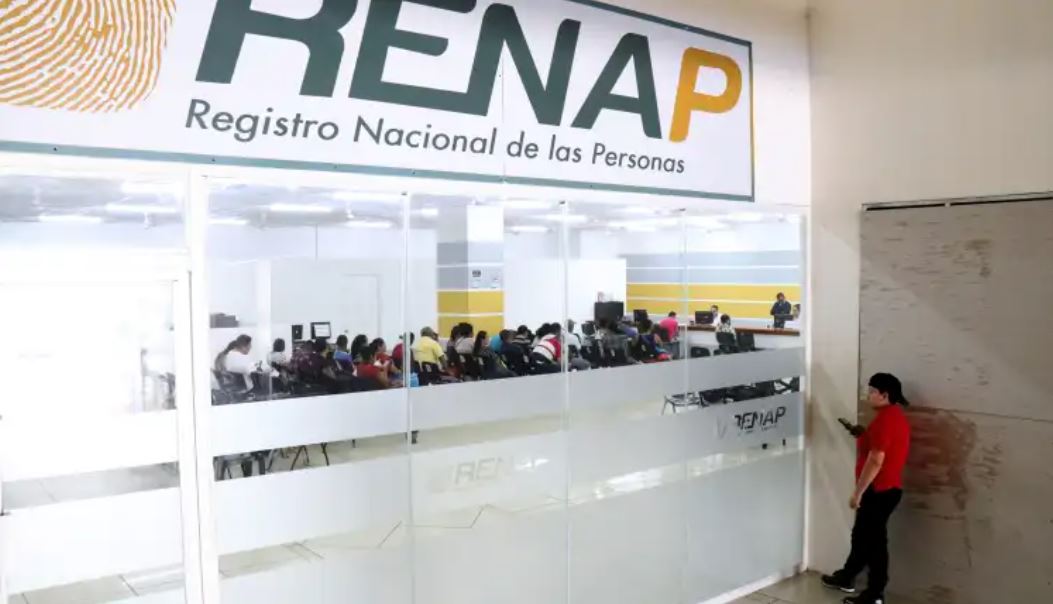
All citizens have biometric data protected by the National Registry of Persons (Renap). The system that contains them is in charge of the institution and operates with a sophisticated computer program for almost 10 years, but that is about to change.
As Renap itself has announced on several occasions, taking fingerprints and facial data is useful to avoid identity theft, which adds importance to the protection of biometric information.
This year the system provider changed and a company with no experience in this type of program was chosen and was awarded a million-dollar contract for the first time.
In July 2025, the Renap Board of Directors, then chaired by Blanca Alfaro, judge of the Supreme Electoral Tribunal (TSE); Felipe Sánchez, Vice Minister of the Interior, and Edgar Rodríguez, representing the Congress of the Republic, approved the acquisition of a new biometric system with different characteristics than the one used in recent years.
According to the event documents, published in Guatecompras, last February the contract was awarded for Q40 million for the new biometric system. According to the documentation, this expands the storage capacity to more than 30 million records and faster operation.
The company that was benefited to provide the new system, New Generation Network, has been established for almost 10 years, but has been a State contractor for less than five years, according to the Commercial Registry file. Until before this contract, the company had sold about Q2 million to the State.
The change will be made 10 months before the call for the 2027 general elections. In this context, a relevant fact is that the biometric system is linked to the Civil Registry System and contains more than 13 million records of Guatemalans, according to official information from Renap, which allows guaranteeing electoral registration.
In addition, this cross-referencing of information also allows simultaneous searches at each Renap headquarters nationwide and is useful for the National Civil Police, the Public Ministry and even banking procedures, according to legal regulations.
New system
Renap assures that the type of contract was changed due to a recommendation from the Comptroller General of Accounts (CGC), so that more suppliers could participate, and that the technology used in the country improves as systems advance in other countries.
“The need to review this model was identified, considering that, in the technological field, there are constant advances and multiple alternatives in the market that can offer more favorable conditions,” Renap responded in writing to a query made by this morning newspaper.
Although in theory the technical differences with the current system are not major, the new contract requires implementation, adaptation and integration of the computer programs in 90 business days, that is, delivery is expected to occur during this month.
Renap, in its response to Prensa Libre, states that the changes are not fundamental, but rather are “to improve accuracy, speed, interoperability between platforms, raise standards in security and data protection and more modern interfaces.”
The system contract does not clarify what characteristics the required equipment has or whether it will be purchased or is already in the possession of the institution. In this regard, Renap indicated that “the necessary infrastructure requirements are being evaluated to guarantee optimal performance of the system,” and that it will operate with high-performance infrastructure, without specifying details or what the process will be to acquire the physical equipment where the New Generation Network system is installed.
The current system used in the Registry was developed by the Argentine company Iafis, in 2017, at the request of Renap, according to the information shared by the provider. On that occasion, the physical support and the biometric system were also installed, so that it met the needs requested by Renap.
Iafis maintained the exclusivity of the service and maintenance of the entire system through the single provider modality, due to the specialized characteristics of the service.
Record
This is the first time that New Generation Network obtains a million-dollar contract with the State. Although their legal representative, Leonel Pérez, assured that they have sufficient experience, after five years in the technology market.
The company was established in 2017 by Freddy Francisco Arévalo García and Luis Guillermo Enrique Vásquez Abril. According to the documents of the Commercial Registry, the company has been represented by the Briz Fernández brothers, businessmen who have already been mentioned in the media because they sold a house to former president Alejandro Giammattei in 2021.
According to journalistic publications, José Luis Briz Fernández was the owner of Lineares Real Estate, which owned the property title to a house in zone 15 where the aforementioned ex-president has lived since 2019. In 2021, the media outlet Con Criterio assured that Giammattei paid close to US$2,000 per month in rent.
The company hired by Renap has had 11 legal representatives since its foundation. According to public documents from the Commercial Registry, at the beginning, the change of representation happened every two or three years, which is how long an appointment lasts. In 2022 there were three representatives, one of them was José Luis Briz, and that was the first time he was in charge of the company.
There was no other change in the position until 2024, when José Pablo Briz Fernández, brother of José Luis, was left to represent the firm. A year later, they changed representatives four times, including José Luis Briz, who was again in charge of the commercial entity.
New Generation Network, until last year, sold Q2 million to the State to entities such as the Ministry of Education, the University of San Carlos of Guatemala and the National Institute of Statistics. They were invoices for the sale of prefabricated data storage infrastructure and an interactive display.
See risks
The system change requires a migration to be carried out from the current biometric system to the new one, that is, the 13 million data of citizens with IPR, including deceased persons, must be transferred to the new program. In addition to the data of minors, who until four years ago began to enroll in the system due to an expansion in the Renap service.
The transfer of data involves logistics, because the records lose quality and others may be lost, similar to when transferring photographs from one hard drive to another: there is a risk that the process will affect some records, explained representatives of Iafis, which has safeguarded the data until now.
New Generation Network assured that the data transfer will be done under international standards, but did not detail what type.
“The process includes data purification, cross-validation and constant audits, in addition to complete backups before and after each transfer stage. The system operates under minimum error parameters, which will be calibrated in the test phases to achieve optimal levels of reliability in citizen identification,” the company responded regarding the guarantee of the transfer process and the risk of data loss.
Maintenance free
The current Renap biometric system has not received maintenance for more than a year, since the last contract expired in 2024, which was for Iafis, for Q16 million.
According to the Argentine company, they carried out between one hundred and 120 support interventions per year, but since last year the service was stopped, so they do not rule out that there is a certain vulnerability in the system.
Renap ruled out any risk. He assures that, last year, entity personnel provided the service that, with limitations, acts in accordance with the capacity acquired during the years in which Iafis did it, and “in the limited technical documentation provided.”
Secure process
It is important that the Renap Board of Directors and the new judges of the Supreme Electoral Tribunal (TSE) ensure this process, so that it is not an aspect that generates fundamental doubts in the electoral roll, according to Rubén Hidalgo, director of the Central American Institute of Political Studies.
“We cannot take the risk of doubting the quality and authenticity of the information on which the electoral roll will rest after 10 or 11 months of calling for the electoral process,” he commented.
Hidalgo assured that the task of guaranteeing this process in all its aspects is the TSE representative on the Renap Board of Directors, so that there are no questions about people who do not appear or deaths that are incorrectly registered.
The TSE was consulted on the issue; however, he did not respond to the request. Neither did the former magistrates, including Alfaro, who knew about the contest, want to respond for this article.
Bases, under the magnifying glass
Renap received two offers, one from New Generation Network for Q39 million 900 thousand, which was the winner, and another from Mühlbauer ID Services GMBH, for Q48 million.
After the award, Mühlbauer submitted a non-compliance requesting that documents related to the manufacturer’s license be submitted. The company presented only one of the two, but maintains that since these requirements are not fundamental, there are no reasons to exclude the offer. The disagreement was rejected.
Iafis, the current supplier, also presented a disagreement, which includes several points. At the beginning, he indicated that after the obligatory visit to Renap, they made 33 queries in Guatecompras that were answered only one day before the reception of offers closed. He also warned of inconsistencies in the dates stated in the offer document.
He argued that some of the answers presented by the bidding board contradict the rules of the contest, in aspects such as the responsibilities of the contractor and system support. He also noted that information about the equipment where the system would be installed was denied, an aspect that, according to Iafis, is essential.
As a last point, the company questioned that one of the non-fundamental requirements refers to the American performance tests of the National Institute of Standards and Technology (NIST), which performs this type of verification on these systems and classifies the results they obtain in a ranking.
Among the bases, according to Iafis, specific results are requested in terms of precision and speed, which excludes all companies except New Generation Network.
“In other words, the bases are not only laid out in such a way that only an offer that includes the biometrics of a specific company can obtain the maximum technical score, but also that only that offer could be subject to qualification and weighting; if so, the above would seriously violate the principles of transparency and freedom of participation,” Iafis said in the disagreement that was ultimately rejected.
Renap responded that the NIST results and their inclusion in the bases were made “as a technical reference of performance and quality, but not as exclusive criteria.”