
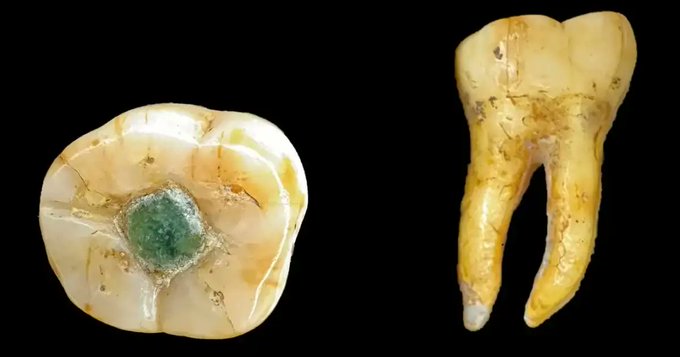
A grinding wheel with jadeite inlaywhich is exhibited in a museum in Guatemala, caught the attention of international scientistswho highlighted that the piece confirms that The Mayans already practiced luxury dentistry that could go beyond aesthetics.
This is a lower left molar with the green inlay embedded in the chewing surfacewhich is part of the osteological collection of the Popol Vuh Museum of the Francisco Marroquín University.
A report about the peculiar piece was published in the magazine Journal of Archaeological Science and replicated by National Geographicwhere highlights that it is the first precious stone filling in a tooth and that it is not a modern jewel or a recent whim.
“It is pre-Hispanic. And, according to the team of researchers, this is the first documented case of a gemstone inserted into a back tooth. among the ancient mayans“, says the publication of National Geographic.
Furthermore, it highlights that This finding may change some theories that were held about the Mayan culture, since it was maintained that the dental modifications they made were, for the most part, ornamental and reserved for the front teeth; However, on this occasion the embedding was done where no one would see it..
The tooth is isolated, since the jaw and the rest of the skeleton are not preserved, making it impossible to know the sex or social status of the individual. However, due to its measurements and the wear in the chewing area, Scientists estimate that it belonged to a young adult between 24 and 30 years old..
“Right in the geometric center of that surface the extraordinary appears: a greenish inlay, identified as jadeite. or a similar material, fixed with cement. The stone is completely flush, that is, it does not protrude and does not bother you when biting. “Whoever placed it there and in that way knew perfectly what he was doing,” the publication details.
The archeology team The task was taken to perform a cone beam computed tomography (CBCT), which allows you to see the inside of the tooth without damaging it.
“What they saw was that, under the cavity carved to house the stone, there were extensive dystrophic calcifications in the pulp chamber, which means that there were mineral deposits produced by the dental pulp in response to stress, and this biological reaction is impossible to occur in an already ‘dead’ tooth. Hence the authors have concluded that the inlay was performed when the person was still alive”says the report.
Although it is known that the Mayans used jade to decorate their teeth for centuries, as markers of identity, status or beauty, The discovery of the embedded tooth draws attention because it was made in an area where it cannot be seen. “This location rules out the purpose of social display, because it would not have been seen when smiling or speaking”he adds.
The researchers consider that The Mayans could have done this job as a “therapeutic filling” or as “a personal or symbolic decision, as a ritual or private gesture”. However, until other similar cases appear, no more will be known about this new dental practice of the Mayans.
🦷 A molar hidden at the back of the mouth with a green inlay perfectly fitted to the chewing surface. It is not a modern jewel nor a recent whim. https://t.co/Zo5mKvIJMv
— National Geographic History (@HistoriaNG) April 14, 2026