
Nigel Farage, who led the campaign Brexit, the British push to leave the European Union, and more recently founded the anti-immigration party Reform UK, was elated when Donald Trump returned to the White House. Farage had campaigned for Trump, visited him at his Mar-a-Lago residence and compared him, favorably, to Winston Churchill. Trump’s return, Farage proclaimed, was “the beginning of a golden age.” That was then. “I know him by chance, but that is secondary,” Farage said last week, describing his support for Trump to The Financial Timeswhile the war between the United States and Israel against Iran sent gasoline and food prices skyrocketing in Britain.
Farage supported from the beginning Trump’s attacks on Iran, But as anger over the war – and the president – grows among Britons, who will vote in local elections on May 7, he is backing down. Reform UK’s popularity has declined in recent weeks, polls show, partly due to what some polls call “the Trump effect”. Farage is not alone. In Britain and Europe, nationalist leaders are distancing themselves from Trump after hailing his second term as a kind of renaissance for populists. Fifteen months later, the symbiosis between Trump’s MAGA movement and European nationalist parties has reached a critical point.
Pro-Trump politicians from London to Rome, already uncomfortable with the president’s punitive tariffs, his threats to take over Greenland and his surprise attack on Iran, have found even clearer limits in his conduct of the war, his genocidal rhetoric, and his verbal attacks against Pope Leo XIV, the first American pontiff. Tino Chrupalla, co-chair of the rising right-wing populist party Alternative for Germany (AfD), accused the Trump administration of possible “war crimes” for attacking civilian infrastructure in Iran.
Alice Weidel, the AfD leader who received to Vice President JD Vance, at a rally last year and celebrated Trump’s public support for “patriotic European parties,” he recently said on social media: “The renewed destabilization of the Middle East is not in Germany’s interest and must end.” Previously, Weidel lamented the government’s military incursion into Venezuela and threats against Greenland, arguing that they had “violated a fundamental campaign promise: not to interfere in other countries.” Marine Le Pen, matriarch of the French National Rally party, condemned Trump’s “erratic” war goals in Iran and warned of “catastrophic consequences” on fuel prices.
“It is clear that very little preparation was done,” declared Le Pen. to the French newspaper Le Parisian. His protégé, Jordan Bardella, the young National Rally leader considered a leading contender for the French presidency next year, recently condemned Trump’s “imperial ambitions.” France’s perception of Trump leaves the National Rally few options, according to Marc Lazar, professor emeritus at the Sciences Po History Center in Paris. “The hostility that French citizens feel toward Trump is enormous,” Lazar said. “This is also seen among Le Pen’s own electorate.
Therefore, she cannot present herself as a potential ally.’ Trump’s return to power began with high hopes for European nationalist politicians, who believed they had regained a protector whose “America First” creed validated their demands for tighter borders, weaker EU institutions and an end to all forms of multilateral interference in their countries’ internal affairs.
Shortly after the American inauguration, Vance traveled to Munich and gave a speech in which he denounced traditional politicians Europeans as undemocratic, accusing them of suppressing freedom of expression and repressing political opposition. Vance referred to EU officials as “commissioners” and claimed that Europe’s own democratic backsliding posed a greater threat than that of Russia or China. Trump’s National Security Strategy explicitly designated support for nationalist parties as a US foreign policy priority. The leaders of those parties imagined a transnational conservative revolution led from the White House, with Trump’s social networks as a launching pad.
For many, that dream has faded. Trump appears to be “a nationalist who does not understand nationalism, particularly the nationalism of others,” Ivan Krastev, a Bulgarian political scientist based in Vienna, said in statements to cnn. The same party leaders who applauded Trump’s hard line on immigration and his culture war offensives are now repelled by his military interventions in Latin America, the Middle East and Africa. “At first it was thought that the US administration would drive the process, since they shared its values, its political objectives and its agenda,” said Mujtaba Rahman, general director for Europe at the consulting firm Eurasia Group.
“Now that idea has completely faded away.” For some of Trump’s closest allies, his unprecedented — at least in recent centuries — public feud with a sitting pope was the last straw. After Leo XIV condemning Trump’s threat that “an entire civilization will die” in Iran, the president lashed out Sunday with a post on Truth Social saying he “should behave like the Pope, use common sense and stop pandering to the radical left.” Trump took personal credit for the election of Leo
That provoked an unusual rebuke from Italian Prime Minister Giorgia Meloni, a Trump favorite who has spent a year carefully positioning herself as a bridge between Trump and European leaders. “I find President Trump’s words towards the Holy Father unacceptable,” declared Meloni, a devout Catholic. “The Pope is the head of the Catholic Church, and it is right and normal that he advocates peace and condemns all forms of war.” Italian Deputy Prime Minister Matteo Salvini, leader of the populist League party, who like Meloni had previously called for Trump to receive the Nobel Peace Prize, broke sharply with him over his attack on the pontiff. “If there is anyone who fights for peace, it is Pope Leo,” declared Salvini.
The breakup could be long-lasting. Trump lashed out at Meloni in a Tuesday phone call with the Italian newspaper Corriere della Seraharshly criticizing her along with other NATO leaders for refusing to provide sufficient aid against Iran. “He doesn’t want to help us with NATOdoesn’t want to help us get rid of nuclear weapons,” Trump said. “It’s very different than I thought. He is no longer the same person, and Italy will never be the same country again.” All politicians are watching the polls and electoral calendars. According to YouGov polls in March, Trump’s disapproval ratings are stratospheric across the continent: 78% unfavorable in France, 86% in Germany and 80% in Italy.
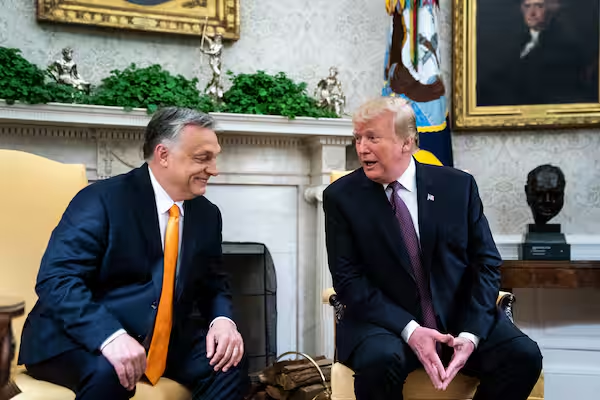
Across the continent, 73% of Europeans considered Trump a threat to peace and security in Europe, according to a YouGov poll last summer, just nine percentage points below the 82%. of Russian President Vladimir Putin. Some political analysts believe that Meloni’s previously close ties to Trump — she was the only European leader to attend Trump’s second inauguration — contributed to the defeat of the referendum on judicial reform that Meloni had backed in March. In Hungary, Prime Minister Viktor Orbán’s close ties to Trump and the MAGA movement could not prevent Sunday’s crushing election defeat.
I find President Trump’s words towards the Holy Father unacceptable.
The campaign focused largely on the economic crisis and corruption, but the White House threw its weight behind Orbán: Trump gave him his backing, and Vance and Secretary of State Marco Rubio visited Budapest to boost the campaign. “I love Hungary and I love Viktor. I’m telling you he’s a fantastic man,” Trump said in a call that was broadcast live during a splashy Vance-Orban rally five days before the vote. The Trump factor was not decisive, said Victor Mallet, author of a recent book on the French and European far right. However, the defeat of Orbán – who campaigned on the slogan “Let’s Make Europe Great Again” and was considered a model of Trump-style populism – demonstrates that Trump’s approach may no longer be a useful guide for European nationalists.
“Trump saw Orbán as a kind of model of how to run things, so the fact that Orbán is out is really interesting because it may show that the model doesn’t work, at least not in the long term,” Mallet said. “I don’t think there is anywhere in Europe where being friends with Trump is a good thing politically, except maybe Russia.” Trump’s toxicity is particularly acute in Britain, where more than 80% of residents have an unfavorable opinion of him, according to YouGov. Conservative leaders are hitting the ground running. back. Surprisingly, the leader of the Conservative Party, Kemi Badenoch, came to the defense of Prime Minister Keir Starmer, of the Labor Party, in the face of what Badenoch called Trump’s “childish” personal attacks against Starmer for refusing to participate in the operation against Iran.
David Frost, who was the country’s main Brexit negotiator, last week repudiated his support for Trump. “There is a moral line to set, and this week Trump crossed it,” Frost wrote in the Daily Telegraphreferring specifically to the US president’s promises to attack civilian infrastructure and his threats against Iranian civilization. “Unfortunately – and I say this with deep regret – we in Europe must recognize that this is already part of a pattern.” For his part, Farage watches with alarm as his party appears to be losing ground three weeks before local elections in England and Wales. Reform UK, which has overtaken both the Labor Party and the Conservative Party in national polls, is on course to make historic progress.
However, support for the party has fallen to 21% this month, from 31% last autumn, a similar percentage to that of the Labor Party. Many pollsters point to Farage’s ties to Trump and the Iran war as determining factors. Labor leaders, seizing their advantage, have become bolder in their criticism of the war. Treasury Secretary Rachel Reeves called Trump’s plans for Iran “crazy.” Starmer himself, always cautious when it comes to criticizing Trump, launched his most forceful rebuke to date on the British network ITV on Thursday. “I’m tired of families across the country seeing their energy bills go up and down, and business bills going up and down, because of the actions of Putin or Trump around the world,” he declared.