
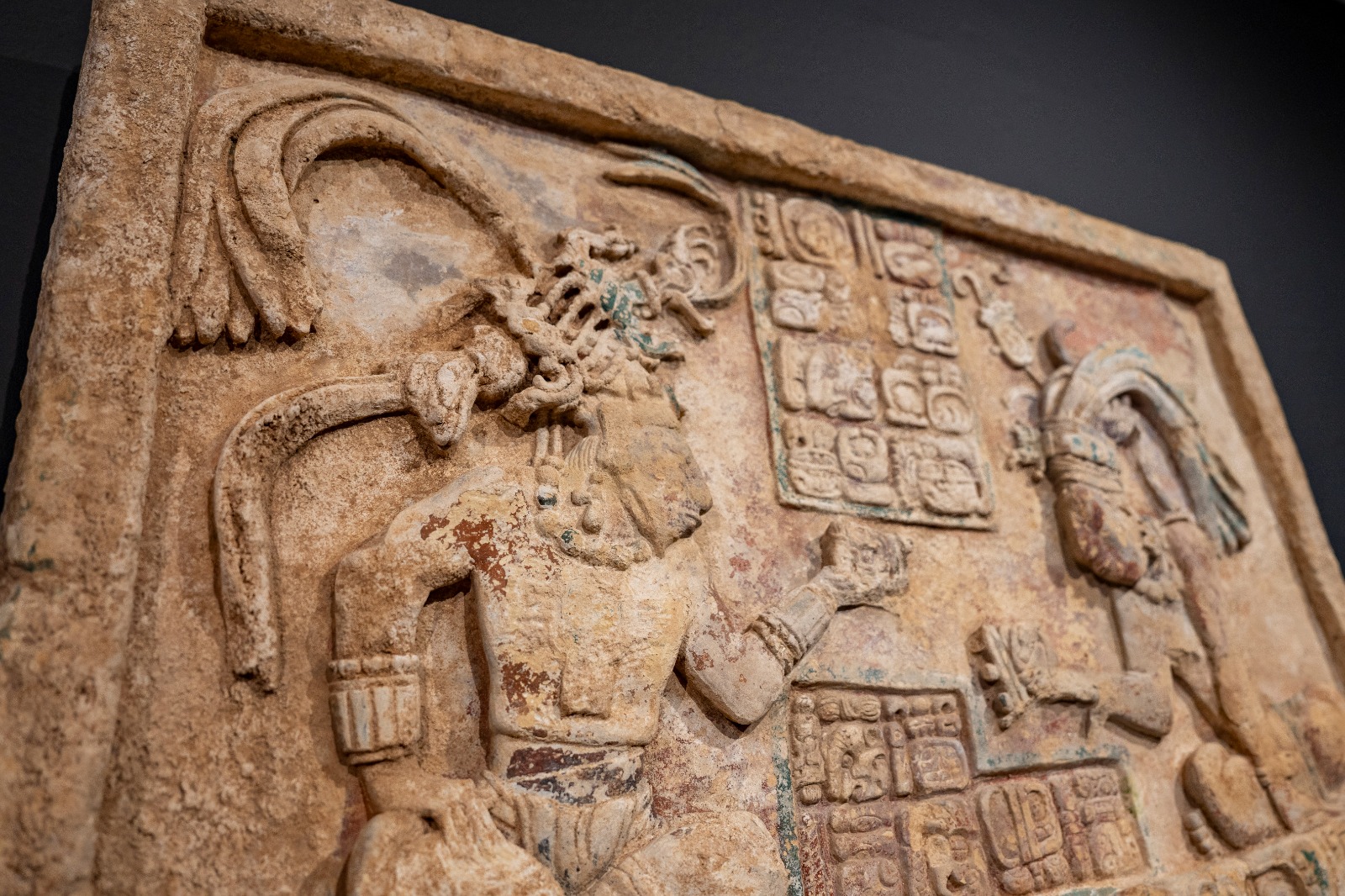
Recently, news broke about the delivery of a Mayan lintel to the Mexican Consulate; however, he archaeologist Stephen Houstonwho for more than 30 years has studied the Mayan civilization in Guatemalastates that the archaeological piece belongs to Guatemalan territory.
This is a Mayan limestone lintel, originally from Yaxchilán, Chiapas, corresponding to the Classic Mesoamerican period (600 to 900 AD). According to the expert, It is part of a series of four lintels: two are in private collections in the United States and one, the Kimball Lintel, is in the Kimball Museum, Fort Worth, Texas.
About its origins, Houston explained that the lintel that was now delivered to Mexico was found by an explorer around 1950, in the middle of the jungle; However, he hid certain information about its origin because he intended to write several books about it.
“He was hiding information because he wanted to write several books for the general public. But we have consulted his field notes, since he died a long time ago, and we have seen that it is 100% clear that the original place where he was (this lintel) is in Guatemalan territory.”, explains the expert.
Then, In the 1960s, the piece was stolen from the national territory and taken to different places, passing through Europe until ending up in New York. “The poor lintel has traveled a lot,” he says.
“7 years ago, more or less, we learned the location of this lintel that we are discussing: it was in a private collection in New York, in Manhattan. And It was possible for us to see the lintel, compare the details, read its text and establish that it was one of the works of a sculptor of primary importance in pre-Columbian art.”, explains the archaeologist.
The Mayan sculptor was Mayuy, born in the kingdom of Piedras Negras, an ancient city-state of the Mayan civilization, located in Guatemalan territory. Your talent is so recognized by historians that Houston describes him as “the Michelangelo of Guatemala of the pre-Columbian era.”
“Through field notes that were in a library in California, We have managed to understand that the original origin was a place that we have visited and is called El Túnel; We have seen the site by LiDAR, a means of viewing ruins through lasers, and it is obviously the same site (Guatemala)”, he indicates.
Even, in his book A Maya Universe in Stone (A Mayan universe in stone), Houston dedicates the first chapter to this lintel, and highlights all the records about the piece and its origin.
“We arrived yesterday after more than a month of rest in the unexplored area of Guatemala. In a marked photo of lintel 2, claims it was ‘found at site #5 [Laxtunich] in Guatemala in June 1950‘”, indicate the notes of the explorer who found the piece and that Houston cites in his study.
Upon hearing the news that the lintel had been delivered to the Mexican Consulate, the expert contacted the Guatemalan and Mexican authorities to report the true origin of the piece.
“I predict that there are very good chances of his recovery in Guatemala. It is a legal question. As far as I know, the two ministries (Culture and Foreign Affairs) in Guatemala are in contact with the Mexican authorities and with the consulate general in New York and Los Angeles. I believe that there is a lot of good will and even some sources in Mexico have told us that they did not have all that information, that they assumed that the lintel came from Mexico, but now everyone knows that yes, it is a treasure from Guatemala, one of the most outstanding jewels of the national heritage,” he explains.
What the lintel tells
The lintel is a work dedicated to Cheleew Chan K’inich (Armored Jaguar IV), ninth lord of Yaxchilán, Chiapas, who reigned between 769 and 800 AD.
According to the description of the piece made by the Mexican Consulate, in the upper left corner you can see the ruler receiving tribute from a subordinate, who is on the right. The entire scene is supported by two Atlanteans who carry the “cosmic monster of the sky” on their shoulders. In the center, seated on a primordial skull-shaped bonfire from which corn sprouts, the god Itzam, responsible for sustaining the universe, is represented as an old man. The five figures make up a quincunx, a symbol of centrality, cosmic order and cyclical renewal of time.
“It is a layer of historical understanding, but on the other side what they do is form a fusion between dynastic roles and supernatural roles: At this moment the arrogant king is the sun, the solar god. Next to him is the corn god, now the duke or marquis. And down there they are the supporters of the entire world, but rather it is the nobility,” explains Houston.
He adds that this piece is an important part of history and cultural and artistic expression of Guatemalaand hopes to see it exhibited in the National Museum of Anthropology of Guatemala.
“I can imagine a fantasy, a dream: the location of the four lintels in a room in the National Museum. That would also be an exciting experience. I hope this opportunity comes”, he concludes.
Stephen Houston is an anthropologist, archaeologist, epigrapher and professor at Brown University, United States. He has been the author and co-author of several books and, for more than 30 years, has dedicated himself to the study of the Mayan civilization in Guatemala. In 2011 he was decorated by the then president of Guatemala with the Order of the Quetzal in the degree of Grand Cross.