
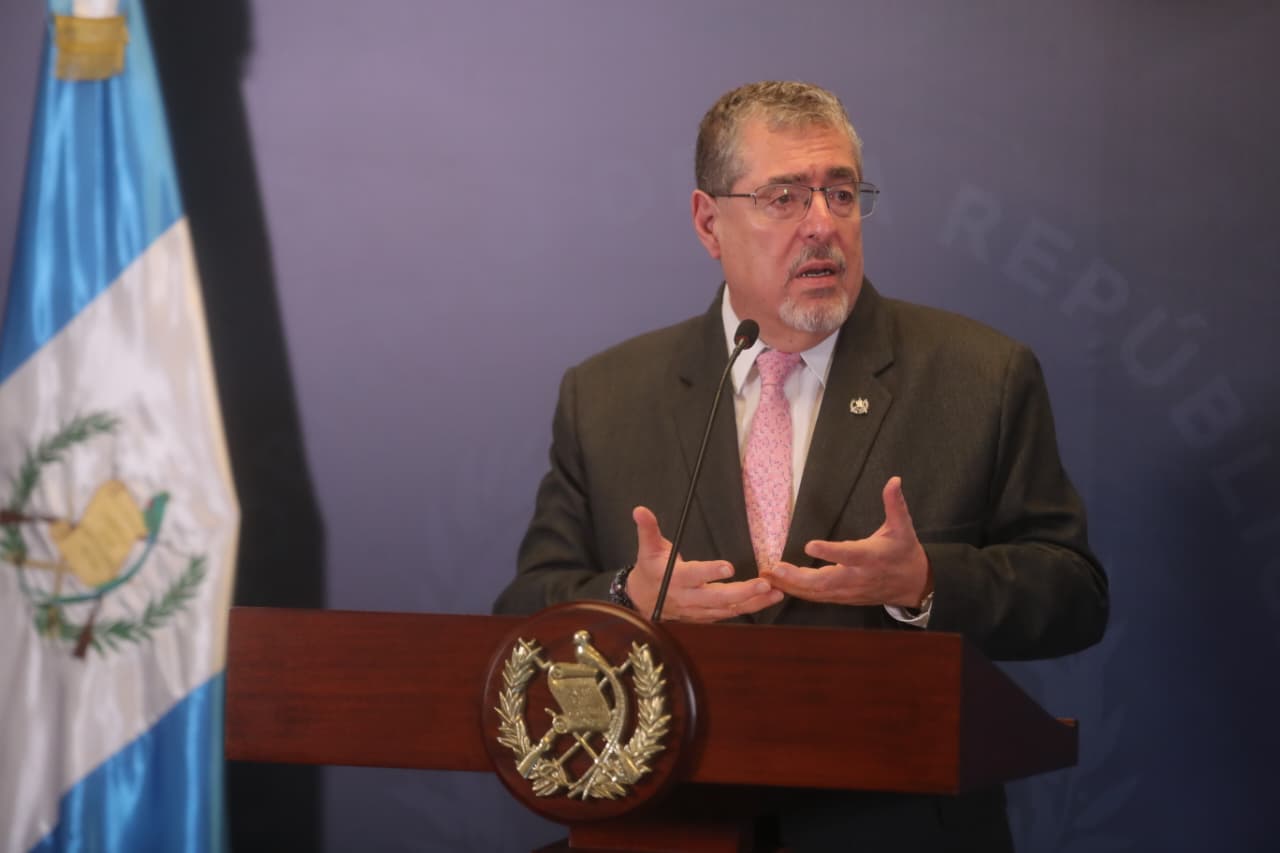
The renewal of the attorney general is now in the hands of President Bernardo Arévalo, But his latest decisions raised suspicions among some observers who asked him to prioritize the honorability of the future attorney general.
On May 17, the new head of the Public Ministry (MP) must take office after two continuous periods under María Consuelo Porras, who unsuccessfully sought a third term.
The nomination commission sent the presidency, on April 24, a new list of six candidates that was formed to comply with an order from the Constitutional Court (CC) that ordered the process to be redirected.
Now that the presidency is in charge of the election, it scheduled interviews with the six candidates to lead the MP, meetings with the president that will be behind closed doors, without access to the press or social observers.
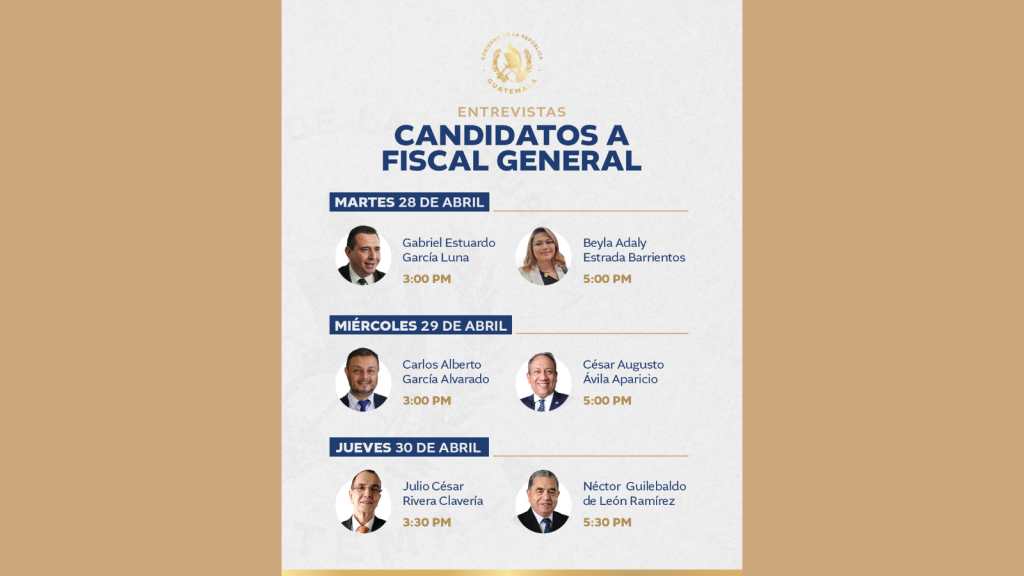
The candidates for the position are Gabriel Estuardo García Luna; Beyla Adaly Estrada Barrientos; Carlos Alberto García Alvarado; César Augusto Ávila Aparicio; Julio César Rivera Clavería; and Néctor Guilebaldo de León Ramírez.
García Luna and Estrada Barrientos will be interviewed this April 28; García Alvarado and Ávila Aparicio on the 29th; leaving Rivera Clavería and León Ramírez until April 30.
Despite inquiries made by journalists and observation groups, Arévalo made the decision to meet privately with each of the candidates.
Arévalo’s period has been marked by MP investigations that suggest alleged electoral fraud, which led to the cancellation of Movimiento Semilla and some militants of the defunct party facing criminal charges.
Is there a lack of transparency?
The attorney general renewal process was carried out by a nomination commission, which, despite doubts, showed transparency and public meetings, sharing the official documents of the decisions that were made.
But that transparency was relegated now that the process is in the hands of President Bernardo Arévalo, who chose to hold private interviews, something that is questionable according to the independent observer, Alejandro Solórzano.
“Ideological and political approaches may be given for those who refrain from making it public. A central point is that the future prosecutor operates without political pressures,” Solorzano pointed out.
For the observer, Arévalo’s secrecy could be due to the fact that he seeks to have a clear reading of how the potential attorney general sees the government and its authorities, who at least with this MP have been the subject of investigations.
“I think that the president should think about a change in criminal policy, I don’t think he sees that; I think he rather sees the relationship with the authorities in power and sectors outside the government, the private sector, allies of Guatemala,” said.
For his part, Pablo Escobar Guerra, strategic advocacy coordinator of the National Civic Movement (MCN), also questions the secrecy that Arévalo is using to interview the future attorney general.
“The fact that the interviews are outside public scrutiny is not a minor detail, if we have to pay attention to it and it is worrying. The postulator gave publicity to her sessions, now the transparency of the process is going back,” he pointed out.
The main doubt that it generates in Escobar is the tension that exists between the government and the MP, an institution that has investigated the president himself and that maintains open cases against people close to the ruling party.
“The president’s decision must go through citizen trust and legitimacy, that is what happens with public decisions. The MP investigated the official party, it directly impacted the ruling party, and that generates tensions,” ihe indicated.
Alejandro Rodríguez, analyst at Impunity Watch, explains that although interviews are a common process in these processes, there is no legal obligation that requires them to be carried out publicly.
“The law does not establish how the interview should be conducted, we have seen that this has been the general trend of all presidents. The president acts in accordance with what has been traditionally established,” indicates.
Arévalo is taking the same steps as his predecessors, Jimmy Morales and Alejandro Giammattei, to appoint an attorney general: interviewing them behind closed doors. Giammattei’s talks with the candidates were broadcast on the government channel.
“It would always be more convenient if public discussions could be held, but the law authorizes it to be done this way,” analyst Rodríguez reaffirms about the interview process.
Reward honorability
Among the six options that the president has to name the new head of the MP, both Solórzano, Escobar and Rodríguez agree that the president has to prioritize the honorability of the candidates.
“You must analyze the trajectory of independence, technical capacity and ethics. You should not review CV, the commission has already done that, you must assess the applicant’s history in the justice system,” Solórzano explained.
Reaching that honorability analysis, he indicates, can be done by evaluating people close to the candidate. “See what circles he met with to detect possible conflicts of interest and an understanding of the institutional democratic system. Public trust must be recovered and that depends a lot on the future attorney general.”
The recent record left in the MP is not the best, according to Escobar. That is why he considers it vital that the president’s decision has technical and objective support.
“The president should not make decisions based on affinities or political situation. Independence must be fundamental, it is not enough for a candidate to say it, his career must be evaluated. A good prosecutor is not the one who pursues the most but the one who investigates the best”he pointed out.
Rodríguez also hopes that the president will make the honorability of the future attorney general a priority, since he will be in charge of the MP for the next four years due to the lack of agile processes for a possible dismissal.
“The president can ask about the dismissals, he must see which policy is the most efficient and responsible to the people of Guatemala. It would be convenient to address these issues to see what is expected of the new prosecutor and that decisions of impunity be reversed,” he concluded.
The president must appoint the future attorney general before Sunday, May 17, the date on which the last report from María Consuelo Porras to the MP and the inauguration of her successor are expected.