
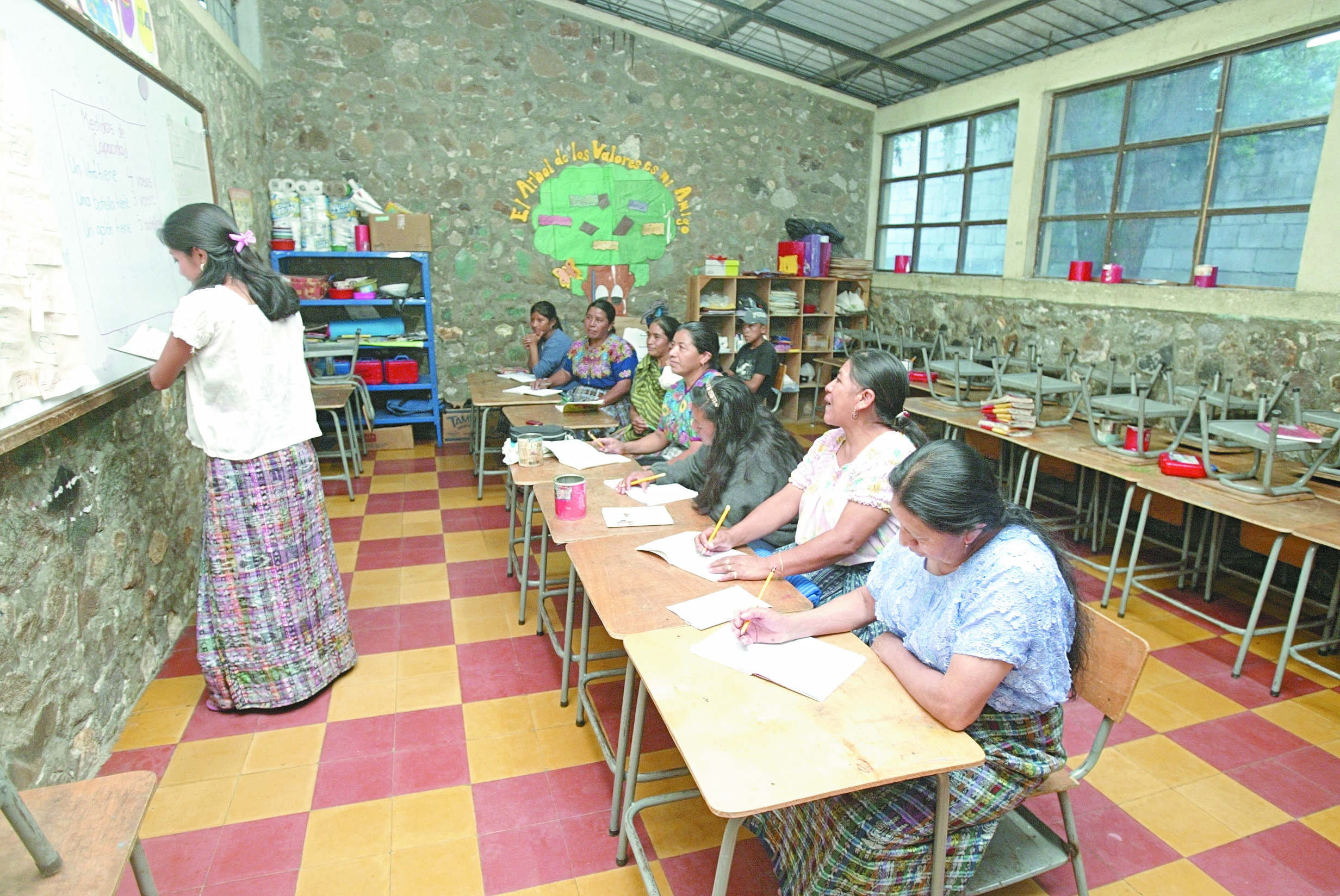
In Guatemala still There are 1.8 million people over 15 years of age who do not know how to read or writeand six out of every 10 are women, according to projections from the National Institute of Statistics (INE) for 2025.
This population could be covered by the National Literacy Council (Conalfa) to achieve literacy and elementary mathematical calculation skills; However, deputies and authorities of the Ministry of Education (Mineduc) propose that The institution’s strategy must be updated or, at one extreme, disappear.
Representative Lucrecia Palomo pointed out, during a technical work table with Mineduc authorities, that Conalfa was created in the 1980swhen necessary. At that time, illiteracy reached 52% in Guatemala, partly due to the low coverage of the educational system.
Currently, the portfolio has a presence in almost the entire national territory, which is why the legislator questions the need for Conalfa in the country and proposes that the budget it receives be directed to the Mineduc; this year it amounts to Q433.1 million.
“Conalfa is given too much money for how little it works. Before, they got large groups in the villages where they could teach literacy; now they have to go hunting to see who wants to learn to read and write, and the budget goes to advisors. It is better that this money goes to the Ministry of Education for kindergartens and first grade, which is where you learn to read and write,” says Palomo.
Last year, the institution had a budget of Q401.5 million and, according to information published on its web portal, by October there were 92 thousand 638 people registered in the literacy process; 73% were women.
Coverage
During the working group, Francisco Cabrera, Vice Minister of Education, indicated that the Conalfa model was conceived four decades ago, when one in two Guatemalans over the age of 15 did not know how to read or write, a figure that in the currently reduced to 15%.
This proportion corresponds mostly to adults, over 25 years old; but in the young people between 15 and 24 years old the number is reduced to 4%.
Cabrera pointed out that a change of focus is required, in which Conalfa approaches where those groups that have not been literate are, which are mainly women who are in rural areas and in departments with high poverty rates.
“We must make a change in strategy, which could be achieved with modifications to the Literacy Law, in which specific groups are served,” indicates the vice minister, since the global reach strategy that was in place in the 1980s no longer works.
Furthermore, within that 15% it is necessary to identify those who really want to learn to read and write, since it is considered that an adult, even if they have a literacy teacher nearby, is not always willing to do so.
Conalfa staff have previously stated that the causes that prevent them from getting involved in the process can be diverse, such as having other priorities – mainly work – or social limitations, such as machismo in the case of women. The conditions of poverty and extreme povertysocial exclusion, the lack of basic services and the limited presence of the State in their communities also make it difficult to achieve basic literacy and mathematical calculation skills.
By 2025, in Alta Verapaz there were 265 thousand 53 people who did not learn to read or write of the stipulated school age, and six out of 10 were women. The same occurs in Huehuetenango, where the figure is 227 thousand 44, and in Quiché, 213 thousand 38.
In Palomo’s opinion, the General Directorate of Extracurricular Education (Digeex) could reach those people who have not been literate because they left the school system.