
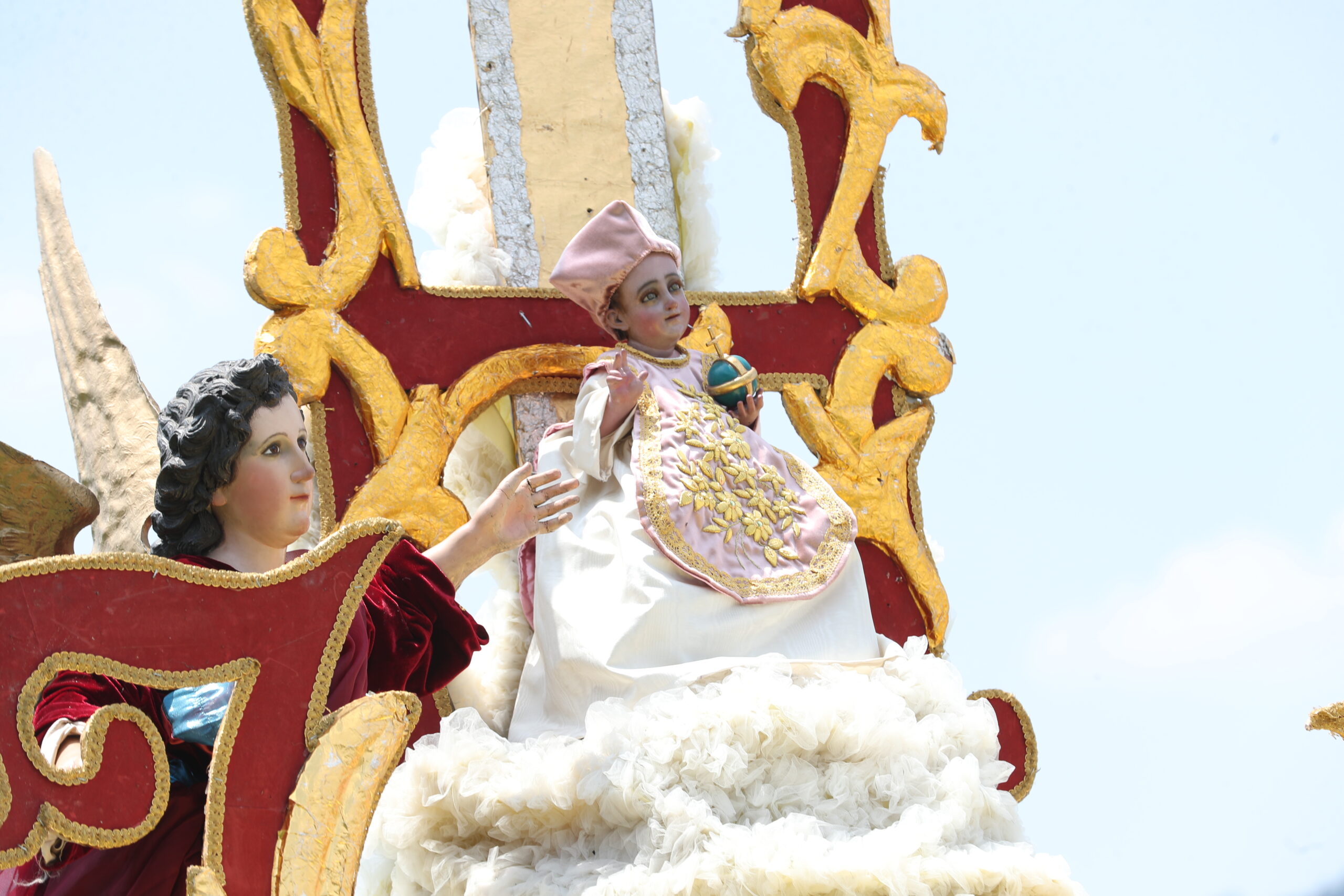
May 3 is the date on which the Catholic Church celebrates the Day of the Cross, commemorating the discovery in Jerusalem of the cross on which Christ died, the search for which was led by Saint Helena, mother of Emperor Constantine.
Devotion to the Child God of Amatitlán dates back to when the Poqomam people of Pampichí, located on the shores of Lake Amatitlán, expressed deep veneration for this image, considered miraculous and visited by faithful devotees from different places, says the Ministry of Culture and Sports.
The processional route begins with the celebration of the Holy Eucharist. Subsequently, the land processional procession takes place through the main streets and avenues of the municipality until reaching the shore of the lake. At this point, the image of the Child Jesus is placed on a boat specially prepared to continue the aquatic journey to the area known as La Silla de Piedra. After this journey, the image returns again to the shore of the lake to resume the land route, which culminates in the San Juan Bautista Parish Church, in Amatitlán.
On May 2, 2007, through Government Agreement 292-2007, the Aquatic Procession of the Pilgrimage of the Child God of San Juan Amatitlán was declared Intangible Cultural Heritage of the Nation by the Ministry of Culture and Sports
The veneration of the Child Jesus inherited elements of the indigenous cult of the protective spirit of the lake, which was conceived with a childish appearance, according to an article published in D Magazine.
In this tradition there is burning of rockets, floral offerings, incense, decorated boats and a small sailor who seems to travel back in time, when this place had another name: Pampichí.
Antonio de Fuentes y Guzmán, colonial chronicler, described it in 1690: “The town of Pampichí, located on the southern shore of the lagoon, has thirty very poor neighbors; its straw-colored church is simple and narrow, although frequented by pilgrimages, due to the miraculous image of the Child of Betlem that they have there.”
“Probably, the veneration of the Child of Amatitlán replaced the pre-Hispanic cult dedicated to the tutelary or nahual spirit of the lake,” explains researcher Manuel Guerra.
Some historians identify this deity as a child who lived in the waters of the lake, whom the ancient settlers pleased by offering gifts that could be ceramic items or stone carvings. This is deduced from the large number of figurines that have been rescued from the bottom by aquatic archaeologists.