
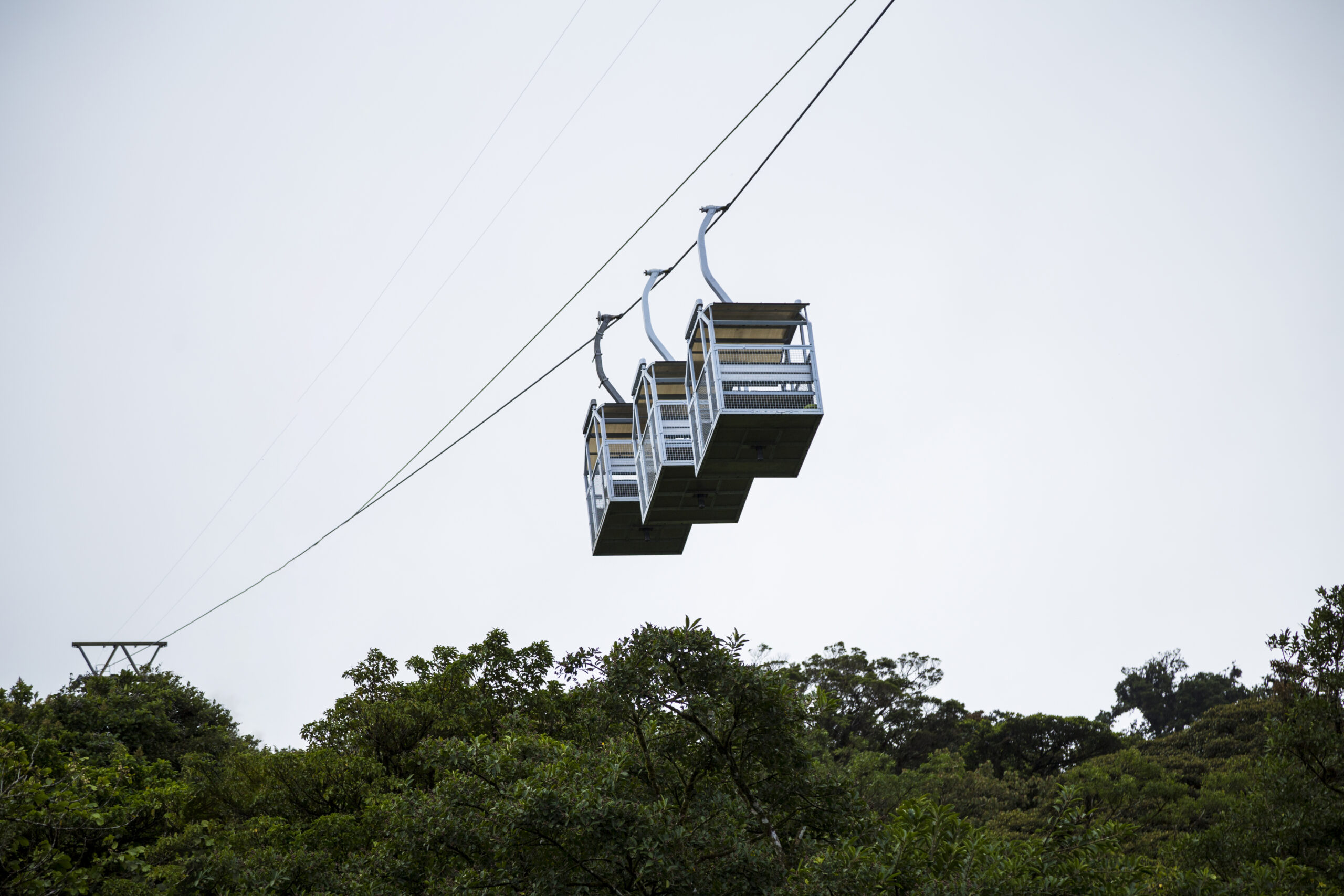
Urban cable cars are proposed as a mobility solution in the country. The Aerometro is currently being built, whose project will connect Guatemala City with the municipality of Mixco. The system seeks to reduce travel times by 70%, going from journeys of several hours to approximately 28 minutes between Mixco and El Trébol. In addition, it is expected to transport 75 thousand people per day.
Quetzaltenango, Escuintla, Chimaltenango, Izabal, Zacapa and Chiquimula are some of the departments of the country where air mobility projects could be executed, due to their territorial conditions and population growth.
According to José Guillermo Guerrero, executive vice president of the Central American Bank for Economic Integration (CABEI), Guatemala City, like other Latin American cities, faces structural mobility challenges derived from accelerated urban growth. “This generates chronic congestion, long travel times, high social and environmental costs,” he stated.
In this context, he added that aerial cable systems—cable cars, cable buses and aerometers—have proven to be effective in cities with complex topography and high density. “They allow historically excluded areas to be connected to the formal urban system,” he mentioned.
During the Urban Cable Cars forum: the municipal concession model that is transforming mobility in Guatemala, organized by the Greater Ciudad del Sur Commonwealth, Guerrero highlighted the advantages of the Guatemalan model for the construction of these structures.
“The Guatemalan case also contains a central and key element of success: the municipal concession model that allows private efficiency to be aligned with public objectives, distributes risks appropriately and guarantees financial sustainability,” he noted.
Likewise, he explained that large urban infrastructure projects require coordination between different actors. “Local governments provide the vision of the city and democratic legitimacy. The private sector, technical capacity, innovation and operational efficiency,” he indicated.
“This public-private collaboration model is key to transforming complex projects into sustainable solutions that generate a real impact for citizens,” he added. He also indicated that there is interest in these schemes because they strengthen the capacity of local governments to execute highly complex projects with international standards.
A cable car in Antigua Guatemala
In Antigua Guatemala The construction of a cable car is proposed that would connect the La Aurora International Airport with the colonial city.
According to Konstantinos Panagiotou, general director of Doppelmayr, the company that executes the Aerometer in Guatemala, this project already shows progress in studies. “The city’s airport project towards Antigua is one of those that is moving. Studies are being carried out and we have the support of CABEI,” he explained.
He added that the process still requires technical analysis. “We have to see if it is viable with this study, both financial and social impact or the impact we want to generate,” he said.
As indicated, the focus of the project is public transportation. “In the case of Antigua it is a public transport cable car, it is not touristic. Although it will move tourists, the idea is that they can arrive as soon as possible, as well as the inhabitants of the capital, who do not spend hours in traffic on special days,” he explained.
Panagiotou added that the project is advancing in its study phase and has the participation of the central government. “We have already started it, we are working on the feasibility of this study,” he said.
Other candidate locations
Departments such as Escuintla, Chiquimula, Izabal, Zacapa and Chimaltenango appear as possible locations for cable car projects, due to their population and territorial conditions.
Panagiotou explained that these systems can be adapted to different contexts. “Medium and small cities also work, as long as there are problems such as traffic or structures such as mountains, lakes or rivers. There the cable car can work,” he indicated.
However, he noted that financing is a limitation. “Many want to do projects, but we are always limited by the budget,” he said. In that sense, he mentioned the role of private investment. “If the budget is not enough, that is where private initiative can enter through public-private partnerships to make these types of projects that need investment a reality,” he explained.
Guido García, electromechanical project manager at Doppelmayr, agreed on the need for articulated participation. “The participation of different actors is very important, because one cannot do it alone,” he said.
“You cannot do the legislative part, have the money and operate it at the same time. Specializations are needed: the financier, the one who makes the laws and an operator that can be regulated by the municipality,” he explained.
Cecilia Pivaral, member of the Guatemala No Se Detiene infrastructure panel, explained that the viability of these projects depends on technical, legal and demand factors. “For a project to really move forward, you must first validate the demand it may have. The legal certainty of the outline is also key, that is, knowing if the area where the pillars will be placed is public or private property,” he indicated.
He added that these projects must respond to real mobility dynamics. “The important thing about this type of connections is that they are from densely populated cities to other densely populated cities, because people travel mainly for work, study, health or commerce,” he explained.
In that sense, he mentioned examples of possible territorial connections. “Xela with Salcajá, Cobán with other nearby areas or municipalities where there is high mobility. It would also be necessary to analyze where there is traffic in municipal capitals or even places with a high presence of tuc-tucs,” he said.
He also mentioned Chimaltenango as a relevant case. “It has become an important point, even due to the concentration of educational centers, which generates constant mobility from nearby municipalities,” he explained.
Private sector participation
Alessandra Gallio, Councilor II of the Municipality of Guatemala, highlighted the role of municipal concessions. “Today, municipalities have a solid, transparent tool, but above all that allows us to provide certainty. And that is the municipal concession,” he stated.
He explained that currently these can be approved by municipal councils without having to go through Congress. “This opens a door for all municipalities to promote public transportation projects,” he indicated.
He also noted the interest of the private sector. “There is an appetite on the part of the private sector to participate in these systems, to invest and diversify their investments,” he explained.
He added that financing can come from multilateral or national banks. Likewise, he highlighted the reforms to Decree 16-2010, Law of Alliances for the Development of Economic Infrastructure. “They opened opportunities for concessions and public-private alliances, allowing financing beyond municipal periods,” he indicated.
Along these lines, Cecilia Pivaral explained how these schemes work. “The municipal concession invites private parties to invest in public services, where the State does not invest directly, but rather receives a royalty for the right of use,” he noted.
Likewise, he explained the difference between models. “In the concession, the investment risk falls on the private party. While in public-private alliances, risks can be shared between the public and private entities,” he explained.
Projects in Latin America
Some countries in the region have chosen to develop mobility projects in different modalities:
Railways
- Pacific Train in El Salvador, is in the pre-feasibility study phase
- Expansion of the TELCA freight train in Costa Rica is in the feasibility phase
- Train 2C Metro Santo Domingo, in the Dominican Republic, is in the execution phase
- GAM Fast Passenger Train in Costa Rica, is in the execution phase
aerial cable
- Cable Desamparados in San José, Costa Rica, is in the pre-feasibility study phase
- La Aurora–Antigua Guatemala Airport is in the pre-feasibility study phase
- TeguzCable in Honduras is in the feasibility phase
Integration/BTR
- Development of Line 5 Metro / Western Panama Integration, is in the pre-feasibility study phase