
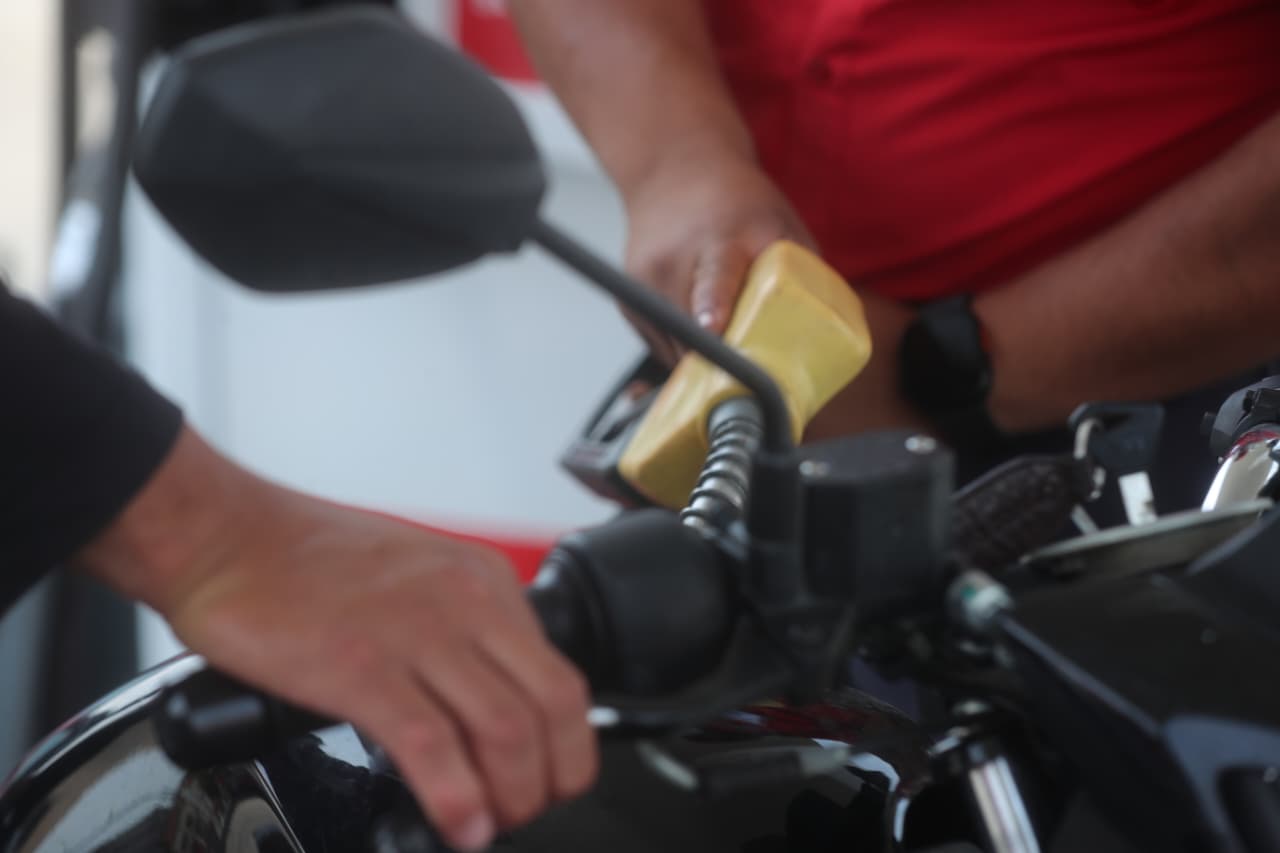
In the second week of application of the subsidy, the price of fuel shows an increase of around Q2.60 per gallon of gasoline and Q1.60 per gallon of diesel, both in terminal prices (called Ex-Rack) and for the final consumer, according to the new reference prices of the Ministry of Energy and Mines (MEM).
In this regard, the MEM reported on the reference prices in force for the week of May 5 to 11, in compliance with the provisions of Ministerial Agreement 189-2026, which regulates the calculation mechanism.
When this institution was consulted about the increase, it stated that prices are subject to the international market and that the aforementioned mechanism was used. This applies from April 28, when the subsidy came into effect (according to Decree 11-2026 and its regulations), and the reference prices are calculated for a period of one week.
In this regard, distributors and importers present their position, while an economic and financial analyst recommends entities implement greater controls.
The Minister of Economy, Gabriela García, said, after a summons in Congress, that the price of a barrel of oil rose to US$106 and that the amount of the subsidy per gallon is fixed, regardless of what happens in the international fluctuation of oil and its derivatives. For this reason, he explained that through the Diaco, it must ensure that the subsidy is applied and monitor prices.
“The fact that the barrel of oil is rising implies that there will be an increase not only in Guatemala, but in the entire world, and what the subsidy does is remain at Q8 and Q5,” said the official.
Regarding the prices of products in the basic basket, he said that they remain stable and have remained within the normal range of the season. He added that the fact that the subsidy was granted to diesel—which has the most impact on the logistics chain for the transportation of basic basket products—has helped mitigate the skyrocketing of prices, although he insisted that before the subsidy they were quite stable.
Gas stations
Enrique Meléndez, executive director of the Guatemalan Association of Gasoline Retailers (Ageg), said that the maximum reference prices are issued by the General Directorate of Hydrocarbons (DGH) of the MEM, based on the formula established in the ministerial agreement.
The manager argued that the international market has had rising prices and considers that this behavior is now reflected in said reference prices, effective since May 5.
CONTENT FOR SUBSCRIBERS
Asked about the amount of the increase compared to last week, he explained that, derived from the application of the subsidy, at this time they are prices that he classifies as regulated, but in which the increase is also reflected. He pointed out that, when the price is managed in the market, the sector is criticized by pointing out the increases, but that it must be taken into account that the international market has risen.
The executive mentioned that, with the mechanism implemented by the MEM based on the approved legislation and regulations, said institution takes the prices from the previous week, which marked higher international prices.
To estimate each reference price, the MEM uses data from five days ago, and the differential marked that increase, because in that period there were significant increases in the international market.
Regarding how gas stations apply the reference price if they still have inventories from the previous week – that is, from May 4 back, when they were lower -, Meléndez said that they are applied from the day the weekly reference prices change, because the regulation only establishes that inventories had to be depleted in cases in which they were acquired before the subsidy came into effect.
Meléndez said that the inventory is only taken into account for the start and end of the subsidy, but that “now that the product has a subsidy, the prices are modified on the day that they (MEM and DGH) set,” which in this case is from May 5. Likewise, if the reference price had decreased, the reduction would have to be applied, he added.
The way in which prices have been managed in the market before the price regulated by the subsidy came into effect is not based on how the gas station or the importer buys, but on the price or replacement cost and the movement of the market. That is, you cannot wait for the inventory to run out, because it has very high rotations.
Importers
José Briones, executive director of the Guild of Hydrocarbon Importing Companies (GEIH), commented that the subsidy is being fully applied, although the first two days it depended on the inventory levels that some stations had.
He said that, from the importing sector, all the terminals have been delivering product with the corresponding subsidy and he considers that it is working well. He added that, since the subsidy already worked in recent experiences in previous years, that facilitated the processes and is advancing appropriately.
He agreed that, regarding the recent increase, if there were no subsidy the effect would have been greater.
The executive of the importers’ union said that what is happening in the international market is affecting all countries, including Guatemala, and believes that no more can be done than what is already being done with the support, except to promote savings measures.
Regarding the increase that is reflected this week in prices, he indicated that it derives from a fluctuation in international prices last week and that this week there was a new increase; However, in the country, with the subsidy, it is not so magnified, because without that subsidy it would have been much stronger.
He added that, regarding the international price, there is no influence and there is no valid prediction at present.
Regarding the requests for greater controls by the MEM and the Diaco, as well as investigations by the Public Ministry (MP), raised by other sectors due to the perception of possible malicious management of rising prices by importers, Briones said that the companies are law-abiding, respectful and formal. In addition, he believed that the MEM has a professional team with many years of experience and that all entities must be aware of what they monitor.
Asked about the criticism that when the international price rises the reflection in the national price is almost immediate but the decreases are not perceived with the same speed, he commented that competition has grown in the number of stations and that there are statistics that show that the reflection of the international market is similar in both cases and is subject to market conditions.
Recommends strengthening price verification
Regarding the effect of the subsidy and the increase in the price of fuel, Ricardo Barrientos, executive director of the Central American Institute of Fiscal Studies (Icefi), said that prices are lower than if the subsidy were not applied and recognizes that this has a share of success, because prices were lower by Q40 per gallon.
However, he explained that several aspects are perceived. One is that the reduction should have been greater and, derived from this, it is perceived that a factor that could be reducing the beneficial impact of the subsidy could be due to malicious price manipulation by importing companies.
CONTENT FOR SUBSCRIBERS
He clarified that it is a perception, but that it is an aspect that must be verified by the entities in charge, such as the MEM, the SAT and the Diaco. These should request the Public Ministry to not only investigate the service stations, but also the importers, and to provide quantitative technical information on the structuring of fuel purchase prices in the last two weeks.
Considers that the MP is responsible, according to its legal and constitutional powers and what is established by the Penal Code, to investigate price speculation. He added that it is known that the MP carried out investigations at gas stations, but it will be up to him to investigate companies that import petroleum-derived fuels.
Only with the increase in the second week of the subsidy, half of the effect was lost on the gallon of gasoline and a fifth on the gallon of diesel, Barrientos said.
The subsidy for gasoline is Q5 per gallon, while the increase in the reference price this week is Q2.60; For diesel, the subsidy is Q8 and the increase was Q1.60 per gallon.
New reference prices
For the week of May 5 to 11, the MEM issued the following reference prices:
- Prices at the terminal (Ex-Rack): the gallon of premium gasoline is Q36.56 and the regular one is Q35.56; In both cases, the increase is Q2.57. For diesel it is Q33.16; Before it was at Q31.55, with an increase of Q1.61.
- Price for the consumer: in Guatemala City, in the self-service mode, the price of premium gasoline is Q39.33 and that of regular gasoline, Q38.33. In both cases, the increase is Q2.57 per gallon, and diesel is Q35.93, with an increase of Q1.61.