
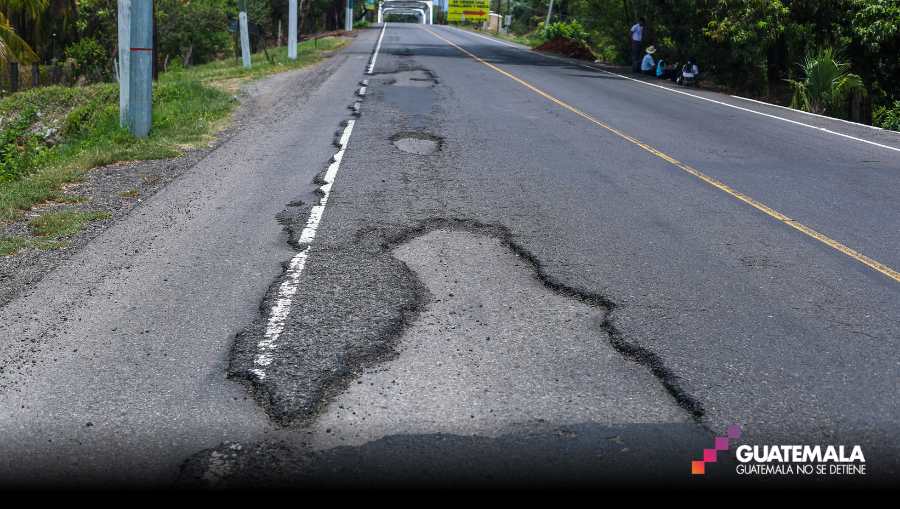
The approval of Decree 29-2024, Priority Road Infrastructure Law, contemplated some legal mechanisms so that the country’s main roads can be intervened more quickly in the event of an emergency or during the rainy season. This is article 95, which allows you to skip some common administrative processes and work immediately on the sections that require it.
According to Delfino Mendoza, a member of the infrastructure table of Guatemala No Se Detiene, although the Directorate of Priority Road Projects (DIPP), whose law contemplates it, has not yet come into operation, the article provides mechanisms that would allow the Ministry of Communications, Infrastructure and Housing (CIV) to make contracts more quickly.
“This methodology was designed to be able to make some contracts in an agile manner while the DIPP assumes complete functions, once it is 100% organized. That is the objective of article 95,” he explained.
In this context, Mendoza pointed out that a tender on average can take between four and six months to formalize a contract and start work. He explained that the procedure established in the law implies that, once the project is approved, the CIV must prioritize it, prepare a profile that justifies the need and the emergency, and request an opinion from the National Coordinator for Disaster Reduction (Conred).
“Once the favorable opinion is issued by Conred, the project should be contracted in 15 days. That is what the law says, because it is practically a direct contract. It is a substantial difference in time,” he indicated.
He added that this modality does not omit the publication in Guatecompras and follows the normal procedure. Likewise, he considered that, if article 95 had been applied since last year, we could already be seeing the first rehabilitated sections.
For his part, Amador Carballido, director of Agexport, explained that infrastructure has a direct relationship with economic development. “Infrastructure produces development. A country with good roads, with good bridges, with borders, airports and ports in good condition, well located and in sufficient quantities, generates development,” he stated.
“There are global indicators that indicate that infrastructure, when it is in operation, helps the growth of the country’s gross domestic product (GDP). There are measurements that speak of an impact that ranges from 2% to 10% of the GDP,” he indicated.
According to Carballido, the state of the roads directly affects economic activity. “For cargo activity, in import and export, in tourism and in the mobility that we all need to get to our jobs, having roads in good condition produces productivity,” he pointed out.
Along the same lines, Herlindo Herrera, Director of Communications of the Logistics Union, pointed out that the deterioration of the road network has direct effects on the costs for the population. “The poor condition of the roads impacts the economy of the entire population, on expenses and costs, such as fuel and transit times, and in the end it is reflected in supermarkets, where everything becomes more expensive,” he stated.
In addition, he explained that transportation efficiency has been reduced. “Before we traveled at speeds of between 50 and 80 kilometers per hour; currently we are between 40 or, sometimes, 30 km/h. This means that more fuel is used and, therefore, freight is more expensive,” he indicated.
He added that this also has an impact on logistical times. “The time to travel from ports to the city or from border to border becomes slower. In a 100-kilometer stretch, which in a country with good infrastructure could be done in one day, here it can take up to two days,” he said.
Projects in progress
Among the projects that are executed under this mechanism are:
- Recapeo RN-02 Fraijanes–Santa Elena Barillas, Fraijanes, CA-01 Oriente
- Recapeo CA-02 Oriente El Jobo–Taxisco, Taxisco and Chiquimulilla, CA-02 Oriente
- Recapeo CA-02 Oriente Chiquimulilla–Las Lisas, Chiquimulilla, CA-02 Oriente
- Recapeo village of El Ingeniero–Quezaltepeque, Chiquimula and Quezaltepeque, CA-10
- Recapeo CA-10 Río Hondo–Gualán, Río Hondo and Gualán, CA-09 North
- Recapeo RN-17 La Cumbre–Perdido Child, Morazán, CA-14
- Recapeo CA-01 West San Carlos Sija–Palogá, San Carlos Sija, CA-01 West
- Recapeo Escuintla–Siquinalá, Escuintla and Siquinalá, CA-02 West
- Recapeo Retalhuleu–Coatepeque, El Asintal and Coatepeque, CA-02 West
- Recapeo Vigen–Huehuetenango, San Bartolomé Jocotenango, CA-01 West
Time reduction
Mendoza explained that the State Contracting Law (LCE) establishes processes that can extend execution times. “For construction work, the law mandates that there must be engineering studies. Generally, institutions do not have the personnel and equipment to do it in an agile manner, so they end up hiring a company,” he said.
This implies a first tender for the studies and, subsequently, others for the work and supervision. “Let’s be optimistic: it will take four months, but depending on the magnitude of the project it could be another six, eight or ten months to carry out the studies, and from there to tender the work and the supervision. There are two tenders,” he explained.
He reiterated that, faced with this scenario, article 95 proposes a different scheme. “We are saving the bidding for the studies and the time to do them, because it is a design and construction contract. The awarded company must propose its solution, it is approved by the Highway Directorate or the contracting entity and the work begins immediately,” he stated.
For his part, Carballido indicated that the scope of the regulations goes beyond a single article. “Really, the entire law—not just article 95—has the capacity to help, at least, accelerate the processes of construction, authorization and improvement, even if it is patchy, of the main roads in Guatemala, such as the Central American routes,” he noted.
As detailed, the law is conceived around three axes. “One, speed up the process, so that it is not as long as it is today to fix a road. It takes any amount of time due to the normal processes, the bureaucracy in the ministry and, in some cases, the attitude of the supervising authorities. The mix of this makes the times very long,” he indicated.
He added that it also allows diversifying contracting modalities. “I can hire companies through different mechanisms, which allows me to expand the amount of money I can use or for the company to contribute more resources, and then the government does not disburse as much. I am using different types of contracts that allow a variety of arrangements,” he stated.
As a third axis, he pointed out the transparency component. “So, we have firstly speed, secondly contracting modalities and, thirdly, transparency to avoid corruption. The purposes and spirit of the law are conceived within those three terms,” he said.
However, he also referred to the results observed so far. “In execution we have presented serious problems to achieve these objectives. As the law goes, which was approved in 2024, we have very little, to say almost nothing, despite that time,” he concluded.
DIPP urgently
Mendoza pointed out that one of the main obstacles in the implementation of the law has been the absence of its regulations. “We fall back a little into the vicious circle in which we have been: we are not moving forward with the regulations and we want to apply the law without regulations. That complicates the situation,” he explained.
He indicated that, although the regulations define the general steps for emergency hiring, they refer the specific procedures to a regulation that has not yet been approved. “Although it indicates the main steps of how to carry out the contracts, in the end it always indicates that the procedures will be established in the regulations and today there are still no regulations. This has made the contracting process, even under this emergency regime, more delayed,” he stated.
He added that the implementation began late and with adjustments underway. “It has started a little late, it can still help, but since there is no established procedure because there is no regulation of the law, they are making adjustments on the fly. The 15 days that the law establishes are not being met, but rather it is taking more time,” he indicated.
In this context, he considered that one of the priority actions is to advance the pending regulations and the planned institutions. “The urgent thing would be to streamline not only the regulations of the Priority Road Infrastructure Law, but also the implementation of the operation of the DIPP, because that could facilitate the process,” he explained.
Herrera also warned about the lack of advance planning. “We always wait for winter with concern, because there are landslides that were not attended to since the previous year. If the rains are stronger, the problems repeat themselves,” he said.
Candidate locations
Mendoza explained that the identification of the sections to intervene depends on a technical evaluation by the Ministry of Communications. “A very specific case could be a bridge in which it is detected that it has cracks or that there is an undercut and that can collapse with the first rains and a flood of the river,” he noted.
He indicated that other types of effects can also be considered. “The ministry identifies the problem, which could be a landslide, a collapse or even sections where the condition of the road – the rolling surface – is very bad. Then it defines the project, justifies the emergency and requests Conred’s opinion to proceed with the contracting,” he explained.
He added that the law delimits the type of routes that can be intervened under this mechanism. “It refers to the sections that remained under the responsibility of the DIPP, that is, the Central American highways and routes in the metropolitan area already well specified,” he indicated.
Herrera highlighted the strategic importance of these roads. “Central American routes are key for trade, especially corridors like CA-2, where much of the regional exchange circulates,” he noted.
Transparency is required
Mendoza pointed out that one of the factors that affects contracting times is the way in which the ministry has decided to apply the mechanism. “I think that is what is delaying the ministry’s hiring, because it made the decision to make some contracts using this methodology that has been available since last year. It could have moved forward sooner, but since there is no established procedure due to the lack of regulations, some delays are generated,” he explained.
He added that, in this context, additional steps have been incorporated with the aim of guaranteeing transparency. “In the spirit of guaranteeing transparency, extra steps end up being taken, because there is no established procedure,” he indicated.
As detailed, instead of opting for a single offer in a direct contract, comparisons between several proposals are being used. “They are requesting not a single offer, but asking for three offers or whatever they are and, within those, selecting the one that best suits. It is a good way to guarantee transparency, but it is something that the law does not require,” he stated.
In that sense, he pointed out that this practice has effects on deadlines. “On the one hand, transparency is justified, but the procedure is delayed a little. They are not leaving the 15 days that the law says; they are taking longer,” he mentioned.
Roadmap
Carballido proposed an action route in three stages to address the road network. “The first point will always be to stabilize roads that are in poor condition, where there are landslides, obstructions or a bridge in poor condition,” he explained.
He indicated that the second element is the anticipation of the rainy season. “In the case of winter, what we would be doing would be thinking about fixing places where there is a lot of risk and that will allow the roads to not be disabled when it rains,” he said.
He added that the third component is the development of new infrastructure and the improvement of the existing one. “The third element is to expand, improve and build new or existing roads to expand their capacities and improve viability,” he stated.
Find more Guatemala Doesn’t Stop on our video channels Free press and Guatevision, alliance content focused on solutions journalism.