
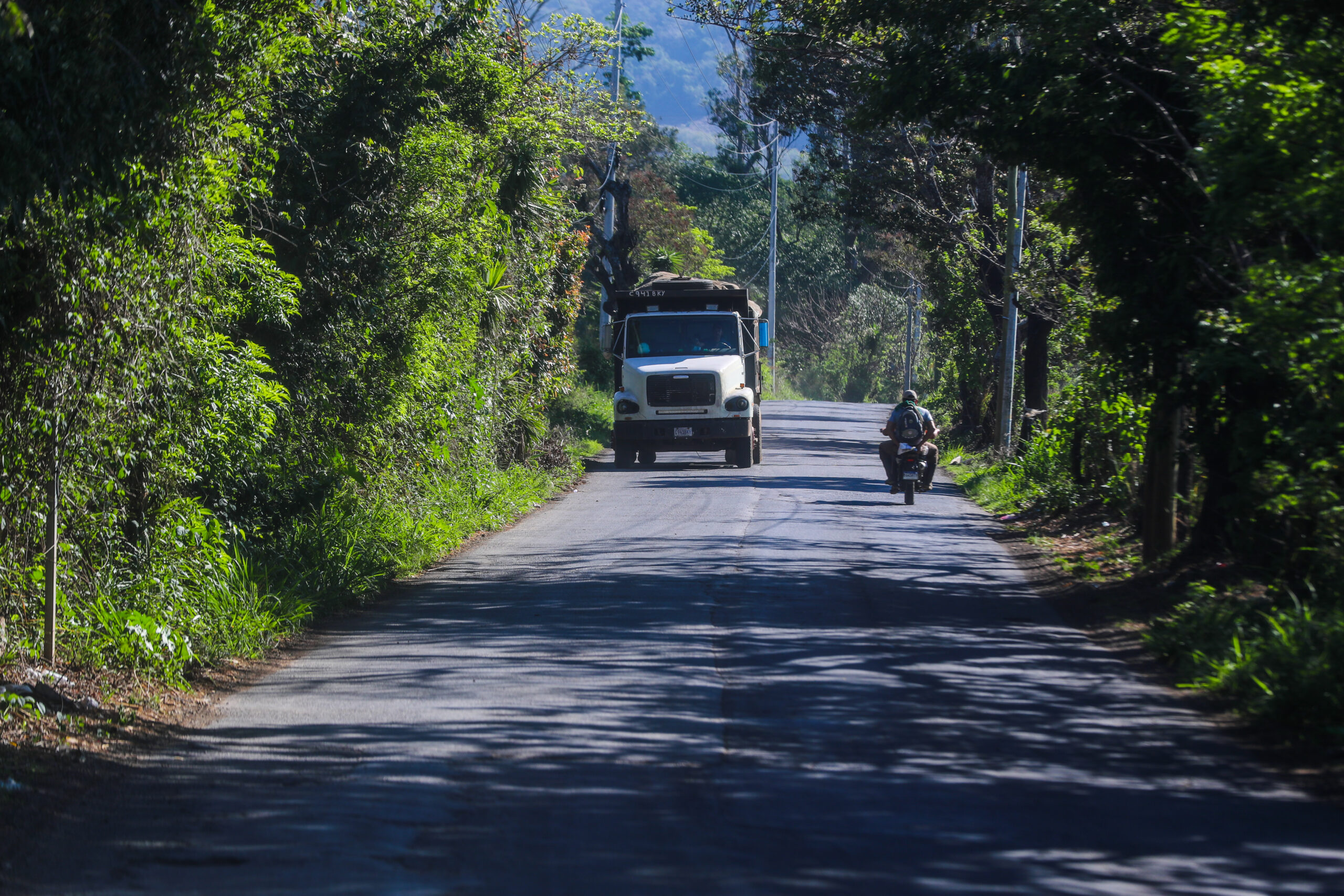
The approval of the Priority Road Infrastructure Law, through article 95, establishes that the executing units of the Ministry of Communications, Infrastructure and Housing (CIV) can grant road infrastructure contracts for a period of no more than 36 months, counted from the validity of the law.
This article facilitates the expediting of projects through a “special emergency bidding modality”, designed to reduce work execution times. The legal mechanism focuses on allowing rapid intervention of roads, especially during the rainy season.
During The Talksegment of Guatemala Doesn’t Stophow to have more rain-resistant roads was addressed. José Ardón, executive director of the Guatemalan Chamber of the Construction Industry, and Cecilia Pivaral, member of the infrastructure table of Guatemala Doesn’t Stop. The segment was moderated by Rocío Lazo.
According to Pivaral, the last winters in the country have been critical. “We have seen that the rains are increasingly heavy and there is a danger of flooding and the bridges not supporting. Maintenance is key for all this road infrastructure that connects us,” he explained.
In that sense, Ardón also agreed that planning is one of the problems facing the country. He added that multi-year planning must be implemented and a budget assigned that responds to the need for planning and prioritization of the main sections that must be intervened.
“Let’s think about a road being like a car. We can have signs of when we should take it to the shop or give it preventive maintenance. This is something we can do every year with roads,” he commented.
Ardón mentioned that maintenance is not carried out because institutions like Covial, when allocating funds, do not prioritize or develop plans that respond to the infrastructure needs required at a given time.
“We reach months like now, in May, in the middle of the rain, and what happens is that we do not have awards made specifically by Covial. We are seeing the projects under the Priority Road Infrastructure modality, but there have been no awards from Covial,” he stated.
Diagnosis of the road network is urgently needed
The creation of the Directorate of Priority Road Projects (DIPP) contemplates carrying out a study of the road network, which would identify critical points in the country that require immediate attention. However, this has not yet been done. On April 25, the deadline stipulated in the law expired.
Within the DIPP schedule, other pending issues are also reported, such as the publication of the regulations—responsibility of the Executive—and the development of financial systems modules and the financial structure of the entity, by the Ministry of Finance (Minfin), Segeplan and the DIPP board.
Ardón explained that the first step is to have a comprehensive diagnosis of the road network. “If one does not have a diagnosis of the inventory of all the road infrastructure — when it was built, how it was built, what materials were used, what the risks are — we will hardly identify when maintenance of a section is due,” he pointed out.
He added that the lack of this type of information causes interventions to be carried out only when emergencies arise. “We arrive at emergencies and that is where we realize which sections were with the greatest risks or those that generate the greatest economic and social impact,” he indicated.
He also mentioned that decisions are not always made based on cost-benefit criteria or impact on trade. “We are talking about roads that connect ports or border posts. It is a series of systemic failures that cause the current situation,” he explained.
For his part, Pivaral indicated that, although article 95 allows for expediting hiring while the DIPP comes into operation, it is necessary to move forward in approving the regulations. “Otherwise, we continue to act only on an emergency basis and it is necessary to work with planning,” he said.
He added that the DIPP contemplates the evaluation of the priority road network, which includes more than 2,500 kilometers of Central American highways that connect ports, borders and the metropolitan area. “Not all sections require the same type of intervention, so planning is key,” he explained.
“It is necessary that the regulations be approved and, once approved, we can request that the resources assigned according to the law enable the DIPP to execute all those actions that the same regulation requires,” he stated.
Supervision required
Ardón indicated that article 95 allows intervention on main roads contemplated in the law; However, he pointed out that other sections of the country also present needs for attention. “The rest of the roads and streets that we have nationwide are also in emergency and are not being intervened,” he indicated.
He explained that the mechanism works as a way to streamline processes, but requires supervision in its execution. “It is important to verify that they are being built with quality materials and that the designs are adequate, to avoid premature deterioration of the infrastructure,” he indicated.
He added that this would help prevent the asset—in this case, the road—from rapidly depreciating. “It’s the same as maintaining a car. If you take a while to do it, it will be more expensive or, if it’s not done, it will be ruined,” he mentioned.
Planning is key
Ardón pointed out the need to move towards more strategic management. “We have to get out of the emergency mentality and start thinking about the future,” he said.
He explained that, if there is already information on the sections that require intervention and those that present greater risks, one can plan further in advance and allocate resources on a multi-year basis. In addition, he added that this would help not be subject to political changes.
“Let’s guarantee resources so that interventions can be carried out preventively. For example, months before the rainy season, instead of acting when the damage is already occurring,” he explained.
He added that, although the margin of action in the current year is limited by the rainy season, it is still possible to plan for the next period. “We have time to think about next year. This has already been done; the ability to prevent in the coming months is very difficult. But we have time for the future,” he indicated.
For his part, Pivaral indicated that the law introduces changes in the form of contracting, by incorporating service indicators. “It is no longer just about contracting a work or supervision in a specific manner, but rather about working with a comprehensive approach to contracts, thinking about years of service,” he explained.
He pointed out that this model involves structuring projects in sections, assigning responsibilities throughout the contractual term. “The idea is that each section has a person responsible over time, under defined parameters. For example, if a landslide occurs, there must be the ability to restore connectivity in a certain number of hours,” he explained.
Pivaral explained that this approach represents a modification in the way road infrastructure has historically been managed. “It implies moving from a work-centered logic to a service-oriented logic,” he indicated.
In that sense, he pointed out that road infrastructure can be understood as a service that articulates different activities. “It connects us in aspects such as health, education, commerce and logistics, in addition to its relationship with employment,” he mentioned.
Find more Guatemala Doesn’t Stop on our video channels Free press and Guatevision, alliance content focused on solutions journalism.