
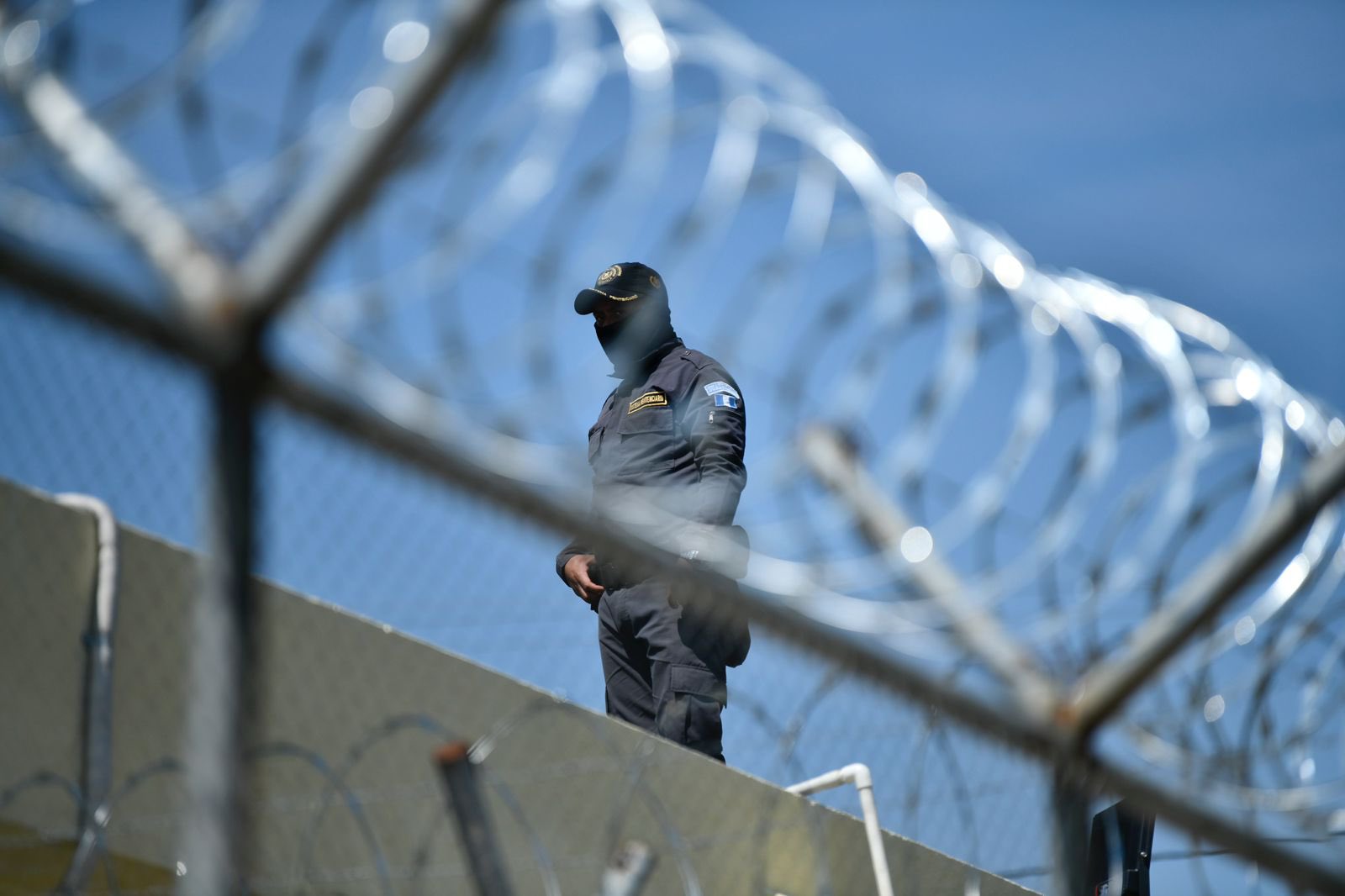
This Tuesday, May 19, the Government presented a strategy to strengthen control of the penitentiary system and advance in the construction and rehabilitation of prisons in the country, as part of the actions to combat organized crime and extortion, as reported at a press conference.
President Bernardo Arévalo affirmed that one of the priorities of his administration is to regain control of the prisons to prevent them from continuing to function as centers from which crimes are ordered.
“The fight against organized crime and narcopolitics is one of the priorities of our government, and we are building relevant changes, so that prisons stop being scholarship territories, which were in the past the universities of crime,” declared Arévalo.
The president pointed out that the strategy seeks to transform the penitentiary system and strengthen security measures within prison centers.
The Minister of the Interior, Marco Antonio Villeda, indicated that the prison system has remained abandoned for decades and assured that the current administration is promoting a comprehensive “reconstruction.”
“The country’s prison system has historically been abandoned,” he said.
Villeda explained that six and a half months ago, when he took office, he warned that it was not possible to develop an effective security strategy on the streets without first regaining control of the prisons.
“You cannot generate a security strategy on the streets if you do not first manage to control what happens inside the prisons,” he said.
He added that the first measures implemented caused a riot that was controlled in less than 24 hours and that, since then, actions have continued to regain control of the detention centers.
“We are regaining control of the prison system,” he assured.
The official recognized that the recovery of prisons is a complex process due to the historical abandonment of prison infrastructure.
“The refoundation of the penitentiary system is not an easy task,” he indicated.
Suspended project
Villeda reported that at the end of March the reconstruction process of the El Triunfo prison in Izabal began, a project that seeks to isolate highly dangerous inmates and reduce overcrowding.
According to the official, the country’s prisons are 340% overcrowded.
However, he explained that the work remains suspended due to a provisional protection granted by an appeals chamber in Izabal.
The minister indicated that the Ministry of the Interior presented an appeal on March 31, 2025 and they hope that the Constitutional Court will revoke the resolution to continue with the work.
“We hope that the Constitutional Court will revoke this provisional protection and allow the construction of this prison,” he said.
He added that the goal is for the prison to become operational within a maximum period of one year.
Masagua Prison will advance to bidding
The head of the Interior also pointed out that the construction project of the Masagua prison, Escuintla, remained stopped due to administrative problems related to the pre-investment phase.
However, he assured that these problems have already been solved and that the project will advance to the bidding stage.
He indicated that the State has already invested Q15 million in that project.
Villeda affirmed that the country needs to expand the prison infrastructure, because for decades no new detention centers were built.
“In almost half a century, a new prison has not been built in Guatemala,” he indicated.
New guards
The official reported that the recruitment of 300 new prison guards is currently underway, who will begin training in June and will complete their training at the end of October.
Subsequently, another process will begin to hire another 300 agents.
According to Villeda, the objective is to have better trained personnel and strengthen the security structure in prisons.
“We need to form a much more trained, much more motivated, better paid and hierarchical prison guard,” he stated.
He added that the authorities seek to improve security protocols and reduce irregular practices within the prison system.
“Our work consists not only of reducing overcrowding in prisons, but also of ensuring compliance with security protocols,” he said.
Isolation center
The minister confirmed that during the early hours of last Saturday, gang members held in Renovación I were transferred to a new pavilion located in the Canada prison.
He explained that the area will function as a Penitentiary Isolation Center and will have reinforced security measures to prevent inmates from communicating with the outside world.
“This pavilion will be known as the Penitentiary Isolation Center,” he stated.
According to him, the objective is to prevent them from continuing to order extortion and other crimes from prison.
“We seek to prevent them from continuing to commit crimes from prisons,” he said.
He added that the pavilion was built in a reserved manner and recently enabled as part of the penitentiary control strategy.
“This new penitentiary isolation center has all the security conditions to isolate these criminals,” he indicated.
He also assured that the new facilities seek to prevent any communication between inmates and criminal structures that operate outside of prison.
“With the construction of these pavilions we intend to completely isolate these individuals,” he stated.
Villeda pointed out that the actions are carried out in coordination with the Penitentiary System, the National Civil Police and the General Directorate of Civil Intelligence.
The official reiterated that the recovery of prisons is part of a broader strategy to combat criminal structures.
“We hope to continue making progress in taking control of the prison system,” he said.
From the #Mingob We are committed to the profound reform of the @_SPGuatemalawhich involves generating conditions that focus on incommunicado and isolating those deprived of liberty. 💪⛓️#WeareComplying #TotalIron pic.twitter.com/8Ncfomu6ho
— MinGob (@mingobguate) May 19, 2026
*Stay up to date with the Now newsletter. Key information at the moment it happens. Subscribe here.