
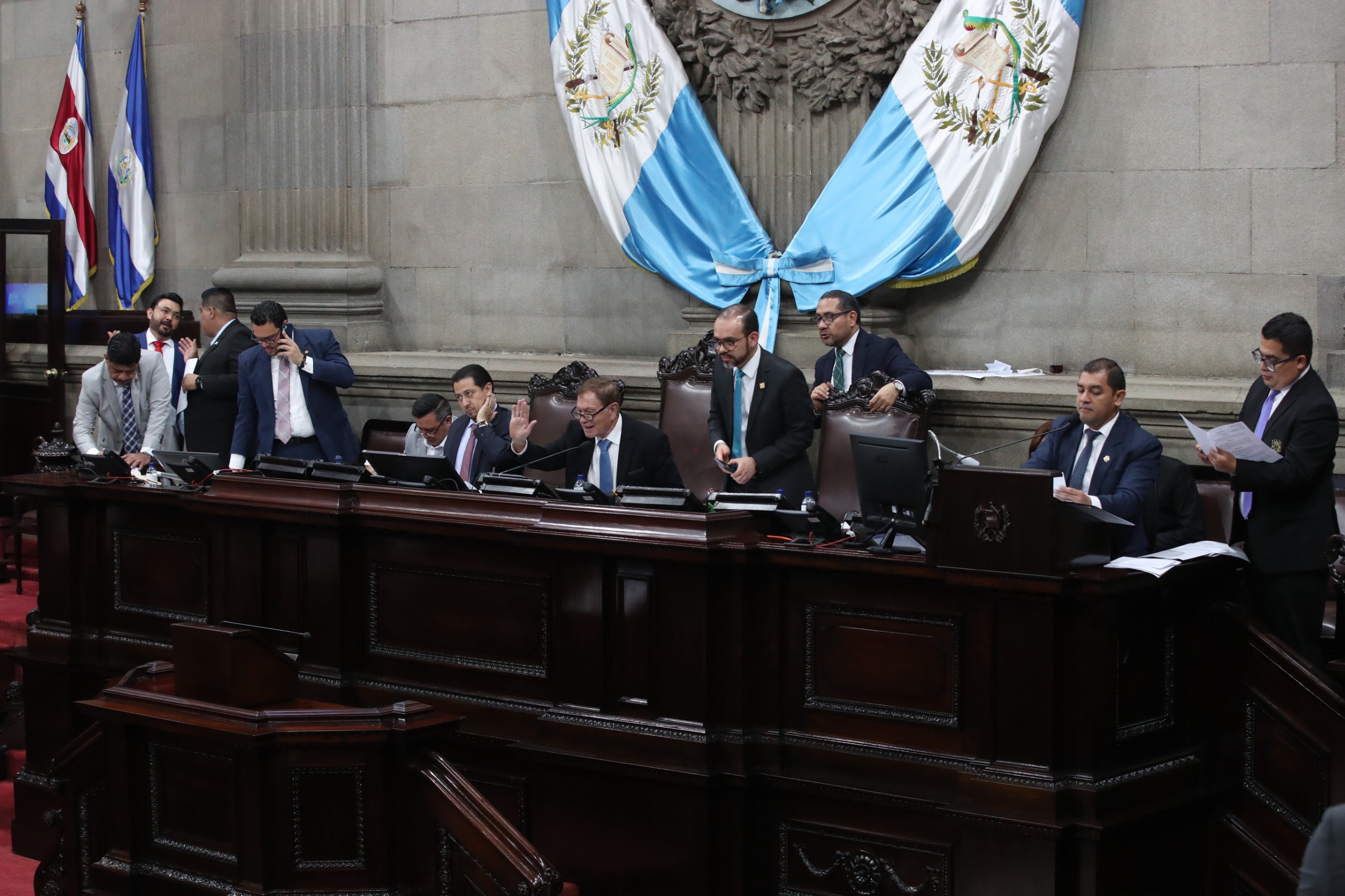
Next Monday, Congress hopes to achieve the necessary consensus to approve the anti-money laundering law in its final wording. But analysts warn that the latest suggestions for changes have weakened the initiative.
Deputies warn that there are eight amendments, of which only four were evaluated in detail on May 18, in a private meeting between the block heads.
The congressmen who make up the Economy Commission also participated in that meeting, held behind closed doors, along with representatives of the Superintendency of Banks (SIB) and the Special Verification Intendance (IVE).
The next call to continue with the evaluation of the amendments is scheduled for Monday, May 25, while the Permanent Commission has already convened the plenary session of deputies for next June 2.
Among the agenda items for that date, the final draft of the anti-money laundering law is expected to be approved, according to the proposal that was shared with the deputies.
Elmer Palencia, second vice president of Congress, trusts that they will reach the necessary consensus to approve the Comprehensive Law against Money Laundering or Other Assets and the Financing of Terrorism.
“I see that there is a will on the part of the Block Chiefs to approve it. I ask that they not be carried away by sensationalist communication, on the contrary, there is a legal and technical opinion to be a good regulation,” he said.
The vice president indicates that of the eight amendments, five would already have a possible agreement, but deputy José Chic, deputy head of the Will Opportunity and Solidarity (VOS) bloc, does not think the same.
“Of the eight, there is still no consensus, we have only begun to evaluate how many comply with the recommendations. This Monday we are going to seek consensus to find out whether or not they are included in the package of amendments,” he said.
They take away your strength
Eddie Cux, an analyst with the Citizen Action organization, believes that the way in which amendments have been presented, without prior consensus, could be a mechanism to delay the approval of the law.
But it also identifies that the wording of these amendments is removing key points from the norm, which could hinder effective criminal prosecution against money laundering activities.
“There are several negative amendments. It is not just an amendment to leave the law as it is; it seeks a fairly strong setback, such as leaving the crime of money laundering dependent, which is as if it did not exist,” he said.
For Cux, the ruling responded to international demands for the nation to arm itself and update itself in the combat of assets, but the changes have been placing obstacles to the norm.
“It appears that there are power groups that are influencing various groups, mainly the opposition. There is an opinion from the Economy Commission, already defended by the Board of Directors, but there is a parallel table to reduce the regime and regulation of the new law,” he said.
poorly written
Francisco Quezada, from the National Economic Research Center (Cien), believes that some of the amendments seek to strengthen the fight against this criminal activity, but identifies that there are serious problems in the wording, which can create confusion during their application.
“I think this law has challenges, undoubtedly, but the formula that everyone uses with amendments is sometimes the worst idea. Really the best way for this to come out in the best possible way is for you to stop giving your opinion,” said the expert.
For him, the best thing the Permanent Commission could do is delegate the drafting to a group of lawyers who are experts in the matter, so that the necessary forms and funds can be refined under the same criteria, since not doing so could be counterproductive.
“The amendments can generate a problem, due to the way they are worded, that is why when it is not reviewed comprehensively, wordings are mixed and confusion increases,” he explained.
Congress is currently on recess, in a pre-electoral year, which may work against the calls for plenary sessions defined by the authorities.
Given the pressure and possible financial complications for the country, Quezada believes that the deputies will approve the law during this period, as long as they reach agreements, for which they do not have much time either.
“I think they are going to approve it. There are many sectors involved. I hope they do it at the best time, with wording with less confusion,” he commented.
The norm, which seeks to update the legal bases to combat money laundering, was presented by President Bernardo Arévalo last year and has since remained under analysis in Congress.
The commission issued the opinion of the norm, which until 2026 began to be processed for its first, second and third readings, but it is in the final draft when the blocks break agreements and expose doubts.
Due to the type of rule, the approval of each of the 126 articles of the opinion, not counting the amendments that finally reach consensus, requires at least 107 favorable votes.