
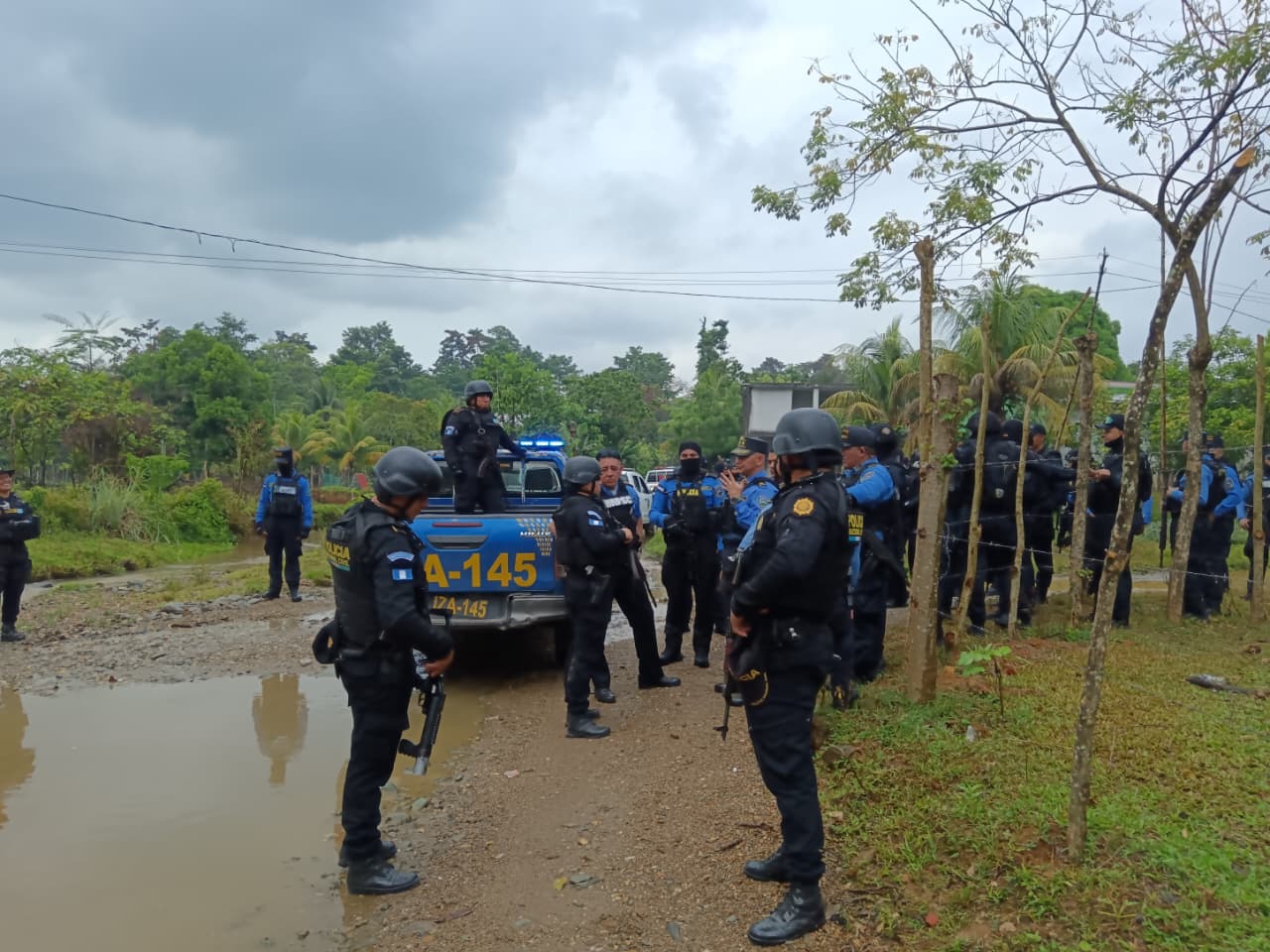
Border security is once again the subject of analysis after in recent days Several armed attacks were recorded that left more than 20 people dead in the area of Corinto, Honduras, on the border with Guatemala, which are attributed to armed groups operating in that sector.
As reported by the Ministry of the Interior, it has coordinated with the Ministry of Defense to reinforce the deployment of security forces, both the National Civil Police (PNC) and the Army, in order to protect Guatemalan citizens who live in this area of the border with Honduras.
A wave of armed attacks has left no less than 20 people dead in the border area between Honduras and Guatemala.
The Minister of the Interior, Marco Antonio Villeda, He stated that the security forces maintain permanent monitoring at border points and coordination with authorities in Honduras to prevent those responsible for the criminal acts from entering Guatemala.
“We have constantly monitored the situation and we have communicated with authorities in the neighboring country to see how the situation is at the border. We have sent several contingents of the National Civil Police to support the border and prevent these people who attacked the Honduran Police from moving to national territory. We have also had the support of the Guatemalan Army,” the official stated.
The head of the Interior portfolio also emphasized that the operations and security actions are concentrated in the bordering areas of Izabal and Chiquimula, where patrols and vehicle controls were increased as a result of the events that occurred on the Honduran side of the border.
The first investigations indicate that five agents of the anti-gang unit were executed in the municipality of Omoa, CourteousHonduras, after raiding a house where members of a gang led by the Honduran Heber Arguetalinked to the Mexican cartel Jalisco Nueva Generación.
Increase resources
According to the independent analyst Óscar Morales, The measure announced by the Executive is positive, but in addition to reinforcing security on the border with Honduras, controls and security measures must also be reinforced on the borders with El Salvador, Belize and Mexico. This is because the “blind spots” that exist on these borders are favorable places for the operations of criminal groups.
“These places are appropriate and are used for drug trafficking, money laundering, human trafficking, illegal migration, prostitution and many other things, as well as for arms trafficking, among other illicit activities,” he says.
Morales also considers that on the part of the State The necessary resources must be allocated for the personnel who provide security, both from the PNC and the Army.which is in charge of carrying out these actions.
“Security personnel, military, police and immigration personnel at the borders cannot work without resources. They require special vehicles, salary increases, staff rotation to avoid exhaustion and also decent working conditions,” says Morales, who also believes that many of the agents who are assigned to these border security tasks neglect their duties as a result of fatigue and long work shifts.
Morales also considers that this type of confrontations in border areas They are promoted by groups “that seek to manage control” to carry out their criminal operations outside the law, which means that in this action there are also collateral victims.
“Phenomenons such as human trafficking and drug trafficking are not exclusive to Guatemala, but are transnational and occur throughout America and Guatemala is a belt through which these phenomena pass. In those areas – border – there are groups that want to manage the area and control certain spaces and sometimes in these situations damaged people, civilian victims, humble people result,” he says.
Given this situation, he also believes it is convenient that there be communication between the Ministry of Foreign Affairs and its counterparts in neighboring countries to coordinate efforts and generate comprehensive security policies and coordination between the countries.
Greater control of the Army
For its part, Francisco Quezada, analyst at the National Economic Research Center (Cien)considers the measure to reinforce border security to be positive, but emphasizes that it is the Army that must concentrate on carrying out security tasks in these areas and not divert to other functions.
“The borders are very wide, there are many crossings, especially in Honduras. And well, this control will have to be attended to due to the fact that these groups – armed – want to come and take refuge in Guatemala when they are persecuted or until the situation passes,” he says.
Although the Army currently carries out tasks and covers security in urban areas, Quezada considers that “it must reinforce the border spaces that are within its natural area of security and patrolling.”
Quezada also considers it important that These operations must also be carried out on the different routes and nearby towns, since many people who are persecuted in their countries of origin settle in these locations.
“Well, they have to carry out operations in the border areas, on the national routes, since then, generally, these groups enter the border and begin to settle in towns near the border, which allows them to have the mobility that they want between both territories,” he assures.
In this sense, Quezada considers that criminal groups, once they cross the border, seek “contact” with people in their country of origin to receive resources and goods, which allows them to continue their stay in the areas near the border, which is why it is necessary that the entities in charge of security carry out the pertinent actions and the corresponding intelligence work to prevent these groups from proliferating and entering the national territory.