
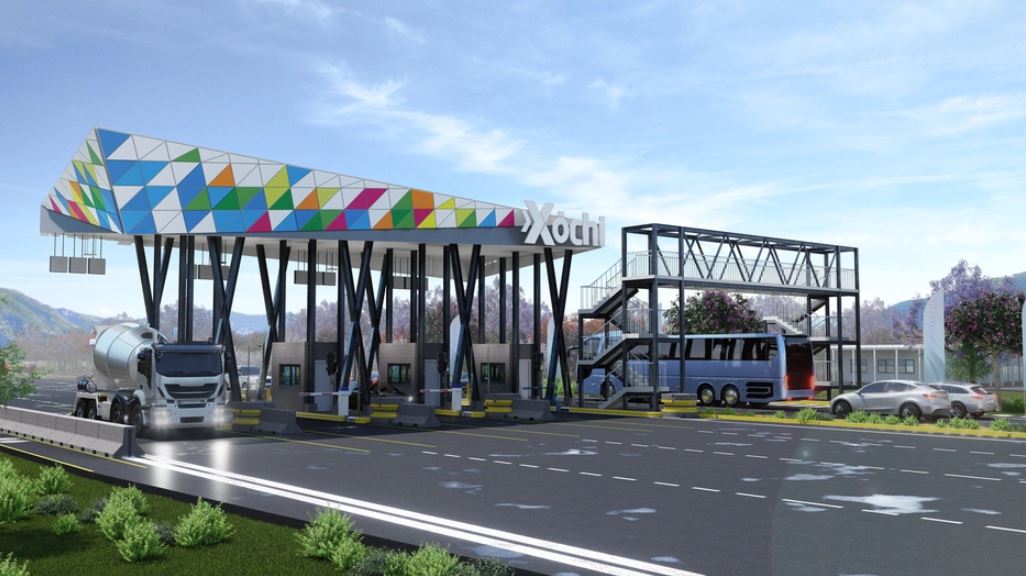
A new option to scroll through the South Coast is close to entering into operation.
Xochi, Corridor of Flowersis a toll highway that seeks to shorten travel times on one of the busiest stretches of the city. CA-2 Westconnecting productive areas of Suchitepequez and Retalhuleu and facilitating access to tourist destinations and recreational centers on the South Coast.
The project is in its final phase and Its official inauguration is scheduled for June 14, 2026.
The highway will have an extension of 31 kilometers, will have three sections and a toll system for different types of vehicles. The entire tour is designed to be completed in approximately 25 to 30 minutes.
What is the highway?
Xochi seeks to facilitate the connection with some of the main tourist destinations on the South Coastamong them the irtraXetulul, Xocomil and the Pacific beaches.
The infrastructure was designed to overcome ravines, slopes and other complex points on the route. The highway will have four lanes, two in each direction, one maximum speed of 80 kilometers per hour and three segments of approximately 10 kilometers each.
New route Xochi, Corridor of Flowers by marlon boryo
Map of the Xochi route, Las Flores Corridor
The project is structured in three consecutive segments along the route.
- Section 1: It starts at km 142.5 and reaches km 152. It includes nine bridges.
- Section 2: It extends from km 152 to 162, with nine bridges.
- Section 3: It goes from km 162 to 172 and includes five bridges.
Design by marlon boryo
Infrastructure to boost competitiveness
The relevance of the work transcends the mobility of motorists.
The South Coast is home to one of the most important economic and logistical corridors of Guatemala, concentrating daily an important part of the transportation of agricultural products, manufactured products and merchandise destined for both the national market and export.
In this context, according to IDB Invest, private sector arm of Inter-American Development Bank (IDB), the project Xochi, Corridor of Flowers, seeks to offer an alternative route that allows reducing travel times in a section where congestion is frequent.
Its main objective is to strengthen and promote commercial competitiveness of goods and services between different points of the southwest and the rest of the country.
The new road will connect strategic municipalities of Suchitepéquez and Retalhuleu, facilitating the movement of people, cargo and services in a region considered key for the country’s agricultural, agroindustrial and commercial production.
IDB Invest has highlighted the potential of road infrastructure to boost competitiveness and tourism. The new route will facilitate access to tourist destinations in the area as well as the Irtra recreational centers, and the beaches of the Pacific, sectors that generate economic activity through commerce, services and hotels.
Local participation in investment
Beyond the physical work, Xochi It has also been presented as a project with economic impact for the communities located along its route.
Landowners along the project route, between the municipalities of San Antonio, Suchitepéquez and San Andrés Villa Seca, They had the opportunity to become partners, which according to IDB Invest, a model used for community participation.
Over the highway’s estimated 40-year lifespan, landowners who gave up part of their property in exchange for becoming partners will benefit from project revenues.
IDB Invest supported the initiative with a loan of US$55 millionintended to support the development of the 31-kilometer highway.
During the construction phase, the generation of more than a thousand direct jobs and thousands of indirect jobs was estimated, with emphasis on hiring local labor.

How the impasse was resolved
Although the project recently faced a controversy related to municipal procedures, the promoter company and the authorities reported that agreements were reached to continue with the work and maintain the planned schedule for the inauguration.
The promoter company reported delays in the renewal of a construction license and the closure of an access linked to the project by the Municipality of Mazatenango.
The situation provoked statements from business organizations such as the Foundation for the Development of Guatemala (Fundesa) and the Chamber of Industry of Guatemala (CIG), that They asked to expedite the pending procedures.
On June 8 it was reported that, after a dialogue between the company and the municipal authorities, an agreement was reached to advance with the work and enable the new route.
In addition, the promoters have already presented plans for a future Xochi City, an industrial and urban development of about 200 hectares associated with the road corridor.
With information from journalists Glenda Burrión and Andrea Domínguez.
Also read: Guatemala delays availability to the public of gasoline with ethanol until August 2026