
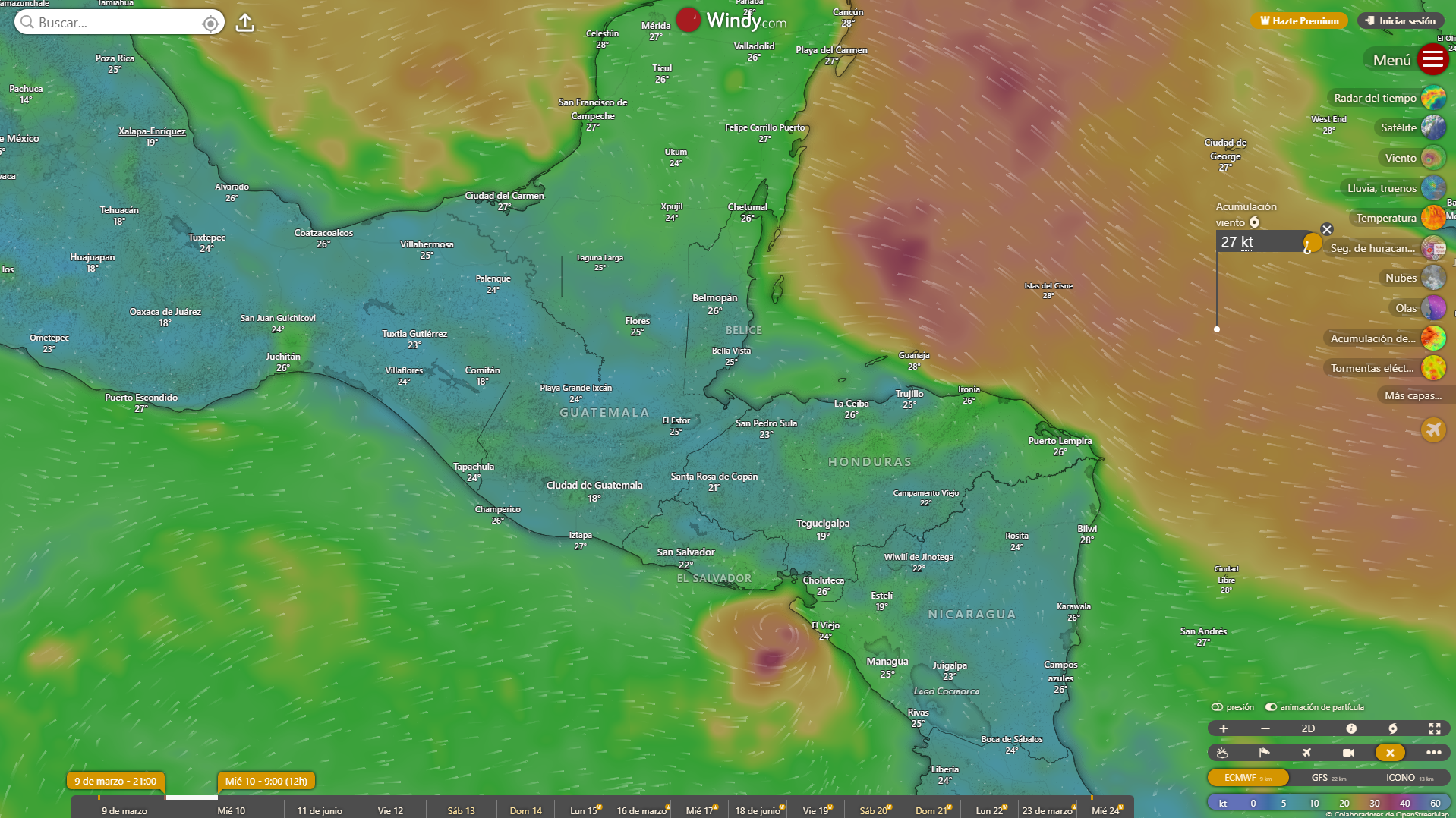
On the afternoon of this Tuesday, June 9, the National Institute of Seismology, Volcanology, Meteorology and Hydrology (Insivumeh) reported that Tropical Storm Cristina was located approximately 275 kilometers from Jutiapawith a slow displacement of 4 kilometers per hour towards the west.
According to forecasts, the system maintains its trajectory towards El Salvador, where it could weaken when interacting with the mainland.
According to official information, although the storm would not have a direct impact on Guatemala, its circulation will continue to favor the entry of moisture from the Pacific Ocean.
This will cause an increase of rain between Wednesday and Friday, mainly in the regions of Valleys of the East, Bocacosta, Pacific, Central Highlands and the Westwhere the highest accumulated precipitation could be recorded.
Track of Storm Cristina live
This is how Cristina has evolved
The timeline shared by the Conred shows that the phenomenon began as a low pressure system on June 7 in the Pacific, it evolved into Tropical Depression Three-E during the morning of June 8 and hours later strengthened into Tropical Storm Cristina.
During the last 48 hours, the system has maintained slow movement near the coasts of Nicaragua and El Salvador. Meteorological authorities indicate that, although there is a possibility that it will weaken upon landfall, its cloud bands will continue to generate rain over much of Central America.
We share the timeline of Tropical Storm Cristina, it is important to stay informed through official sources such as CONRED and INSIVUMEH.
Prevention is everyone’s task! pic.twitter.com/BkF6Pb37ul
— CONRED (@ConredGuatemala) June 10, 2026
Regions under surveillance in Guatemala
The director of Insivumeh, Edwin Rojas, explained that the departments with greater proximity to the phenomenon are Jutiapa, Santa Rosa and Chiquimulaalthough the rains could also affect areas of Chimaltenango, Sololá and Quetzaltenango.
For its part, the Conred keeps active institutional orange alert and has requested governors, mayors and local coordinators to strengthen monitoring of areas vulnerable to floods and landslides, as well as verify evacuation routes and emergency response plans.
Authorities also warned of possible flash floods of rivers, damage to vulnerable infrastructure, undermining and accumulation of water in urban areas due to soil saturation caused by the rains of recent days.
📌 INFORMATION WARNINGS – TROPICAL STORM CRISTINA MAINTAINS ITS PATH TOWARDS EL SALVADOR. pic.twitter.com/D25ttMTk4L
— CONRED (@ConredGuatemala) June 10, 2026
Recommendations in the face of increased rainfall
The Conred recommended that the population stay informed only through official channels, avoid crossing swollen rivers or flooded streets, identify evacuation routes and prepare the 72-hour backpack.
Likewise, he asked families to review their response plans and follow the instructions issued by local authorities and relief bodies, especially in communities near rivers, slopes and areas prone to flooding.
Cristina’s effects in Central America
While Guatemala prepares for increased rainfall, the storm is already generating emergencies in neighboring countries. In Costa Ricathe rains associated with the phenomenon have caused flooding, the opening of shelters and the search for five people missing after the overturning of two boats due to strong waves in the Pacific.
SYNOPSIS OF SPECIAL METEOROLOGICAL BULLETIN #08-2026#SomosINSIVUMEH #PassionForScience #AlPuebloDignoSeLeResponde #CIV pic.twitter.com/1UawazKHUK
— INSIVUMEH (@insivumehgt) June 10, 2026
In El Salvadorthe authorities decreed national orange alert and they warned that coastal areas will be the most affected by intense rains, increased waves and possible flooding. Several families were even evacuated preventively in sectors near beaches in the department of La Libertad.
For its part, Honduras maintains nine of its 18 departments under preventive alert due to the risk of river flooding, flooding, landslides and high waves in the Gulf of Fonseca. The authorities of that country recommended preventive evacuations in vulnerable sectors and reinforcing protection measures against the rains that are expected during the next few hours.
*Stay up to date with the Now newsletter. Key information at the moment it happens. Subscribe here.